I am standing on the bank of Somsagar Lake in Alwar, Rajasthan. In front of me, photographer-turned-muse Avani Rai poses on a boat in a canary yellow Roberto Cavalli dress with someone waist-deep in the waters working a fogging machine to diffuse the world around her.
Norwegian photographer Sølve Sandsbø, having only recently concluded photographing model and Chanel house ambassador Bhavitha Mandava against the weathered walls of Jaigarh fort, holds on to a mammoth camera setup and clicks away with the Ajabgarh Fort behind him. We, an odd mix of city-dwelling Indians and a partly Italian crew, in our matching Pirelli sun hats are a sight for the locals as the 2027 edition of the Pirelli Calendar, dubbed ‘India, Beyond a Single Gaze’, comes to fruition.
It has been 62 years since the Italian tire manufacturer Pirelli got British photographer Robert Freeman (famous for his portraits of The Beatles) to produce the first edition of The Cal. And 18 years since French photographer Patrick Demarchelier shot an Asian country, Shanghai, for its pages for the first time. The 2027 edition is an ode to India, being shot entirely in the country.
Each of the three photographers who have taken on this project has completely different reasons for it — given that it is the first time that The Cal has allowed itself to become a collaborative endeavour. “It is like being asked to exhibit at a museum or gallery that has a history that you really want to be a part of,” says Sandsbø, who is photographing the calendar for the second year in a row.
Avani credits her father, Indian photographer and photojournalist Raghu Rai, for bestowing this project upon her after his passing in April. “It is as if my father is like, ‘Here you go; you better do this well’,” she says. Most, if not all, of the photographs by Avani for The Cal use massive prints of her father’s work as their backdrop.
For Raghu Rai, it was a project he wouldn’t have traditionally done, but “every time someone interpreted India, he wanted to grab it”. To him, the idea of someone paying tribute to the country felt like “watching a person write a romantic letter to your lover — and then being asked if you wanted to join in”, she explains. The answer was an undoubted yes.
It is perhaps this idea, of a beloved land being chronicled by those who love it and strangers all at once, that forms the premise of the 2027 Pirelli Calendar. It is certainly why The Cal featuring India for the very first time feels authentically vivacious and inadvertently hackneyed in equal measure.
Embracing the clichés
Sandsbø, right out of the gate, admits he has no right to photograph India or represent it. “I can’t try to capture India in any way, shape, or form. I’m not qualified,” he tells me. “I’m a tourist; I’m a guest. But what I can do is portraits of people from India.”
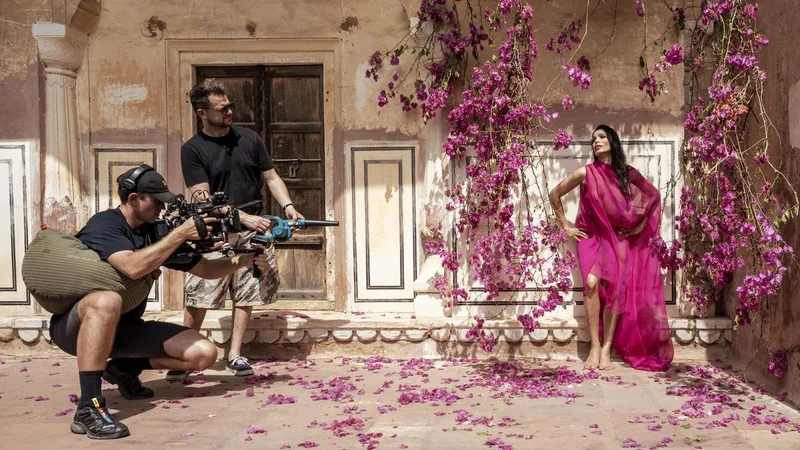
And that is what he does. I watch host and model Padma Lakshmi float ethereally in an artificial pond at Amanbagh, with lotus flowers all around her, and musician Anoushka Shankar joyously drench herself against the Rajasthani sky in a lawn dotted with peacocks. Elsewhere, model Lakshmi Menon is splashed with multicoloured powdered pigments typically used for Holi, and Bollywood actor Aditi Rao Hydari lies on a bed of sun-soaked chrysanthemums. Mean Girls (2024) star Avantika Vandanapu wears a bejewelled ferronnière (headband) like a long-lost Indian princess from a Disney adaptation, and Frieda Pinto loses herself among bunches of pink bougainvillea against palatial wall frescos. The flowers, the clothes, and the colours — all read as trying to be emphatically exotic.
As a long-time fan of the country and of Raghu Rai himself, Sandsbø isn’t interested in competing to depict the complexities of India. “[Avani] has the right to do it, even if she doesn’t feel qualified,” he asserts. “I’m doing my thing.” The resulting photographs attempt to reinvent the sensual appeal of India and its women.
Padma Lakshmi, for one, is excited about India being in focus and getting its dues lately, on every front. It is impossible to tell a unifaceted story, she says: “We have gay couples living together in Mumbai. We also still have child marriages and bride burnings. You can’t say that there’s one story coming out of India,” she says. Anoushka Shankar, on the other hand, sees an evolution in how Indian beauty is perceived today. “We weren’t thought of as beautiful people,” she shares. Now that, thankfully, seems to be a dated idea. She also concedes: “It’s really hard with a country like India that has such strong imagery associated with it, not to fall into cliché — where the cliché is also true.”
Photographing the chaos
Avani’s street-smart photography, juxtaposed against her father’s work of similar, out-of-place environments and people, offers a contrasting vision to Sandsbø’s. “The imagery that he [Raghu Rai] has captured over the last six decades can only be photographed in the streets. That’s where he belonged,” she says, explaining that her father’s photos have always centred the common people engaged in magically mundane things that make the world go round, and not much of it cared about a curated wardrobe or an elaborate crew.
And just like that, Indian bandsmen play Bollywood numbers alongside Bella Ciao, a protest folk song of female rice-paddy workers in northern Italy, in the middle of Old Delhi’s Kinari Bazaar gali as she looks through her viewfinder. The otherwise poised Italian executives from Pirelli can’t help but dance along. In the archaic single-screen Delite Cinema, a cast of regulars is gathered to throw popcorn in the air and gawk and shriek at the screen. After a point, Avani invites the journalists and some of the crew to join in as she keeps photographing the chaos that ensues.
In a colony near Jama Masjid, with the mosque in full view, a group of local natak performers prance around on a terrace. A boy flies a kite over a mint-green rooftop — he doesn’t escape Avani’s lens. Women dressed in matching yellow saris, with gajras in their hair, giggle together, as do trans and intersex people from the hijra community. Through it all, her father’s black-and-white photographs loom and watch, because even though Avani is a photographer in her own right, Raghu Rai is still a creative voice sitting at a corner in her head, as she tells me later on.
Can you frame India in its entirety?
Within these many Indias that Pirelli tries to put forth, hides the real one — whatever that is to you and me. That India is unapologetically complicated. As Padma puts it, “Is my experience of being an Indian person in the world any more valid than that woman selling flowers outside my old temple? No, it’s not. Both are true; both are valid. Both exist.”
Within these exists a conversation that The Cal attempts at having, an institution that has built up a genuinely staggering roster of subjects shot by photographers of massive stature — from Naomi Campbell and Christy Turlington by Richard Avedon to Adriana Lima by Steve McCurry, and Serena Williams, Yoko Ono and Patti Smith by Annie Leibovitz. It is clear that this discourse, albeit enchanting, especially with India at its centre, cannot have a definite benchmark for success in demonstrating the country’s plurality. Perhaps only a few India editions down the line will a semi-complete vision begin to take form.
Until then, India will keep doing what it has always done to those who try to frame it in its entirety — slip the frame ever so slightly and dare them to catch up.
The Mumbai-based writer, artist and editor reports on fashion and culture.
Published - August 11, 2026 02:30 pm IST