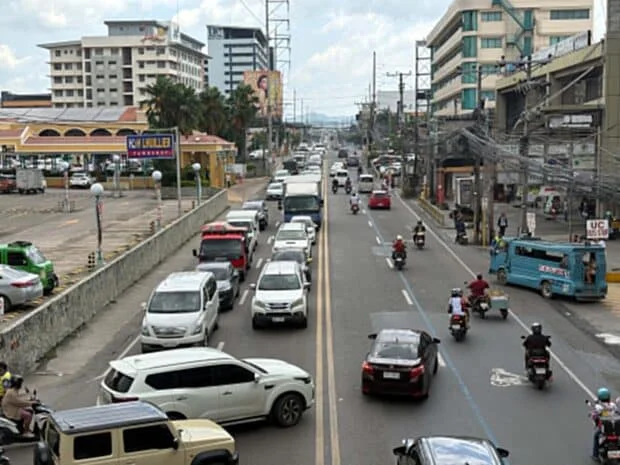
Tomas seeks Cebu City plebiscite on BRT amid BanTal traffic woes
CEBU CITY, Philippines — Vice Mayor Tomas Osmeña is pushing for a citywide plebiscite on the Cebu Bus Rapid Transit (BRT), arguing that Cebu City needs to settle now whether it wants the long-term transport project as traffic problems worsen along the Banilad-Talamban corridor.
Osmeña made the call on Monday, August 10, as the city continued adjusting Oplan BanTal, its traffic discipline campaign that drew complaints after full enforcement began on August 5.
The vice mayor said the traffic congestion is a problem that authorities should have addressed years earlier through the BRT.
“Don’t you see it? You see it? No. I solved the problem of BanTal a long time ago. Don’t you see it? You want me to tell you what it is? It’s called BRT,” Osmeña said, referring to the Banilad-Talamban area.
Cebu City BRT: ‘Widen the road’
He said that the BRT could address the corridor’s long-term traffic problems through road widening and a more comprehensive transport system, rather than temporary traffic measures.
“The solution to solving BanTal, with the BRT, you widen the road,” Osmeña said. “It’s expensive, but you widen the road once and for all.”
Osmeña said he had sought funding from the World Bank for the BRT project but claimed that it did not receive sufficient priority from the current city administration.
He then called on the Cebu City Council to put the BRT to a plebiscite. A plebiscite is an electoral process by which people directly approve an initiative or proposal.
Osmeña: Traffic needs long-term planning
“That’s why I’m asking the city council to put it in a plebiscite, pass a resolution, have a plebiscite, and let the people of Cebu City decide what’s good for them,” he said.
“I’m not afraid to go before the people and explain the story,” Osmeña added.
Osmeña said the city should not wait until traffic reaches a crisis point before building infrastructure designed to address it.
He argued that city governments should anticipate problems years ahead because major infrastructure projects take time to complete.
Mentions SRP as an example
“When you run a city, you look at the problems that you will have seven years from now,” Osmeña said. “Because sometimes, it takes seven years to make the solution.”
“You have to look at the problems ten years from now, because sometimes, the solution takes ten years,” he added.
He also pointed to the South Road Properties as another example of long-term planning.
Councilor Pastor “Jun” Alcover Jr. separately called for a formal review of the implementation of Oplan BanTal.
Alcover seeks review of BanTal implementation
In a privilege speech during the regular session on Tuesday, August 11, Alcover asked the City Council to convene an executive session with traffic authorities and sectors affected by the traffic scheme.
Alcover said he raised the matter after experiencing the congestion himself and receiving complaints from residents, motorcycle riders, habal-habal drivers, and transport network vehicle service (TNVS) operators.
The councilor focused on the temporary restriction that barred motorcycles from using the Foodland flyover on August 5, the first day of full enforcement of Oplan BanTal.
“Sometimes, a dry run tells us something that planning alone cannot,” Alcover said. “It tells us how a traffic scheme actually behaves on the ground.”
Consult more before changing traffic schemes
Cebu City Transportation Office (CCTO) head Raquel Arce previously said that the city restored motorcycle access to the flyover on August 6 after traffic authorities observed the effects of the restriction and heard complaints from motorists.
Alcover said the experience highlighted the need for stronger consultation before authorities introduce major traffic changes.
“Our roads are shared by everyone: private motorists, motorcycles, public utility vehicles, TNVS, habal-habal drivers, pedestrians, businesses, and residents,” he said.
He also called for affected businesses to participate in consultations because changes in traffic flow can affect customers, employees, deliveries, and daily operations.
“Consultation should not be seen as an obstacle to traffic management. It should be part of good traffic management,” Alcover said.
Council asked to hear from traffic authorities
Alcover asked the council to invite Arce, representatives of the Traffic Management Council, TNVS groups, motorcycle and habal-habal drivers, affected communities, and business establishments to an executive session.
He also asked the council secretariat to formally invite the concerned offices and sectors.
Among the issues he wants authorities to explain are the basis for the August 5 traffic change, consultations conducted before its implementation, the objectives of the scheme, traffic observations during the dry run, complaints received, and the decision to restore the previous route.
Alcover stressed that his proposal did not seek to assign blame.
“This is not about blaming anyone. It is about understanding what happened and determining how we can prevent similar difficulties in the future,” he said.
BanTal adjustments follow first-day complaints
The CCTO reopened the Foodland flyover to motorcycles on August 6, barely a day after full enforcement of Oplan BanTal began.
The adjustment allowed motorcycles to use the flyover in both northbound and southbound directions starting 8 a.m., reversing one of the most criticized restrictions under the traffic discipline campaign.
Arce said the move did not mean Oplan BanTal had failed.
“No. Wala na siya [nag-fail]. Usa lang na sa aspeto nga atong gi-adjust… Padayon ang atong discipline zone. Timan-i nga naa pa ta sa punto nga nag-estudyo ta,” she said. (No. That’s not the case. We only adjusted one aspect. Our discipline zone continues. Remember that we are still at the stage of studying it.)
Banilad-Talamban discipline zone
Arce said CCTO personnel had also observed operational problems during the first day, alongside complaints from motorists.
“Nadungog nato ang clamor sa publiko… Dili lang kay ang clamor sa publiko, apan nakita usab nato kagahapon,” she said. (We heard the public’s clamor. It wasn’t only because of the public’s complaints; we also saw it ourselves yesterday.)
The CCTO nevertheless retained other Oplan BanTal rules, including the requirement for motorcycles to use the designated outermost lane and for motorists to follow traffic signs, road markings and instructions from enforcers.
The city launched full enforcement on August 5 after an information campaign that lasted four to five days. The CCTO said the discipline zone covers the Banilad-Talamban corridor up to the Gov. M. Cuenco flyover, also known as the TESDA flyover.
The campaign targets traffic violations involving motorists and pedestrians and runs daily until 10 p.m. It initially carries a one-month implementation period, with possible continuation or expansion depending on its impact.
Disclaimer: The comments uploaded on this site do not necessarily represent or reflect the views of management and owner of Cebudailynews. We reserve the right to exclude comments that we deem to be inconsistent with our editorial standards.