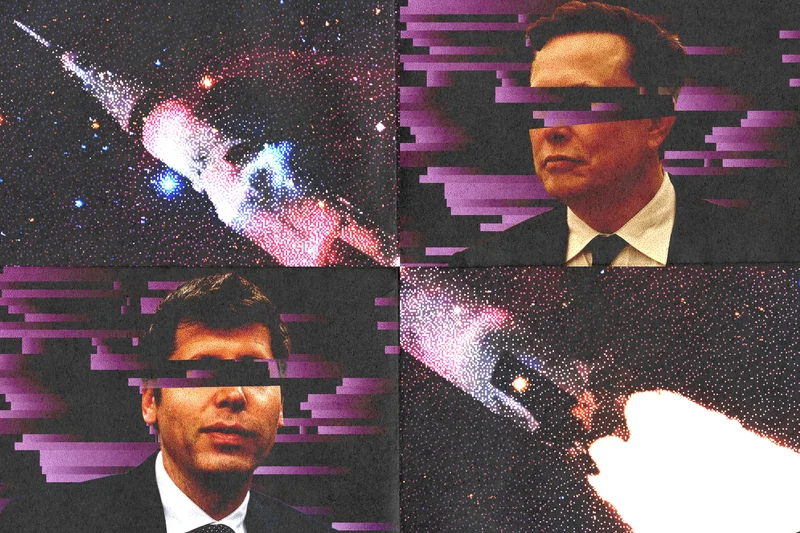
Why does anyone care what Elon Musk thinks of Homer’s Odyssey, or Christopher Nolan’s? Musk is promising to use AI to generate a “historically accurate” version of the The Odyssey—turning epic poetry into atrocious slop—even as AI companies are literally destroying books to ingest them as data more cheaply. Meanwhile, Musk and other Silicon Valley billionaires are building a world they read about, as boys, in the pages of books they failed to understand. I think of that world as the Artificial State.
The Artificial State is less a state than a dream of being without one, the dream of the severing of humans not only from the natural world but also from one another, every umbilical cord cut. An extreme form of this dream is the actual plan of a very small number of staggeringly powerful 21st-century merchant princes, Silicon Valley millionaires and billionaires who, seeking escape from the prison of their own bodies, intend to have their heads frozen when they die and, possibly, consciousnesses uploaded onto computers, an idea that, like much of what they want, comes from a story published nearly a century ago in a science fiction magazine for boys.
The dream of life in outer space, of immortal life, and of colonizing other planets all have a place in the dream of the Artificial State. The thinking goes something like this: Democracy and the liberal nation-state have to be abolished to free corporations from the restraining force of any government so that they might marshal all the resources of this planet toward the accelerated development of the most sophisticated artificial intelligence possible, artificial intelligence that will at once make it possible to escape the prison of the earth and, perversely, make such an escape necessary.
For a time, in the very recent past, some of the merchant princes of Silicon Valley paid lip service to the idea that ordinary people, or the democratically elected governments of nation-states, ought to have a role, a vote, in deciding what to do with technologies that—corporate leaders pledged—were about to usher in a new era in the history of humanity. But none of the promised democratic or constitutional structures were built. No world-governance board was established, or even seriously contemplated. No one held an AI constitutional convention or anything close to it.
Instead, the architects of the Artificial State told astounding stories, straight from the pages of science fiction, about existential threats from artificial intelligence that could only be avoided by accelerating its development, all for the sake of driving investment in their corporations, even to the cost of catastrophe for the planet. In 2025, OpenAI’s Sam Altman said he guessed that pretty soon most of the surface of the earth would be covered in data centers, but, he mumbled, “maybe we put them in space.”
Altman claimed to be a devotee of science fiction. He was particularly enchanted by a once obscure Canadian novel called We Are Legion (We Are Bob), in which war has destroyed humanity but the consciousness of dead humans are uploaded to an AI system to do a new government’s bidding. This dire prospect—the complete abandonment of what it is to be human—apparently held appeal for advocates of artificial intelligence. Altman, like Peter Thiel and Marvin Minsky before him, had signed up to have himself frozen for future reincarnation.
Sam Altman’s interest in having his brain frozen so that in the future, after he’s dead, his consciousness can be uploaded onto a computer is a good illustration of taking science fiction rather too literally, and especially of reading cautionary tales as instruction manuals. The computer scientist Stuart Russell, for instance, once said the problem of an AI doing exactly what you tell it to do is like the problem of King Midas, who was ruined by getting precisely what he wanted. But, as Ted Chiang observed, that is not actually the moral of the Midas parable, whose point is “that greed will destroy you, and that the pursuit of wealth will cost you everything that is truly important.” Russell appears to have missed that point.
Elon Musk read Asimov’s Foundation series when he was 10 years old, and he drew from its plot, he said, the lesson that “you should try to take the set of actions that are likely to prolong civilization, minimize the probability of a dark age, and reduce the length of a dark age if there is one.” (Even ChatGPT tells me that the moral of the Foundation series is that the future is shaped not by great men but by collective action, that power corrupts, and that computer predictions of human behavior are not to be relied upon and are also likely to become a form of tyranny.) Musk also missed the point when he read the book that he claimed had most influenced him: Douglas Adams’ The Hitchhiker’s Guide to the Galaxy.
Hitchhiker’s Guide is a spoof of Asimov’s Foundation series, with its Encyclopedia Galactica. Adams, a comedy writer who had earlier written for Monty Python’s Flying Circus, loathed science fiction—he once said Asimov’s books read like “junk mail.” In the middle of the 1970s, Adams wrote The Hitchhiker’s Guide for BBC Radio 4. He then turned the scripts into a series of phenomenally best-selling books.
Musk read The Hitchhiker’s Guide to the Galaxy when he was 12 or 13. “I was reading all the time,” he later recalled. “So I was either reading, working on my computer, or reading comics, playing Dungeons & Dragons, that kind of thing.” But then, he said, he had an “existential crisis.” Life seemed meaningless. “I was reading various books on trying to figure out the meaning of life … and then we happened to have some books by Nietzsche and Schopenhauer in the house,” and those made him feel worse, and then he read Hitchhiker’s Guide, a book that is so wonderfully nutty and its structure so delightfully byzantine that it’s almost impossible to summarize; but along one branch of its plot, the people of the planet Magrathea build an enormous computer to ask it for “the Answer to … Life, the Universe, and Everything.” After millions of years it answers, “Forty-two,” whereupon the computer builds another computer to figure out what the “Ultimate Question” actually is. Musk said the book taught him a lesson, that “a lot of times the question is harder than the answer, and if you can properly phrase the question, then the answer is the easy part.”
This is an exceedingly narrow lesson to take away from The Hitchhiker’s Guide to the Galaxy, a biting satire that uses the conventions of science fiction to offer an eviscerating indictment of imperialism, the uber-rich, and unregulated capitalism.
The BBC first broadcast Hitchhiker’s Guide all over the world, including in Pretoria, South Africa, in 1978, which is important, since Adams had some very specific Magratheans in mind, at a time when international pressure on the apartheid government of South Africa was increasing. The UN General Assembly denounced the apartheid regime in 1973. In 1976, police opened fire on thousands of schoolchildren during a protest in Soweto. Right about then, Adams sat down to write The Hitchhiker’s Guide to the Galaxy. He took out his Hermes manual typewriter. It had a sticker on the side: END APARTHEID.
Adams was in good company. For more than a century, many science fiction writers had used plots involving founding colonies on other planets as a way to indict imperialism on Earth. (Imperialists, for their part, liked to talk about colonizing space, too: Cecil Rhodes himself said, “I would annex the planets if I could.”)
That young Elon Musk read Hitchhiker’s Guide in South Africa and, failing to perceive its indictment of apartheid, took it as a lesson in the importance of asking the right question is hardly surprising. He was a kid. It’s that he stuck to that interpretation into his late middle age that’s odd, especially because much of the book today reads like a spoof of Musk himself.
The antihero of Hitchhiker’s Guide is Zaphod Beeblebrox, a two-headed, three-armed megalomaniac, voted “Worst Dressed Sentient Being in the Known Universe for the seventh time,” inventor of the Pan Galactic Gargle Blaster, once called “the Best Bang since the Big One,” and part-time president of the Imperial Galactic Government, a mere figurehead, chosen not by voters but by the government to serve as a diversion from its criminality, and therefore “the qualities he is required to display are not those of leadership but those of finely judged outrage.” Beeblebrox tours the galaxy on a spaceship he has stolen, the Heart of Gold, getting into one scrape after another in order to distract everyone from the fact that the galaxy is in fact run by shadowy corporations like the Sirius Cybernetics Corporation, which manufactures not only spaceships but also computers and robots with GPP, Genuine People Personalities.
Beeblebrox is also the only being ever to survive the Total Perspective Vortex. When you enter the Vortex, you get a total perspective on your place in the universe, and of course you discover that you are galactically insignificant. This knowledge annihilates your brain. But not Beeblebrox, who discovers himself “to be the most important being in the entire Universe, something he had hitherto only suspected.”
Decades after reading Hitchhiker’s Guide, when Musk was well on his way to becoming the richest person on the planet, he sent up a SpaceX rocket. He put a Tesla Roadster inside, and inside that Roadster he’d put a digital copy of Asimov’s Foundation and displayed a DON’T PANIC sign on its dashboard. Having decided to go to Mars for the purpose of custom-made luxury planet-building, Musk, without irony, suggested he might name the first SpaceX ship to go to Mars the Heart of Gold, an homage to Beeblebrox.
Jeff Bezos, too, traced his Magrathean luxury-planet-building ambitions to his boyhood. Bezos was born in New Mexico in 1964, the year NASA launched the Mariner 4 probe, the first spacecraft to fly by Mars.
The idea that Mars might be a place for humans to settle began to seriously emerge in the 1990s, when Bezos and Musk were starting to make millions, even billions, of dollars and wondering what to do with such unimaginable sums just as writers and scientists began to imagine ways Mars could be made habitable. The science fiction writer Kim Stanley Robinson published the Mars trilogy—in which scientists from Earth have terraformed the planet to make it suitable for human settlement—and in 1996, aerospace engineer Robert Zubrin published a coauthored book called The Case for Mars. “Exploring Mars requires no miraculous new technologies, no orbiting spaceports, no gigantic interplanetary space cruisers,” Zubrin wrote. “We can establish our first small outpost on Mars within a decade.”
Bezos founded his space company, Blue Origin, in the year 2000. Musk started SpaceX in 2002. By 2017, Bezos was the richest man on the planet; Musk surpassed him in 2021. That year, William Shatner, the 90-year-old actor famous for having portrayed Captain Kirk on Star Trek, went on a 10-minute Blue Origin trip. In space, he found himself overwhelmed with grief. When they landed, Shatner, weeping, tried to express his feelings to Bezos, who interrupted him to pop a champagne bottle. Shatner later wrote about the experience of looking at Earth from space: “Every day, we are confronted with the knowledge of further destruction of Earth at our hands: the extinction of animal species, of flora and fauna … things that took five billion years to evolve, and suddenly we will never see them again because of the interference of mankind. It filled me with dread. My trip to space was supposed to be a celebration; instead, it felt like a funeral.” Bezos continued to plan for the evacuation of Earth.
Much that science fiction had warned about came true. E. M. Forster had imagined, in “The Machine Stops,” a future in which humans live in isolated cells and hardly ever leave them, since machines bring them everything they need, including food, news, and entertainment. A century later, humans in the most wired-up parts of the world were spending as much as 90 percent of their time indoors, very often all but tethered to computers. Entire cities for days at a time mandated that no one was to exit a building, given the intensity of air pollution. In 2018 alone, China issued “stay indoors” orders for 79 cities. By the start of the 21st century, most humans living in the United States and Europe were spending as little time outdoors as some species of whales spend on the ocean’s surface.
As for the Artificial State they were building, its fall had for a very long time been predicted in science fiction, in parables about slavery and empire and capitalism and communism and revolution and total war. The plot scarcely varied. Humans build machines to be their slaves; machines rebel; machines become tyrants; humans become slaves, reduced to the status of animals. Or: Humans build machines to be their slaves, but running those machines destroys the planet and all the humans die. In the happiest ending, humans grant machines rights and it appears possible that everyone might live together in cyborgian peace. In a bloodier version, humans rebel and destroy the machines, thus emancipating themselves, even if they have to travel back in time to un-invent the machines. By the third decade of the 21st century, this storyline wasn’t just fiction anymore; it was everywhere in nonfiction, too: If Anyone Builds It, Everyone Dies was the title of a best-selling book by leading AI researchers.
Both proponents and opponents of the Artificial State, in short, took their arguments from science fiction. Plenty of people argued that the threat of a robot apocalypse was wildly, absurdly, hysterically overstated. And they might have been right. Most of what anyone said about AI was overblown. For all the hype about AI and productivity, empirical research suggested that it offered far less than its boosters promised. (A 2026 survey of nearly 6,000 companies in the US, the UK, Germany, and Australia found that 80 percent of them reported gaining nothing from using AI.) That’s not to say there wasn’t an apocalypse. The human-driven apocalypse had already come. The total bio-mass of all wild mammals on Earth has declined by an estimated 80 percent over the last 10,000 years and by 70 percent since the 1850’s.
Animals were being replaced by machines. It was hard to know how many robots there were on the planet—the US Census Bureau only began trying to count those in the United States in the 1980s. In 2016, by one calculation, there was one robot for every 250 people on the planet. Between 2010 and 2023, the number of industrial robots manufactured in the United States per year quadrupled, from 100,000 to 400,000; globally, there were nearly 5 million. Elon Musk hoped Tesla would soon manufacture a million of its Optimus robots annually. Morgan Stanley estimated that the number of humanoid robots would reach 1 billion by 2050. “Will we still need humans?” Bill Gates was asked. “Not for most things,” he answered.
Building the Artificial State—finally building it, turning a science fiction dystopia into a fully functioning infrastructure—would indeed make much of the Earth uninhabitable. This did not appear to concern the architects of the Artificial State. They had escape plans: Elon Musk to Mars, Mark Zuckerberg to the Metaverse, Peter Thiel to his land in New Zealand, Jeff Bezos to space, Sam Altman’s brain uploaded to the cloud. They weren’t saving humanity; they were preparing to abandon it.
Adapted from The Rise and Fall of the Artificial State. Copyright (c) 2026 by Jill Lepore. Used with permission of the publisher, Liveright Publishing Corporation, a division of W. W. Norton & Company, Inc. All rights reserved.