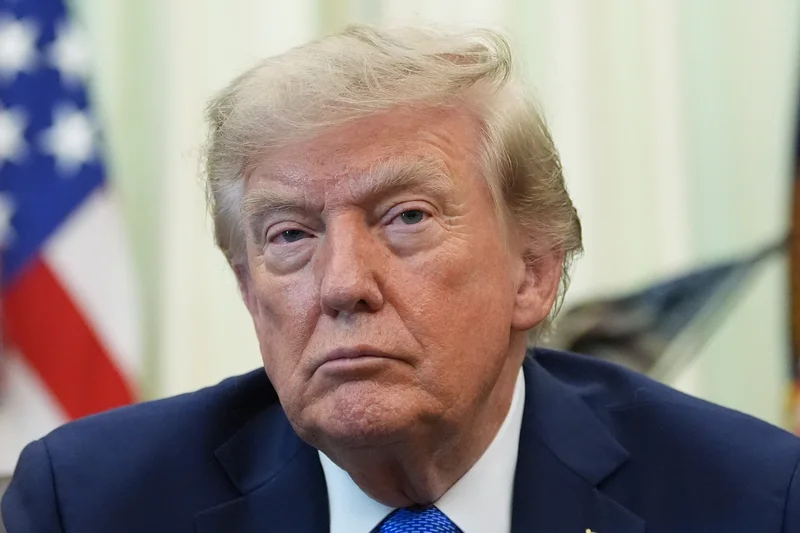
President Donald Trump is not backing down on three core goals of his administration: in recent weeks he slapped tariffs on dozens of trading partners, launched a new attempt to remove a governor of the Federal Reserve—a move seen as interference in the central bank’s decisions—and signed two executive orders to partially limit birthright citizenship amid his anti-immigrant offensive.
Those matters were at the center of three cases that Trump escalated to and lost before the U.S. Supreme Court in a period when, nevertheless, the high court expanded executive power. It allowed, for example, the president to fire officials at independent agencies without cause, and eliminated a protection that for years shielded thousands of immigrants from deportation because returning to their home countries would endanger them.
During that period the president also frequently pushed issues through what is known as the shadow docket of the Supreme Court. This is a channel that has been criticized for the speed and the limited reasoning the Court provides when responding to those requests.
These three key cases that the Trump administration lost —the tariffs, the restriction on birthright citizenship and the attempt to remove Lisa Cook from the Federal Reserve Board of Governors—were decided following the Supreme Court’s usual process. The parties filed extensive briefs and presented oral arguments to the nine justices.
The tariffs were the President’s first major setback. Shortly after his return to the White House, Trump took an unprecedented step: he invoked the International Emergency Economic Powers Act of 1977 (IEEPA) to impose tariffs. Relying on that statute, he set tariffs on Mexico, Canada and China for allegedly failing to curb the flow of migrants and fentanyl into the United States; and imposed another 10% tariff on virtually every country in the world.
Six of the nine Supreme Court justices rejected, for different reasons, that IEEPA authorized the imposition of tariffs. Three said the matter involved economic policy of such magnitude that it must receive congressional approval, and three concluded the statute does not expressly allow “regulating imports” through this type of tariff.
The administration’s response has been to seek other mechanisms to replicate the tariff scheme. It first turned to Section 122 of the Trade Act of 1974 and, when that window expired in July, it relied on another chapter of the same law to maintain the duties. With a complex legal framework and wide discretion, the Trump administration now justifies its tariffs on the claim that countries lack or fail to comply with rules on forced labor.
The maneuver has already been challenged at the U.S. Court of International Trade, a little-known tribunal based in New York. Two retail companies say in their complaint that Trump’s tariffs under Section 301 of the Trade Act “exceed the authority Congress granted” and that that chapter must be “country-specific and seek a specific remedy.” “It is not an independent authorization to impose a substantial tax on all trading partners at rates intended to replicate the tariff regime under IEEPA that was already invalidated,” the complaint says.
The case is still in an early stage. But the trade court and, later, an appeals court both ruled against the IEEPA-based tariffs. That was why Trump then took the matter to the Supreme Court.
The fight to limit birthright citizenship
Another central plank of the Trump administration is restricting who should be considered a U.S. citizen. In June the Supreme Court made clear that children born in the United States to parents who are in the country unlawfully or temporarily “are subject to the jurisdiction” of the United States and are citizens under the 14th Amendment to the Constitution.
But again the administration has sought a different route to achieve its goal. Last week Trump signed two executive orders: one requires federal agencies not to issue or accept documents that recognize certain children born in the United States to noncitizen parents as citizens; the other asks the State and Homeland Security departments to deny visas to people the administration believes are entering the country specifically to give birth.
Steve Vladeck, a constitutional law expert at Georgetown University who follows Supreme Court matters, wrote in an analysis that the government combined the language of existing law with new concepts. That is what it did, for example, by including “foreign government employees,” not only diplomats, as grounds to deny citizenship to their children born in the United States.
“This provision is the easiest to confuse with existing law. It is not law. The order applies not only to diplomats, who are outside U.S. jurisdiction because they enjoy diplomatic immunity. It seeks to create a broader category of ‘foreign government employee,’ including embassy staff who are nationals of the country they serve. It also covers employees of international organizations,” Vladeck added.
“All of this goes well beyond current law. Under settled practice, a child born to a consular officer, a consular employee hired locally or an administrative employee without diplomatic immunity is a U.S. citizen at birth. So the substitution (that the government makes in the language of its orders) does matter,” he said.
The expert says it is not yet clear who could bring a court challenge to these orders now, as happened with the first decree that sought to limit birthright citizenship in January 2025. He also noted that even if someone tried to challenge the order, any protection would be limited to that person and not broadly applied. That is because the birthright citizenship case previously before the Supreme Court narrowed what are known as universal remedies that would apply to everyone potentially affected by a measure.
Attempts to intrude on the Fed
Another fight the president has fixated on centers on the Federal Reserve. He first insulted and threatened to remove Jerome Powell, the previous head of the world’s most important central bank. The anger stemmed largely from Trump’s insistence that the Fed cut its key interest rate. At one point he said that benchmark rate should be as low as 1%, a level that typically indicates the economy is in trouble.
The president then turned his attention to Lisa Cook, the first Black woman to sit on the Board of Governors that sets U.S. monetary policy. Last year he tried to remove her from office citing alleged irregularities in two mortgages, a charge she denies. According to an ally of the President, Cook said in court filings that two properties, one in Michigan and one in Georgia, were her “primary residence.” Cook’s legal team, for its part, says the matter was an error that has been remedied.
But for Trump that amounts to “cause” sufficient to fire Cook. The Supreme Court told him he could not. “The protection from removal enjoyed by Governors of the Federal Reserve is consistent with the Constitution. The Founders knew from experience the calamities that could arise from even the “suspicion” of political manipulation of monetary policy,” Chief Justice John Roberts wrote in the Court’s opinion.
With its decision, the high court also sought to clarify that a very high bar exists when it comes to establishing “cause” to remove a Fed governor before the end of their term. It is key whether the stated cause really means the person is unfit for office or whether it simply represents an effort to secure a more amenable replacement, Roberts added.
Despite the Supreme Court’s opinion, a new letter from the Trump administration to Cook—dated August 5 and giving the official 21 days to respond—again makes allegations that so far have not led to formal charges and are exactly the same as those made last year.
Cook’s lawyers replied that they will challenge any further presidential attempt to “interfere with the Fed’s independence.”