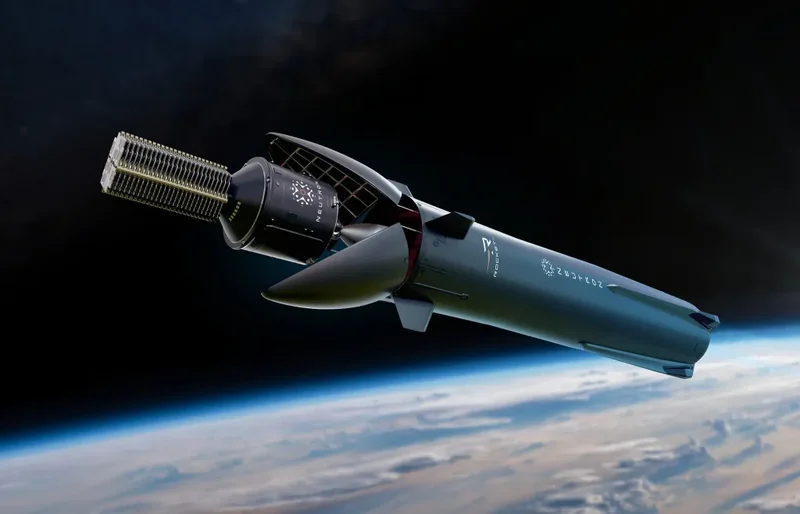
WASHINGTON — Rocket Lab warned that the chances of launching its Neutron rocket for the first time before the end of the year are “narrowing” despite progress on the vehicle’s development.
Rocket Lab executives used an Aug. 10 earnings call to both emphasize the progress on Neutron, its medium-lift reusable rocket, and demand for the vehicle. That included a contract announced that day to launch satellites for Kepler Communications on a Neutron no earlier than 2028.
“As with any complex development program, we’ve had to tweak a few things along the way, but we’re moving now into final checkout and assembly of all of our flight hardware before integrating them at the pad,” Peter Beck, chief executive of Rocket Lab, said on the call.
Ongoing work on the vehicle’s two stages, engines and other systems, he said, “lines up with our target delivery of Neutron to the pad in Q4 2026.”
However, putting Neutron on the pad in the fourth quarter of this year is not the same as launching it that quarter, since the company plans tests of the vehicle on the pad, including a static-fire test of the rocket’s first stage. Beck acknowledged that in the call.
“While the window for an end-of-year launch is narrowing, the work we’re doing now is about risk trading, balancing the timing of our first launch against how quickly and seamlessly we can scale our 10th launch,” he said. “Our focus is on the bigger picture and making sure that when Neutron flies, it enters service as a system ready for full-scale production and high-cadence launch.”
The biggest, and riskiest, milestone toward that first launch will be integrated stage testing and static-fire tests on the pad.
“Stage testing is always the thing that gets your adrenaline running because you have fully fueled vehicles on the pad, and you’re igniting the engines for the first time,” he said. “You can also see for another space company that when that doesn’t go well, it really doesn’t go well.” That was a reference to Blue Origin’s New Glenn, which exploded during a static-fire test on the pad in May.
A slip in the first Neutron launch to 2027 would be the latest in a series of delays for the vehicle. Rocket Lab announced Neutron in 2021 with a goal of performing the vehicle’s first launch in 2024. By 2024, though, the company pushed back that inaugural launch to mid-2025.
In August 2025, the company said it was still pushing for a first Neutron launch by the end of the year, but that was on a “green-light” schedule that offered no margin for error. In November, it said the vehicle would be on the pad in the first quarter of 2026, with a launch later in the year.
However, in January, the company suffered a setback in the vehicle’s development when a tank built for the first Neutron vehicle ruptured in testing. The company said in a February earnings call that it was projecting a first Neutron launch in late 2026.
Despite those delays, demand for Neutron remains strong from both commercial and government customers. “Neutron demand is just not a concern,” Beck said in the Aug. 10 earnings call. “I think everybody will be more comfortable with buying Neutrons post-test flight, but we’ve had absolutely zero issues in selling full-price Neutrons pre-test flight.”
That interest is linked to high demand for launch and a scarcity of other launch options. “Launch has never been so constrained,” he said. “Neutron is going to help unblock the industry’s bottleneck, giving operators a reliable capacity that they need for years to come.”
Rocket Lab, even with that strong demand, is sticking with a gradual ramp-up of Neutron. Beck mentioned the company’s “one, three, five” approach, referring to annual Neutron launches in the vehicle’s first three years of operations, which he said is informed by the company’s experience with its smaller Electron rocket.
Increasing that cadence, he said, hinges on the vehicle’s reusability. “As we’ve discussed, we have a one, three, five cadence,” he said. “Hopefully, we’ll do a lot better than that.”