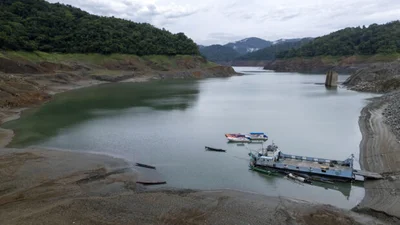
Angat Dam will still require strong rains to be able to irrigate 2,000 hectares of Pampanga rice fields being tended by farmers who took the risk of planting early this month despite the onset of El Niño, according to the Bulacan office of the National Irrigation Administration (NIA) on Tuesday, July 21, 2026. INQUIRER PHOTO / GRIG C. MONTEGRANDE
BUSTOS, Bulacan— Angat Dam will still require strong rains to be able to irrigate 2,000 hectares of Pampanga rice fields being tended by farmers who took the risk of planting early this month despite the onset of El Niño, according to the Bulacan office of the National Irrigation Administration (NIA) on Tuesday.
Enrique Carlos, who heads NIA’s Irrigation Management Office (IMO) in Bulacan, said these farms need water to sustain their growing crops until the October harvest time.
But Angat has been heavily depleted and is unable to release water to Bustos Dam, which supplies the Angat Maasim River Irrigation System (AMRIS) consisting of 27,000 hectares of rice farms of more than 22,000 farmers in 17 towns in Bulacan and the towns of Apalit, Candaba, San Simon and San Luis in Pampanga.
Article continues after this advertisement
READ: Angat Dam’s water level still below critical threshold – Pagasa
Butos Dam is currently at the low elevation of 15.53 meters but has yet to receive water discharge from Angat Dam.
The Angat reservoir continues to drop to one of its lowest record in history at 152.19 meters above sea level (MASL) as of 11:00 am on Tuesday. The level increased by 0.04 meters at 6:00 am due to intermittent rains at the Angat Watershed areas within the Sierra Madre mountain ranges.
However, the reservoir is 8 meters below its 180 low critical elevation.
On July 9, Angat logged an unprecedented low level of reserved water with 156.69 masl. Angat reservoir needs to be at an elevation of 212 masl, which is within its normal high elevation. The reservoir depletion has remained constant at 152.49 masl measured on Monday (July 20); it was 153.10 masl on Sunday (July 19) and 153.72 masl on Saturday (July 18).
Article continues after this advertisement
Its main function is to supply Metro Manila’s domestic water requirements, generate hydroelectricity, provide Bulacan’s water needs, and irrigate.
READ: NIA banks on rains as Angat Dam level dips further
Article continues after this advertisement
“We are waiting for the local inflows to water the 2,000 hectares in Pampanga wherein farmers took the risk planting this month and are due for harvest in October,” Carlos told the Inquirer.
Melencio Domingo, president of a farmers group in the Bulacan city of Malolos, said they are now preparing Bulacan rice lands for this year’s second cropping period./coa
Your subscription could not be saved. Please try again.
Your subscription has been successful.