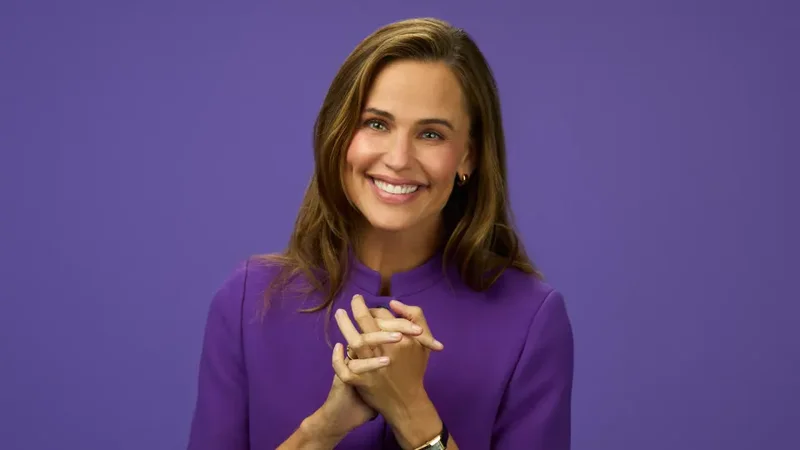
The actress and cofounder of Once Upon A Farm shares what she’s learned in the first six months of leading a publicly traded company.
By Chloe Sorvino, Forbes Staff
In February, Jennifer Garner stepped onto the balcony of the New York Stock Exchange to ring the opening bell and celebrate the $724 million IPO of Once Upon A Farm, the Berkeley, California-based organic baby food company she cofounded nearly a decade ago. The stock closed its first day of trading up 17% and is now down about 15% for the year, but Garner says she has “no interest” in checking the price on any given day. She’s already mastered tuning out noise from Wall Street.
“People say to me, ‘Oh, I know you're checking it. You have to be checking it,’” the 54-year-old actress, a member of the 50 Over 50 class of 2026, tells Forbes. “And I say, ‘You underestimate my discipline.’”
“The first six months in, I can't know that in the same way that I can't know what's written about me in tabloid media. It would break me,” adds Garner, who was named to the 2026 Forbes 50 Over 50 list. “I would not do well under that kind of pressure or scrutiny from myself. I have to put that away—and I work very, very hard to avoid ever seeing my name in print in that way. Same thing with the OFRM stock.”
For the past decade, Garner has been just as committed to her Hollywood career (starring in and producing two hit streaming series, The Last Thing He Told Me on Apple TV+ and The Five-Star Weekend on Peacock) as she has been to her children’s food company. As chief brand officer, Garner has been a key driver of the $288 million (trailing 12 months revenue) business, which reported revenue of $85.4 million in its second quarter (a roughly 17% increase from Q1) on its earnings call last week.
“Beat and raise,” Garner says, showing off her the new vocabulary she acquired since going public. “We have incredible loyalty from families who are raising their kids with Once Upon a Farm. We have very strong velocities and the IPO was a big lever for us. We added a lot of households.”
Garner is the single largest shareholder in Once Upon a Farm, with a 7% stake worth around $55 million. But her equity in the business, she says, is not top-of-mind. “That is not even something I reflect on at all or ever really remember from one time it's mentioned to another.”
Garner's work in film, television and commercials (most notably Capital One and Neutrogena) has earned her at least $125 million over the course of her career, Forbes estimates. She’s been a Capital One spokeswoman since 2014 and once did a crossover commercial featuring her baby food and how the business has grown thanks to its credit cards.
She was also an early investor in Angel City Football Club—and she retains a very small minority stake—which Forbes estimates to be the most valuable women’s soccer team in America, worth about $340 million. “That turned out to be good,” Garner says with a laugh. “I can’t say I’m some queen investor.”
But it did give Once Upon A Farm another opportunity to expand. In 2024, Garner helped broker the business’ first-ever sports sponsorship. The company signed a multi-year deal to be Angel City’s exclusive partner for children’s snacks.
“I'm wholly focused on us executing against our mission,” she says. “And if we do that, the stock will follow.”
One big priority, Garner adds, has been getting Once Upon A Farm products WIC-certified so low-income families can access its products more easily. The brand now has that distinction in more than 20 states.
“It's been our north star,” she says. “We are feeding kids who would not have access to the level of nutrition that Once Upon a Farm offers.”
The mother of three children (with ex-husband Ben Affleck), Garner had been a trustee for Save The Children for several years when she joined Once Upon A Farm in 2017 as a cofounder. Garner had met the original founders, Cassandra Curtis and Ari Raz, who had started the brand after not being able to find organic, farm-fresh baby food in their local supermarket, and says she “wanted to be part of solving a problem that I had experienced as a mom.”
Garner, who grew up middle-class in West Virginia, had never taken an economics or business course, and says she “didn’t know how to read a spreadsheet.” But she figured it out and found key places (including meetings with retailers and visits to farms, where the brand sources ingredients) where she could add her perspective.
“They still really overwhelm me,” Garner says of spreadsheets, “but I sure as heck love the process of being the student in the room, always.”
John Foraker—an angel investor in Once Upon A Farm, who had previously been CEO of the Berkeley-based Annie’s organic food brand, took it public in 2012 and led its acquisition to General Mills two years later—also joined in 2017 as a cofounder and became CEO.
About a year in, he recalls visiting a prominent retailer with Garner and hearing that “they were going to be cutting us back from 14 items to 5, and from over 1,00 stores to about 500” because the rate of repeat purchases was “just not there.” After leaving the retailer’s headquarters, Foraker recalls that they were “not sure whether to laugh or cry” but, Garner, after jokingly describing the meeting as her “first CPG punch in the face,” doubled down and said they would “make it work and show everyone that we can.”
“All these years later this is a massive and very successful retailer,” Foraker says. “That is her resilience and competitive spirit. I’ve seen that constantly for almost a decade.”
“She’s been there at each of our wins, in each of our many losses,” Foraker adds, “and at each pivot from where we started to where we are today, literally in the trenches.”
Once Upon A Farm has also proven itself on shelves since then. The brand’s 40-plus different products—including refrigerated drinkable smoothies and oat bars—are currently sold in more than 25,000 stores. That includes over 480 locations of Sprouts Farmers Market, run by CEO Jack Sinclair, who has been a mentor to Garner for years.
"I encouraged Jennifer to use the IPO as an opportunity to stay focused on what has made Once Upon a Farm successful, rather than becoming overly corporate,” Sinclair says. “We discussed the importance of building a strong team, continuing to innovate and evolve the product portfolio, and driving meaningful change across the food supply chain."
Garner recalls how Sinclair also pushed her to “reinvest in who you are to this company.”
“Now what are you going to do?” he asked her.
She committed to using the first six months to strengthen the relationships she has built with retailers over the years, just as she did with the bankers on the IPO roadshow.
And the mission continues. In the next few months, Garner will travel with Foraker and the sales team to Bentonville, Arkansas, Austin, Texas, Cincinnati, Ohio and Minneapolis, Minnesota, to name a few stops on her tour. “I'm re ally itching to get back out there and to be reinvigorated by what those relationships mean to me at this point nine years in,” Garner says. “I'm still really hungry.”
Additional reporting by Matt Craig and Maggie McGrath.