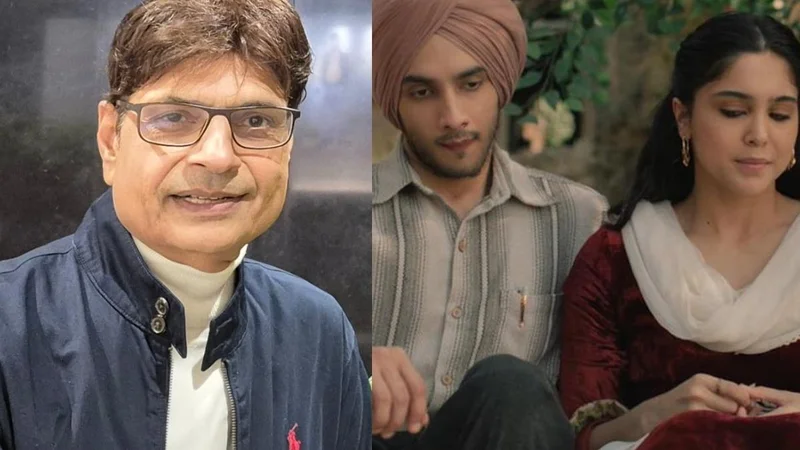
Irshad Kamil writes about love with a rare demystifying quality. He invokes its irresolvable charm with expressions echoed in the everyday — like in ‘Tum Se Hi’ from Jab We Met or ‘Tum Jo Aaye Zindagi Mein’ from Once Upon a Time in Mumbaai —Mere Brother Ki Dulhan and underlining the feeling of innocence in ‘Jug Ghoomeya’ from Sultan. His collaborations with Imtiaz Ali are particularly striking, seeming to come from a deeply personal space and swiftly becoming the voice of Jordan, Ved, Chamkila and Keenu. Irshad, however, opines that all of his songs come from a personal space.
“It is just that Imtiaz and I have consistently worked together for years and so it gets underlined more in that case,” he tells The Hindu over a long phone conversation. “For me, even ‘Dil Diya Gallan’, ‘Jug Ghoomeya’ and ‘Isq Risk’ have come from the heart. And all of these are from Ali Abbas Zafar films. So, my effort has always been to write all songs with a sense of personal belonging.”
Even then, there’s something different about the songs of Chamkila and Main Vaapas Aaunga — the two recent Imtiaz Ali films set in Punjab, recounting stories rooted in lore and collective trauma. Irshad, who hails from the State as well, says that these stories feel closer to him. “They are in my veins. I have grown up listening to tales of the Partition and the songs of Chamkila were an active part of my teenage years,” he adds. Due to a sense of familiarity, he didn’t have to make an effort to recognise the characters or understand their psychology in these films. “I just had to translate my own feelings into the songs, because you can’t lie to yourself.”
The lyricist also acknowledges the wider scope present in Main Vaapas Aaunga, which allowed for greater exploration. “In MVA, the situation was unique, which made the writing process fun and exciting. I recently also wrote for Krishnavataram, which was something I hadn’t done before. When you work on something entirely new, your involvement unknowingly becomes more,” he says.
That sense of exploration, for Irshad, is ultimately rooted in one simple idea: a song must first find a way to the listener. He explains what makes a good song: “Identification is the key to the success of a song. When someone identifies themselves with a piece of art, there is an automatic liking generated towards it. So, a good song gets translated to the point-of-view of every person,” he says.
That’s what is reflected in abundance in MVA, where the specificity of the trauma of the Partition finds a universal release in ‘Vo Nahin’, a song that captures the longing of Keenu, who gets separated from his lover due to the violence of Partition. It underlines the absence of something rudimentary, a perpetual feeling of homelessness that he feels in a new land, where everything is there, but is not the same. Irshad wanted to infuse a feeling of ‘missing someone’ into the song.
“I like to add multiple layers in my songs. The idea of ‘Vo Nahin’ came with that thread, which can be woven to mean many things. So, the song can be seen as a plea to the beloved and a representation of the pain of the Partition. There is a line which says that even I am not the same, so it reflects on that feeling of change, where we are not what we were. Here, it also adds a third layer of personal reflection,” Irshad explains.
The song attains unpredictability also due to the variations in the music of AR Rahman, who lets it begin as a love ballad but switches into his trademark Sufism towards the end, as the song becomes a harmonious blend of the spiritual oneness that the words signify. Irshad says that when he, Rahman and Imtiaz work together for a song, they don’t have a final destination in mind.
“We never fix anything what a particular song will become. We just have a wider idea about the zone, and we just let ourselves go there. The song completes organically,” he says. “Neither does Rahman sir compose music for the entire song in one go, nor do I write lyrics for the entire song in one sitting. I just wrote four or five lines of ‘Vo Nahin’ and gave it to Rahman sir to experiment. He worked on it then, and I wrote more, and then Imtiaz gave an input. That’s how we work. It is not conventional at all.”
That unconventionality is also experienced in ‘Kya Kamaal Hai’, which plays in the end credits as a devastating reminder of the continuation of human suffering and displacement in contemporary times. Irshad was imagining an ideal world while writing the song, which he calls “a prayer of the writer”. “When I was writing the song, I felt that it was becoming something more than what a song should look like. It has crossed those boundaries. For me, the song is the writer’s dream which wonders on the beauty of the world. It tries to imagine a world without any pain, tears and fears,” Irshad says.
The anthemic beats of ‘Kya Kamaal Hai’ contrast with the unassuming presence of ‘Tere Paas Main’, where the shared forces of the three unify to a level of perfection. It comes at an important juncture in the film, riddled with complexities of love and divisions of borders. Yet, the song is filled with a disarming simplicity that accentuates the feeling of pain.
“The tune given by Rahman sir was so good and easy that I didn’t even try to write. I just tried to bring a particular kind of romantic simplicity and a feeling of missing someone. I wanted to underline this emotion that we are missing someone and we are with them as well. That’s such a wonderful feeling,” Irshad explains.
Innocence and simplicity are recurring traits of Irshad’s song and poetry, which don’t rest on the weight of difficult words to bloom with meaning. He balances even the Arabic roots of the word ‘Saiyaara’ in the title track from Mohit Suri’s film and follows it up with images resting in ease. “I don’t like using difficult words in my songs because I am writing them for the common folks. They should be able to understand me. Mera vichar bada hona chahiye, shabd nahi (My thought should be greater not my word),” he says.
Main Vaapas Aaunga is currently streaming on Netflix
Published - August 11, 2026 05:06 pm IST