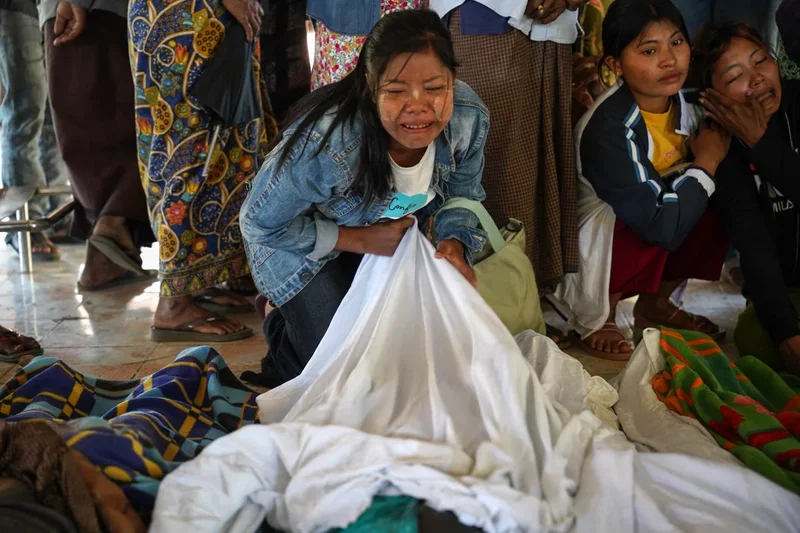
Myanmar’s military escalated attacks in the run-up to the last election in a deliberate campaign to inflict greater harm on civilians, with investigators finding evidence of torture and sexual violence, according to a new UN report.
Airstrikes on homes, schools, medical facilities and displacement camps “intensified” ahead of the election, held between December last year and January, and continued afterwards, investigators appointed by the Human Rights Council found.
The report – covering the period from July 2025 to June 2026 – was released by the Independent Investigative Mechanism for Myanmar, which was set up in 2018 by the UN to investigate abuses against civilians in the Southeast Asian country.
It found the military has increasingly used weapons that have made it harder for people to escape the attacks. “Growing use of motorised power gliders and drones has made attacks harder for civilians to see coming, cutting the time people have to flee or find shelter,” it noted.
The revelation of abuses as recently as earlier this year, including during the election period, undermine attempts by the new military-backed government to present itself as legitimate and stable as it pursues a diplomatic drive to deepen ties with neighbouring countries.
Aung Min Hlaing, the junta leader who took over the civilian role of president after the election, visited China, India and Laos earlier this year and Thailand most recently as part of an ongoing effort to bolster his international legitimacy and re-enter the regional diplomatic mainstream.
However, Asean, the regional bloc of Southeast Asian nations, has banned Myanmar from its meetings for failing to comply with a peace plan agreed upon in April 2021 and has pressured Naypyidaw for the unconditional release of Aung San Suu Kyi, who has remained in detention since the military removed her elected government in a 2021 coup.
The military’s seizure of power triggered a civil war that has so far killed over 100,000 people, according to a conflict monitor. The junta detained Ms Suu Kyi and thousands of other political opponents as it cracked down on resistance to military rule.
The coup was led by Min Aung Hlaing, who was the army chief then and became the junta’s de facto leader.
After years of fighting with anti-junta forces, the military held elections around the turn of this year that were widely criticised as neither free nor fair. The military-backed process resulted in Min Aung Hlaing becoming president in April 2026, allowing the former coup leader to formally consolidate his grip on power.
“Communities across Myanmar are not only living under the constant threat of violence, but are also coping with the profound and lasting impact of what they have endured,” said Nicholas Koumjian, the head of the Independent Investigative Mechanism for Myanmar.
Investigators said they documented widespread torture and sexual violence in military-run detention facilities, including cases tied to a 2025 law that criminalised criticism of the elections.
The military-run government enacted the Law on the Protection of Multiparty Democratic General Elections, commonly called the Election Protection Law, criminalising speech, protests or social media posts deemed to criticise or disrupt the general election. Violations of the law carry harsh penalties ranging from three years in prison to 20 years in jail, life imprisonment, or even the death penalty.
As the election approached, the report found, the military increasingly used low-cost paramotors, gyrocopters and drones to conduct low-altitude strikes with unguided explosives.
The investigators said they were examining incidents in Sagaing region where pilots had allegedly cut their engines before reaching targets, allowing them to glide silently and giving civilians little warning.
Investigations over the past year showed “the frequency and intensity of war crimes and crimes against humanity committed by the Myanmar military and by various armed groups continued to escalate", the report said.
Mr Koumjian said their investigation was focused on command structure and how the orders would be given for such airstrikes. "In particular, there are many airstrikes targeting, hitting schools. Children are often the victims of these airstrikes and also hospitals. So our team is collecting that evidence of where it has occurred, the kind of munitions that are used," he said.
The investigation draws on more than 1,600 sources, including over 750 witness accounts, along with photographs, video, forensic evidence and satellite imagery.
While most of the evidence concerns the military and allied militias, the investigators are also looking at abuses by armed groups opposed to the military.