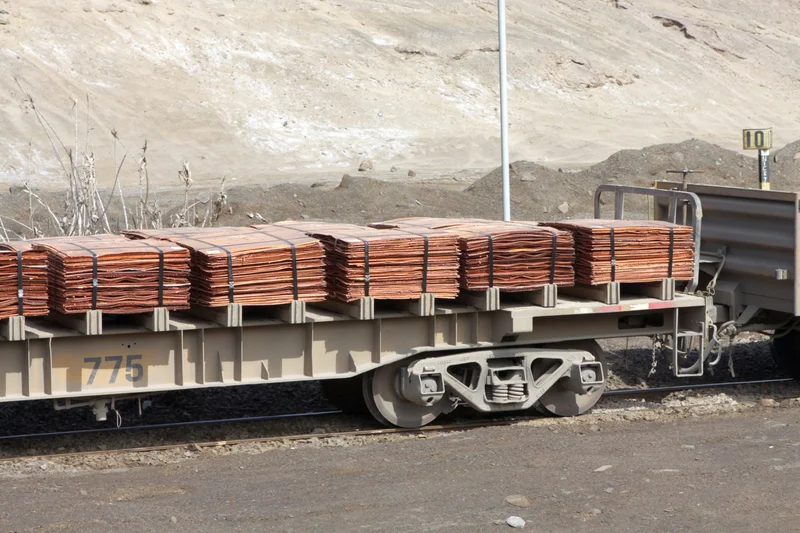
Copper and Lithium Anchor the Chile-US Minerals Alliance
Chile · Economy
Key Facts
- Copper dominanceChilean electrolytic copper accounted for 54% of U.S. imports of that product in 2025.
- Lithium leverageChilean lithium hydroxide made up 82% of U.S. imports in that category in 2025.
- Trade scaleChile’s annual mineral exports to the U.S. averaged $9.412 billion from 2020 to 2025, growing 24.4% per year.
- Investment stockU.S. mining firms have invested $24.2 billion in Chilean copper, lithium, and cobalt projects.
- Tariff exemptionIn 2025, the U.S. exempted refined copper cathodes globally, including Chile’s, from a new 50% copper tariff; that tariff still applies to semi-finished copper.
- China exposureChina absorbs 53% of Chile’s copper exports and about 70% of its lithium, driving diversification efforts.
Copper provides the commercial backbone, lithium the strategic edge, and together they are reshaping how Chile and the United States do business beyond traditional trade.
For anyone watching Latin America’s role in the global energy transition, the quiet but decisive shift in the Chile–U.S. relationship is less about tariffs or agriculture than about who controls the minerals that power electric vehicles, semiconductors, and defence systems. Chile and the United States have moved from occasional trading partners to co-dependents in critical-mineral supply chains, with copper and lithium anchoring a partnership that is increasingly defined by industrial policy and geopolitical hedging against China.
Copper: The Mature Commercial Backbone
Copper remains the single most important trade link between the two countries. Chile is the world’s top producer, and its shipments to the U.S. averaged $8.684 billion per year between 2020 and 2025, growing at an annual rate of 26.5%, according to figures compiled by BNAmericas. That figure represents the bulk of Chile’s mineral exports to the U.S., and in 2025 Chilean electrolytic copper captured 54% of the U.S. import market for that specific refined product.
The numbers matter because they show a mature, reliable flow rather than a speculative boom. Washington’s 2025 decision to exempt refined copper cathodes — globally, including Chile’s — from its new 50% copper tariff reinforced copper’s status as a strategically necessary input, even though that tariff still bites on semi-finished products. For Santiago, the U.S. market offers a stable buyer at a time when China’s share of Chilean copper exports — 53% — creates a concentration risk that policymakers are keen to manage.
Lithium: The Strategic Growth Mineral
If copper is the present, lithium is the future. Chile holds roughly 25% of global lithium reserves, and its processed lithium hydroxide accounted for 82% of U.S. imports in that category in 2025. This is not raw ore but refined material, indicating that Chile has moved up the value chain in a way that few other suppliers have managed.
The strategic importance is clear: U.S. battery manufacturers and clean-energy projects rely on Chilean lithium to reduce dependence on Chinese processing. Corporate activity reflects this. Rio Tinto signed a binding deal with state-owned ENAMI in July 2025 for the Salares Altoandinos project, committing up to $425 million for a controlling 51% stake, in a transaction expected to close in the first half of 2026. Months earlier, in May 2025, Rio Tinto agreed to invest up to $900 million in a joint venture with Codelco for the Salar de Maricunga. These are not marginal bets, though Rio Tinto is British-Australian rather than American. The genuinely U.S. investors — Freeport-McMoRan, Albemarle and Newmont — anchor the American-aligned side of the supply chain.
Investment and Institutional Cooperation
U.S. mining companies have reportedly invested a total of $24.2 billion in Chile for production expansion across copper, lithium, and cobalt. The roster includes Freeport-McMoRan, Albemarle, and Newmont, all of whom frame their Chilean operations as part of a broader effort to secure minerals for semiconductors, EV batteries, and defence technology. This investment is not purely commercial; it is policy-driven, with Washington treating Chile as a non-Chinese source of critical inputs.
Institutional mechanisms have followed. The U.S. and Chile signed a non-binding Joint Declaration on critical minerals and rare earths on March 12, 2026, formalising what both governments describe as an effort to “consolidate a strategic alliance” around mining supply chains. The timing was not accidental: it followed the March 2026 inauguration of President José Antonio Kast, who has moved quickly to align Santiago with Washington. While the specific officials involved have not been publicly named in available records, the joint statement signals a level of coordination that goes beyond typical trade diplomacy. For Chile, this offers leverage as it diversifies away from China; for the U.S., it provides a reliable partner in a region where Chinese influence is growing.
Geopolitical Context: Diversifying Away from China
The geopolitical framing is inescapable. China absorbs 53% of Chile’s copper exports and about 70% of its lithium, giving Santiago significant bargaining power but also exposing it to demand shocks. In July 2026, Chile announced a plan to attract around $100 billion into its copper sector over the next decade, explicitly aimed at selling to more markets and reducing reliance on Beijing.
This is where Chile and the United States find common ground. Washington wants to reduce its dependence on Chinese processing and refining; Santiago wants to avoid being locked into a single buyer. The result is a relationship organised around investment, processing capacity, and supply-chain security rather than traditional trade volumes alone. Copper provides the mature revenue stream, lithium the strategic upside, and together they make Chile one of the most important non-Chinese sources of critical minerals for the U.S. The question for 2026 and beyond is whether this cooperation can withstand political changes in either country — but for now, the minerals themselves are doing the heavy lifting.
Frequently Asked Questions
What is the main driver of Chile’s economic relationship with the U.S. in 2026?
Copper and lithium exports, supported by U.S. investment in Chilean mining projects and a formal bilateral mechanism for critical-minerals cooperation.
How dependent is the U.S. on Chilean lithium and copper?
In 2025, Chilean electrolytic copper accounted for 54% of U.S. imports in that category, while Chilean lithium hydroxide made up 82% of U.S. imports in that segment.
Why is China relevant to the Chile–U.S. mineral partnership?
China absorbs over half of Chile’s copper exports and about 70% of its lithium. Both Chile and the U.S. see diversification away from Chinese supply chains as a strategic priority, driving new agreements and investment.
Connected Coverage
Sources: BNAmericas; Rio Tinto; Mining Weekly; DLA Piper; Bloomberg; U.S. State Department.
This article was produced by The Rio Times’ automated newsroom system. How we use AI · Report an error