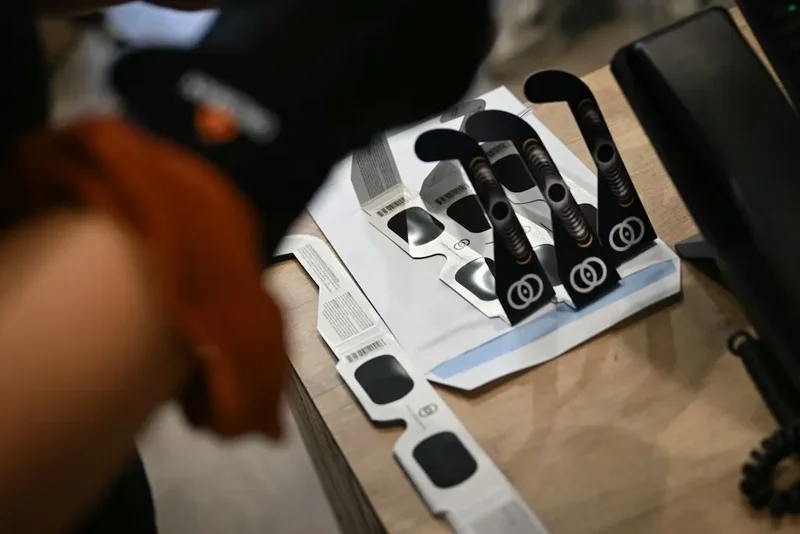
If you're planning on viewing the solar eclipse in Spain on Wednesday August 12th, it's worth noting that several brands of special glasses have now been recalled by consumer watchdog Facua.
The recalled brands and models are as follows (images further down):
Lionstar (model LSP1)
ECP Eye Care Professional
Pelispan
Homanaje (model QW-50Z1)
Orro (model O37-R, batch 2603-01)
Opticalia
These glasses have primarily been found in Madrid, Castilla y León, Galicia, La Rioja and Aragón regions, all of which have issued recalls.
That doesn’t mean, however that these brands won’t be found in other places in Spain too, so it’s important to check before you use them.
The issues were detected during a market surveillance campaign conducted by the Ministry of Consumer Affairs to ensure that eclipse glasses comply with safety legislation.
The results showed glasses showed that while all these brands comply with eye safety rules and have no deficiencies in materials, surfaces or frames, they could be dangerous because they're more likely to be adjusted.
The risk with these brands is that people using them may tend to remove them or adjust them to be able to see more clearly, exposing their eyes to the sun in the process.
READ ALSO - Q&A: Everything you need to prepare for the total solar eclipse in Spain
Essentially this means that the recall of six models of eclipse glasses is nothing to do with the actual function glasses themselves being unsafe, but rather because they could cause people could inadvertently expose their eyes to direct sunlight.
Because the filter on these glasses, as well as some others, has a transmittance lower than the minimum required, they are extremely dark. This means that users often momentarily remove the glasses in order to look at the solar disk directly, without protection, which exposes their eyes solar and ultraviolet radiation.
This can cause both thermal and chemical damage to the cells of the retina.
The Consumer Affairs Department recommends that even if vision is less than ideal, the glasses should always be worn when looking directly at the sun and not be removed or adjusted.
Only certified eclipse glasses with ISO 12312-2 approval or indirect viewing systems can be used to view the eclipse.
Glasses must show an ISO 12312-2:2015 designation and have a valid CE mark if sold in the European Union, as well as the manufacturer's name, instructions and warnings. If only the ISO 12312-1 reference appears, they may be unsuitable for direct solar observation.
READ ALSO: Spain to see its first total solar eclipse in over a century in 2026
Several Spanish towns and cities are distributing free glasses for the event, either via tourist offices, certain science museums or other.
The Ministry of Science, Innovation and Universities and the ONCE Social Group is also distributing two million pairs of safe eclipse glasses.
To see a list of where you can get these free glasses, click here, although many places may not have any left.
This will be the first time that a total solar eclipse will be visible from Spain in over 100 years.
It happens when the moon comes directly between the Earth and sun, blocking the sun out completely and only leaving the corona. This is the outer layer of the sun's atmosphere and looks not unlike a halo of light around a dark disc.
The total eclipse will be able to be seen from hundreds of locations all the way from Galicia through Castilla y León and central Spain, over to Aragón and then finally, southern Catalonia, northern Valencia and the Balearic Islands. For the exact locations, you’ll need to look at an eclipse map.
Regional, provincial, and municipal authorities have begun publicising observation points across the country which will not only have good viewing, but will also be able to accommodate visitors.
RTVE has compiled a good map here showing all the official viewing locations.