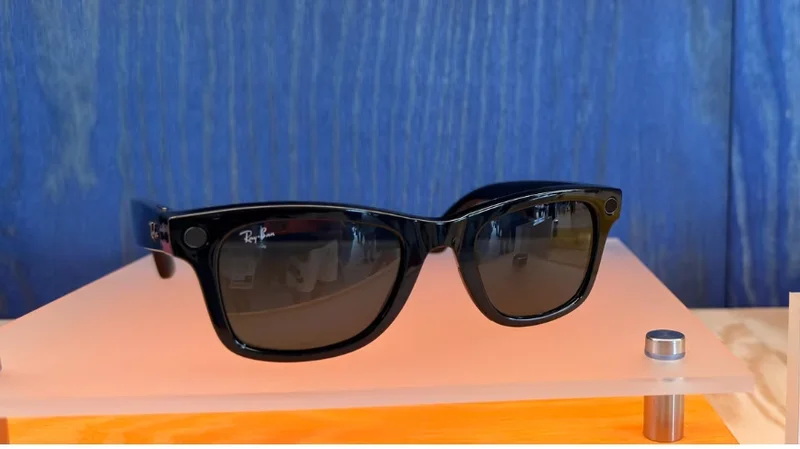
His Majesty’s Courts & Tribunals Service has banned Meta smart glasses from court buildings across England and Wales, a move that pulls one of Silicon Valley’s buzziest gadgets into a very old argument about who gets to record what.
HMCTS, which runs the criminal, civil and family courts, will now confiscate the glasses on entry and return them only when the wearer leaves, treating a fashion accessory as covert recording kit.
It is a small policy with a large subtext, because it follows a wave of venue bans that has already spread from restaurants to theatres to pubs, as anyone who has watched Meta’s Ray-Bans get shown the door will recognise.
“There are clear restrictions on taking images or videos within courts and tribunals which is why the use of Meta glasses is prohibited,” an HMCTS spokesperson said, and the sentence does most of the work.
Recording inside a UK court building is already forbidden without permission and can amount to contempt of court, so the ban is less a new rule than an old one catching up with new hardware.
What makes the glasses awkward is precisely what makes them clever. Smartphones are allowed into court so long as nobody uses them to record, a compromise that leans on the fact that a phone raised to film is conspicuous.
Yet no equivalent exception exists for a device that captures images and video while sitting quietly on your face. The whole appeal of the product, its discretion, is the reason a courtroom cannot tolerate it.
New York’s courts announced their own ban last month for exactly this reason, and the collision between a courthouse crackdown and Meta’s technical fix has become a template other jurisdictions are quietly copying.
When two of the world’s busiest legal systems reach the same prohibition within weeks, it stops looking like local caution and starts looking like a pattern.
There was, as ever, an incident to concentrate minds. Earlier this year a claimant named Laimonas Jakstys was accused of wearing smart glasses in the High Court and being “coached” through them while giving testimony, an allegation he denied.
Whether or not it happened as described, the mere plausibility of it, a witness fed lines through a camera nobody could see, is the kind of scenario that turns an abstract privacy worry into an operational headache.
The scale of the thing is what stops this being a niche concern. Meta sold roughly seven million pairs of glasses last year, priced between £269 and £469, enough to make them a genuinely common object rather than a gadget-blogger’s toy.
The trouble is that the people most affected, the ones being filmed, have almost no way to opt out, and that imbalance is what venues, and now courts, are trying to correct with a blunt instrument.
Meta, for its part, would rather talk about engineering than about bans. The company declined to comment on the court policy, though it has repeatedly pointed to the pulsing light that is supposed to signal when the glasses are recording, along with tamper-detection technology meant to stop anyone disabling it.
Those are real safeguards, yet a courtroom is not in the business of trusting a small LED to enforce a contempt law, which is why the response has been to remove the device entirely.
The deeper problem is that the technology has outrun the etiquette, and institutions are improvising the rules in public.
Courts, where the ban on recording protects witnesses, jurors and the basic fairness of a trial, are the place where that improvisation matters most, so it is fitting, if a little ominous, that they are drawing the clearest line.
For now the answer in England and Wales is the oldest one available: if the camera cannot be switched off with confidence, it does not come in.
Get the TNW newsletter
Get the most important tech news in your inbox each week.