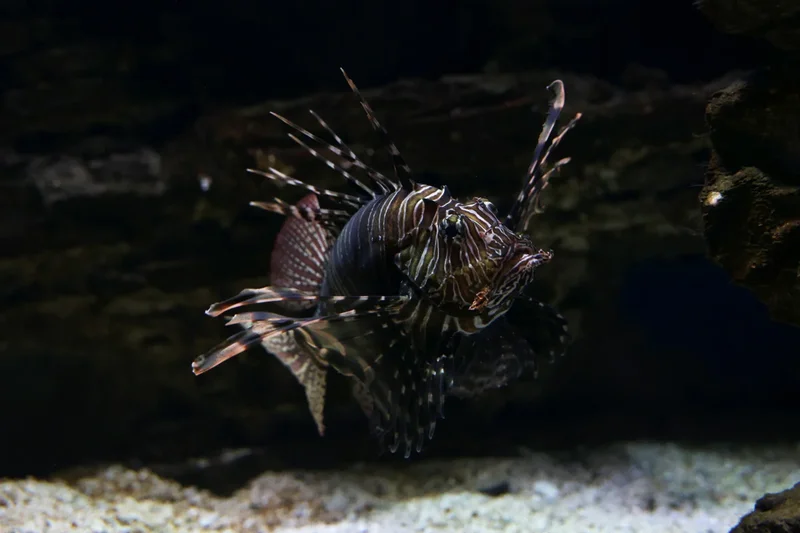
Off the coast of Cyprus, a bearded skipper named Pepis skilfully pulls two lionfish from experimental traps. He slices away their poisonous spines, prepares the catch, and drops them into a bucket.
The surrounding Mediterranean water appears completely still, offering little indication of the profound ecological shift taking place beneath the surface.
Pepis’ routine is part of a broader scientific effort to monitor and contain the influx of invasive species such as lionfish. Marine environments here are altering rapidly due to rising sea temperatures alongside the Suez Canal, which provides a gateway for species migrating from warmer tropical waters.
According to a survey compiled by the Cyprus Academy of Sciences, Letters and Arts – based on research from scientists across 11 nations – a new non-indigenous species is introduced to the Mediterranean roughly every fortnight. The report identifies over 1,000 non-native species in total, a notable rise from fewer than 800 recorded between 2012 and 2017 by the European Environment Agency.
Experts highlight that these tropical arrivals from the Red Sea and beyond are pushing out indigenous marine life, altering natural food webs, and placing local fisheries under strain.
This underwater shift mirrors the severe impacts of climate change observed across European landmasses this summer, where extreme heatwaves, wildfires, and droughts have caused widespread disruption.
The development poses serious concerns for conservationists: although the Mediterranean represents just 0.8 per cent of global ocean surface, it holds as much as 18 per cent of all marine species worldwide.
"Changes have been drastic, especially since 2000," said Periklis Kleitou, a marine scientist at the Cyprus-based Marine and Environmental Research (MER) lab which is looking at ways to reduce the impact of invasive species.
"We see more and more non-indigenous species proliferating and dominating the marine environment and, unfortunately, fewer native species."
With a distinct spiky crest and permanent frown, the lionfish resembles an underwater punk. Lacking natural predators in Mediterranean waters, it consumes native fish and crustaceans in large volumes.
To address this, MER is trialling specialised traps near Cyprus designed to capture lionfish and Atlantic blue crabs while permitting indigenous species to escape unharmed.
Similar ecological disruptions are occurring off the coast of Greece, where over 230 non-native species have been documented in recent decades, according to Paraskevi Karachle, research director at the Hellenic Centre for Marine Research.
These non-native animals affect ecosystems in distinct ways. Rabbitfish consume significant amounts of algae, stripping underwater habitats bare and competing directly with local plant-eating fish species, Karachle explained.
Meanwhile, the carnivorous Lagocephalus pufferfish – also known as the silver-cheeked toadfish – carries toxins potentially lethal to humans. It preys on native fish species and has been linked to declining octopus catches. Recognisable by its bulging eyes and buck teeth, it features a silver body covered in black spots.
Scientists turn to unique solutions
To control populations, authorities in both Greece and Cyprus have introduced financial rewards for fishers who land pufferfish.
"Invasive species are taking over our seas, and that affects the local biodiversity as well as the economy," said Christina Kakoulli, a marine biologist at MER.
Researchers are exploring practical adaptation strategies, including promoting non-native fish as viable food sources. Once stripped of venomous spines, lionfish is safe to eat; skipper Pepis suggests lightly flouring the fish before frying it.
"In the beginning people were afraid, but now they understand it's a high quality, delicious fish," said Petros Yiangou, a chef who works with MER on Life Prometheus, a European Union-funded project that looks at ways to reduce accidental capture of sharks and rays, while encouraging ways to harvest invasive species.
Commercial interest is already growing, with emerging markets for these fish in Lebanon and Turkey, while Tunisia has developed a market for Atlantic blue crabs.
In Greece, researchers have tested processing methods to neutralise pufferfish toxins, turning them into fishmeal for farmed sea bass, Karachle noted. Other studies are investigating potential applications for alien species across cosmetics, dietary supplements, leather goods, and pain relief products.
Establishing practical uses for invasive life forms may prove far simpler than pinpointing a single cause behind their expansion. Scientists emphasise that managing the phenomenon requires continuous, long-term monitoring.
"The sea is very complicated," Kleitou said. "It has so many confounding variables interacting at the same time."