History tells us that President Trump’s executive order calling for the measles, mumps, and rubella vaccine to be split into separate shots could do real harm. If policymakers prevail on vaccine makers, it will mean more missed vaccine doses, and more sick kids. But first a lesson on where the shot comes from.
In March 1963, a 5-year-old girl named Jeryl Lynn woke up with a sore throat at 1 a.m. Her father, a six-foot-one widower who had lost his wife to breast cancer four months earlier, bent down and felt the lumps on her neck. He was a scientist at the pharmaceutical company Merck, and he checked “The Merck Manual,” a medical reference book. “Oh my God,” he said. “You’ve got the mumps.”
The father put his daughter to bed and told his housekeeper he would be gone for a while. He went to the office, rummaged through some drawers, and found cotton swabs and a vial of nutrient broth. He woke Jeri, swabbed her throat, and comforted her. Then he went back to work again, using that virus to infect incubating chicken eggs and then move the virus into culture dishes of chick cells. As it became adapted to chickens it became worse at infecting humans — and became a vaccine.
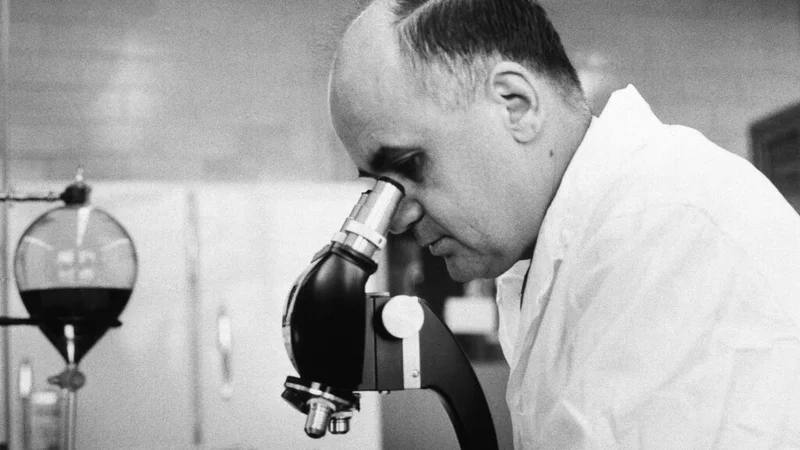
That father was Maurice Hilleman, the scientist who developed the vaccines for meningococcus, pneumococcus, and the mumps vaccine that was licensed in 1967 and is still used in the U.S. He also combined the mumps shot with measles and rubella vaccines to create the MMR vaccine, licensed in 1971. Every time the Merck MMR vaccine goes into an arm, it is a father’s lasting revenge against a virus that made his daughter sick.
Hilleman was not a man you wanted mad at you. His mother died in childbirth, and he grew up on a Montana farm raised by his aunt and uncle, cleaning the chicken coops. He relished firing people as much as Donald Trump does, and kept a collection of shrunken heads his daughter Kirsten carved out of apples to commemorate employees he had let go. These and other details come from vaccine developer Paul Offit’s biography of Hilleman, based on hours of interviews.
Before the vaccine, the mumps was the leading cause of deafness in children, but it is the least terrifying of the three conditions that MMR protects against. Before the measles vaccine was in wide use, measles led to 48,000 cases of hospitalization annually in the U.S., 1,000 cases of encephalitis, and about 500 deaths.
Rubella was normally not a severe disease, but it caused birth defects. During an epidemic in 1964 and 1965, 20,000 infants were born with congenital rubella syndrome. Some 11,000 were born deaf, 3,500 blind, and 1,800 with intellectual disabilities.
The children’s author Roald Dahl wrote of losing his 7-year-old daughter to measles encephalitis in 1962. “In an hour, she was unconscious. In twelve hours she was dead.”
There is also evidence that children who are infected with measles are more likely to die of other infectious diseases afterward, because of changes it wreaks on the immune system.
When talking about medical interventions, researchers usually talk about their benefits and their risks. More than 60 years of use has shown that the MMR vaccine’s benefits are huge. The biggest controversy over its safety has come from claims it is linked to autism, either as a combination or because of one of its components. There are numerous studies showing that the MMR shot does not increase the risk of autism spectrum disorder. And though it was never in the MMR vaccine, there is no evidence that thimerosal, a preservative that was once commonly used in other vaccines but is no longer used in routine childhood vaccines in the U.S., causes harm, despite allegations to the contrary. There is no evidence that combining many vaccines increases the risk of autism.
We also have a cautionary story from Japan. In 1989, Japan introduced an MMR vaccine that used a different strain of the mumps virus. That vaccine was suspended in 1993 after it appeared to increase cases of meningitis that was not caused by bacteria. That meant that only individual vaccines for measles, mumps, and rubella were available.
Mumps is still endemic in Japan today; there were more than 300 cases of mumps-induced hearing loss in 2015 and 2016, according to one survey. Measles vaccination rates fell to 83% in 2001. A measles outbreak that year affected an estimated 265,000 children. Japan also had a rubella epidemic in 2012. We can’t link either example directly to the MMR withdrawal – obviously there are other factors in a story playing out over many years – but they demonstrate the risks of low or spotty vaccination rates. Meanwhile, the MMR withdrawal had no effect on autism rates.
Japan introduced a combination measles-rubella shot in 2006 and an expert panel cleared an MMR shot this year, though it is not yet available. The country was verified as having eliminated measles in 2015 and rubella in 2025.
There are no single-dose measles, mumps, or rubella vaccines marketed in the U.S. Exactly how or if they will become available is an open question. Drops in vaccine uptake could worsen the ongoing measles outbreak. A Stanford modeling study estimated that measles could become endemic again at current vaccination rates, and that a 10% decrease in MMR vaccination would result in 11 million cases over 25 years.
It’s enough to make one fantasize about Donald Trump being visited, Dickens style, by the angry ghost of Maurice Hilleman.