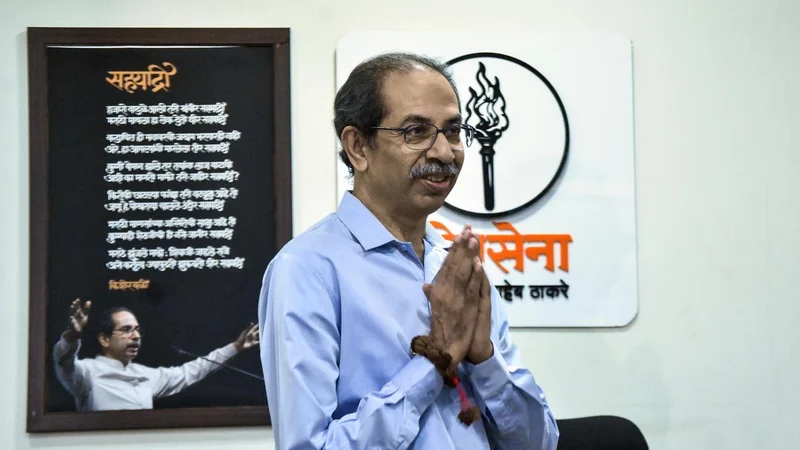
A split in a legislative party can never, by itself, amount to a split in the political party and the Election Commission of India's decision to recognise the Eknath Shinde-led unit as "real Shiv Sena" and grant it the bow-and-arrow symbol was unlawful, the Uddhav Thackeray faction told the Supreme Court on Tuesday (August 11, 2026).
The assertions were made by senior advocate Kapil Sibal, appearing for the Shiv Sena (UBT), before a bench comprising Chief Justice Surya Kant and justices Joymalya Bagchi and V. Mohana on the third day of final hearing.
The bench was hearing two pleas filed in 2024 by the Uddhav faction against the poll panel's order allotting the 'bow and arrow' symbol to the Maharashtra Deputy Chief Minister Eknath Shinde-led unit.
The pleas have also challenged the February 17, 2023 order of the ECI recognising the Shinde faction as the original Shiv Sena.
Assailing the poll panel's decision, Mr. Sibal said, "The assumption that the split in the legislative party means the split in the political party is unlawful and liable to be set aside."
Referring to a paragraph of the erstwhile Tenth Schedule of the Constitution, he said it also had a similar requirement that the split had to occur in the original political party.
"Only thereafter could one-third of the legislators constitute a separate group. This issue was considered in a judgement," he added.
The court had rejected the argument that legislators wear two hats, one as members of the original political party and another as members of the legislative party, and that the formation of a separate group by one-third of the legislators would itself be sufficient to infer a split in the original political party, he said.
"The court held that there were two distinct requirements: first, a split in the original political party; and second, a group comprising one-third of the legislators separating from the legislature party. It expressly rejected the proposition that a split in the original political party need not be separately established merely because there was a split in the legislature party," it said.
The same logic applies here, he said, adding that what the ECI has done is precisely what was prohibited in the earlier judgement.
"The Election Commission relied upon two judgments to conclude that there was a split in the political party on the basis of a split in the legislature party. But neither judgment supports that proposition," he added.
He said therefore, the impugned order, insofar as it assumes jurisdiction in the "Symbols Order" merely on the basis of a split in the legislative wing, is "unlawful and liable to be set aside".
"If I am right on this submission, then the Election Commission's very assumption of jurisdiction was erroneous, and everything that follows from it is illegal," he said.
He said the poll panel had relied principally on communications concerning separate meetings of the two groups, the appointment of rival legislature party leaders and chief whips, and disqualification proceedings against MLAs.
"The Commission treats these communications as evidence of the emergence of a rival group within Shiv Sena," Mr. Sibal said, adding that such material related essentially to the legislative wing and could not establish a split in the political party.
Mr. Sibal also challenged the ECI's decision to disregard the Shiv Sena's 2018 constitution on the ground that it was undemocratic.
He pointed out that members of the Shinde faction had themselves obtained positions and benefits under the same constitution and argued that they could not subsequently challenge the document on that basis.
"The very persons making that argument had themselves been appointed under the 2018 Constitution," Mr. Sibal said.
According to Mr. Sibal, even if the 2018 constitution were assumed to be undemocratic, that could not justify transferring the party's name and symbol to the rival faction.
He further said that the ECI had no power under Section 29A of the Representation of the People Act, 1951, to adjudicate whether the internal constitution of an already registered political party was democratic or undemocratic.
Section 29A, primarily governs the registration of political parties and requires them to affirm allegiance to the Constitution and the principles of socialism, secularism and democracy, he said.
He said the provision did not confer a subsequent adjudicatory power on the Commission to invalidate a party constitution on the ground that it was undemocratic.
Mr. Sibal also invoked Article 19(1)(c) of the Constitution, which guarantees the right to form associations, submitting that a political party is a voluntary association entitled to function according to its own rules.
Justice Bagchi, however, observed that the expressions "public order" and "morality" under Article 19(4) were wide and flexible.
Mr. Sibal said he was only flagging the constitutional issue, while Justice Bagchi observed that the concept of morality could also raise the question of constitutional morality.
The Thackeray faction has maintained that the ECI wrongly allowed legislative strength to prevail over organisational support in determining which faction represented the Shiv Sena.
The hearing would resume on Wednesday (August 12, 2026).
Published - August 11, 2026 08:01 pm IST