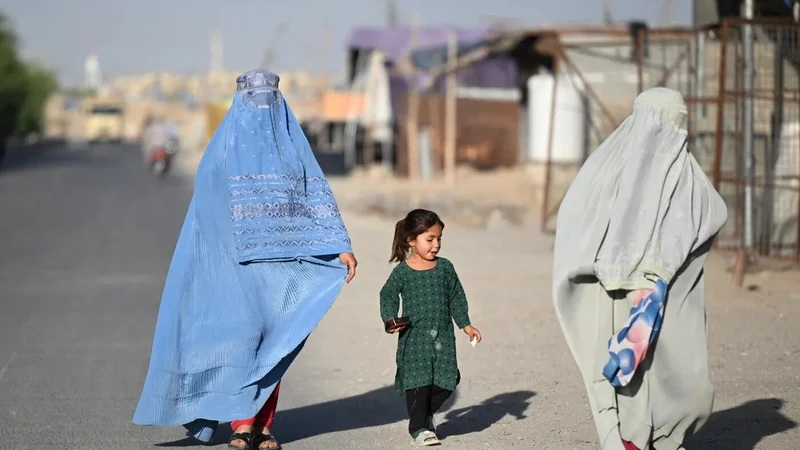
Exclusive: ICC issued two secret arrest warrants for Taliban members for gender persecution
Judges at the International Criminal Court (ICC) issued two secret arrest warrants last year for senior members of the Taliban for the crime against humanity of persecution on gender and political grounds, Middle East Eye can reveal.
According to sealed documents and sources briefed on the matter, the warrants were issued confidentially by a panel of three judges in September 2025.
This was two months after the same panel publicly issued arrest warrants for the Taliban's supreme leader Hibatullah Akhundzada and Abdul Hakim Haqqani, Afghanistan’s chief justice, for the same crime.
The secret warrants include new evidence and new alleged victims not covered by the two public applications.
The ICC is charging the four Taliban members for alleged crimes committed by the group as the de facto government authority in Afghanistan from at least 15 August 2021 until at least 20 January 2025.
MEE is not disclosing the identity of the two members in the secret warrants to protect the confidentiality of proceedings.
The Taliban warrants set a historic precedent under international law. They mark the first time the ICC or any other international tribunal has recognised LGBTQ+ victims.
The charge of gender persecution is also very rare under international law, and there has never been a conviction on it. The charge has been prosecuted just once by the ICC, in the Al Hassan case, but never led to a conviction.
Threat of sanctions
The Taliban warrants were filed in January 2025 shortly after the inauguration of US President Donald Trump.
The four applications were prepared under the leadership of former prosecutor Karim Khan and Nazhat Shameem Khan, the ICC's deputy prosecutor, who oversees the Afghanistan investigation. The team has been guided by Lisa Davis, a special adviser who authored the office’s policy on gender-based crimes.
MEE understands that court officials decided not to publicise the two additional applications because they knew the US was opposed to them and they forsaw US sanctions being issued against the ICC as a result.
A month after the applications for Akhunzada and Haqqani were made public, the US did indeed impose sanctions on ICC officials, beginning with Karim Khan.
Staff members were wary of potential sanctions targeting them and affecting their ability to visit family in the US, sources familiar with the matter explained. Some were even reluctant to have their names on the applications.
Since April, judges have ordered the prosecutor’s office not to publicise any further requests for arrest warrants.
Contacted by MEE multiple times regarding the status of arrest warrant applications, the office of the prosecutor refused to comment, citing the court’s amended regulations imposing secrecy on new filings.
Since February 2025, the US has imposed retaliatory financial and visa sanctions on court officials in connection with the Afghanistan and Palestine investigations, citing efforts to prosecute nationals or allies of the US.
The first target was Karim Khan, the former prosecutor who was controversially removed by member states last month after an 18-month long misconduct probe.
Also targeted were eight judges, three of whom - Kimberly Prost, Solomy Bossa and Luz Ibanez - were members of the 2020 Appeals Chamber that authorised the Afghanistan investigation.
The sanctions came despite the decision by then-prosecutor Khan in 2021 to deprioritise the strand of the Afghanistan probe concerning US military and CIA personnel, as well as former Afghan government forces, in order to focus the investigation on the Taliban and the Islamic State-Khorasan Province (IS-K).
MEE understands that even though the office of the prosecutor is not investigating US nationals, successive US governments, including Joe Biden's, have opposed the ICC’s prosecution of the Taliban for pragmatic reasons.
The main reason is the Taliban being the de facto government, which necessitates diplomatic contacts with its members. The US is also worried about the potential of more extreme groups like the Islamic State replacing the Taliban in the event of a collapse of its government.
Judges seek to split investigation
The Afghanistan situation at the ICC dates back to November 2017, when then-prosecutor Fatou Bensouda first requested authorisation to investigate alleged crimes committed since 2003, including by Afghan and US forces as well as the Taliban and the IS-K group.
That request was initially rejected by a pre-trial chamber in 2019, before the appeals chamber overturned the decision in March 2020 and authorised the investigation to proceed. Bensouda was sanctioned by the US government a few months later over alleged attempts to subject Americans to the court's jurisdiction.
The probe was suspended later that year after a deferral request from the then Afghan government, and only resumed in late 2022, a decision upheld on appeal in April 2023.
In November 2024, six states (Chile, Costa Rica, Spain, France, Luxembourg and Mexico) jointly referred allegations of crimes against women and girls committed since the Taliban's return to power in August 2021, asking prosecutors to fold them into the existing Afghanistan investigation.
Weeks later, in January 2025, Khan applied for arrest warrants, arguing that the gender persecution allegations already fell within the scope of the 2020 authorisation.
MEE revealed last week that ICC judges have asked the office of the prosecutor to open a standalone investigation into allegations of gender persecution by the Taliban, separating it from the original Afghanistan war crimes probe that covered US nationals.
The move, if prosecutors proceed, is likely to raise questions about whether the court is seeking to ease tensions with Washington by signalling that it will no longer pursue allegations against US forces and their allies.
Khan’s two deputies, both under US sanctions, are in charge of the office until the election of a new prosecutor.