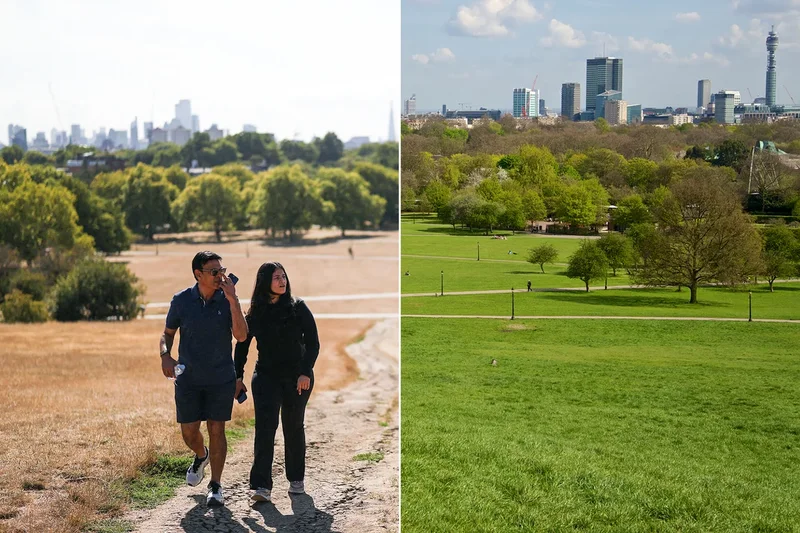
Nearly three-quarters of England is officially in drought, affecting up to 45 million people across the country ahead of scorching temperatures this week.
It comes after the East Midlands, Lincolnshire and Northamptonshire, Kent and East Sussex, and Solent and the South Downs were added to the list of regions already in drought.
According to the National Drought Group, 71.3 per cent of England is in drought, while the North East and Yorkshire are now under a ‘prolonged dry weather’ status.
Photos from across the UK show the scale of the damage to the natural environment caused by the dry weather.
Reservoirs and rivers in England are showing signs of depletion, with the rare sight of beds becoming visible as water levels sink.
Meanwhile, agricultural land, forests and fields have turned brown in the heat. Farmers have reported poorer yields as a result of the weather, with livestock farmers forced to use winter feed as a result of low grass growth.
Farmers have called for efforts to make agriculture more resilient to climate change, including making it easier to build on-farm reservoirs and flexible abstraction licences so farmers can take and store water when it rains.
It comes after southern England experienced its driest July and driest month ever recorded. According to the Met Office, southern England measured a mere 1.9mm of rain last month, while England had 6.5mm of precipitation throughout July.
This is the second consecutive summer drought, and the third in four years after the one seen in 2022.
Helen Wakeham, director of water at the Environment Agency and chair of the National Drought Group, previously said: “The hot and dry weather means we are currently using water faster than nature can replenish it.
“A second consecutive summer drought is an exceptionally serious situation and one that will have long-lasting impacts on our environment, wildlife and the economy.
“We want everyone to stay safe and hydrated during the hot weather but every drop we can save is a drop more for nature and agriculture.”
The whole of England is currently under amber heat health alerts issued by the UK Health Security Agency, with temperatures set to reach 38C this week. All alerts are in place until Friday, 14 July at 9pm.
Meanwhile, the Met Office has issued a rare amber extreme heat warning for parts of the country on Thursday, covering the majority of the Midlands, London, parts of the south east, Yorkshire and the Humber and the east of England.
It comes as the forecaster has said that the UK is on track to record its warmest summer, with provisional statistics showing that Britain’s average temperature for meteorological summer thus far currently sits at 16.48C. This is 1.88C hotter than the 1991-2020 average.
Jason Kelly, Met Office chief forecaster, said: “Heat will gradually build this week, with temperatures reaching into the mid-30s Celsius in what will be a fairly widespread heatwave for England and Wales.
“The driver for this week’s heat is high pressure, this becoming dominant over the next day or so, bringing plenty of sunshine and allowing temperatures to build day-by-day.
“Southerly or southeasterly winds will also tap into the hot conditions over Europe, meaning we’re looking at further notable heat for many this week, likely peaking on Thursday.”