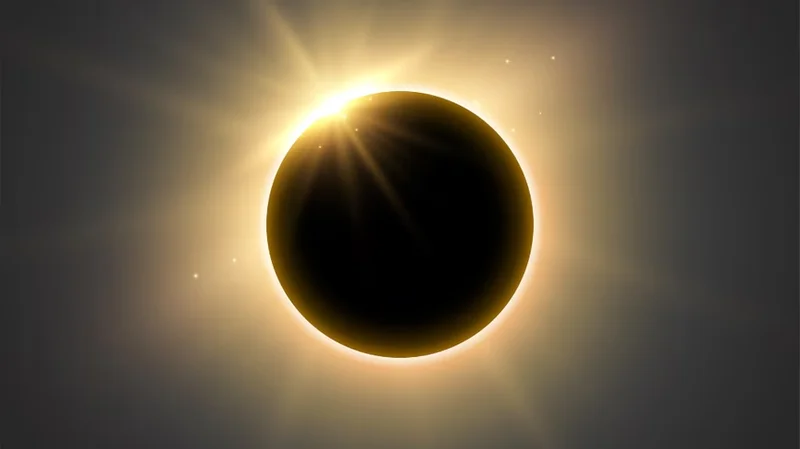
Italian researchers have packed up a new solar instrument, driven it carefully across the continent by road rather than risk it in an aircraft hold, and readied it for one of the more nerve-racking experiments in physics: a test that has to succeed on the first attempt, during the total solar eclipse that sweeps over Europe on 12 August.
The device, called the Circular Slit Spectrometer, or CISS, will point at the Sun from the Javalambre Astrophysical Observatory in Spain, directly under the path of totality.
The appeal of an eclipse is simple, and it is the reason these events remain such prized natural laboratories. When the Moon slides over the Sun’s blazing disc, the faint outer atmosphere known as the corona finally becomes visible, a wispy halo that is usually drowned out by light a million times brighter than it is.
For a solar physicist, those few precious minutes are a rare open window onto a hard-to-reach region, which is why teams still chase eclipses around the world rather than wait for the Sun to co-operate.
CISS is not a coronagraph, the kind of instrument that manufactures its own eclipse by blocking the disc.
It is a spectrometer, designed to split the corona’s light into its constituent wavelengths and read the story written there, from temperature to composition to the churn of the solar wind. The novelty is in the geometry.
Where conventional linear spectrometers scan the corona strip by strip, a process that can take hours, CISS uses a circular slit to capture the spectrum of the whole ring in a single photograph.
“There is neither space nor time for the unexpected,” senior researcher Paola Zuppella of the Institute for Photonics and Nanotechnologies in Padua told Reuters, a line that neatly captures the stakes.
Totality at Javalambre lasts only a couple of minutes, so an instrument that grabs everything at once, instead of dragging a slit across the sky, is the difference between a full dataset and a frustrating near-miss.
The team behind it spans two Italian outposts, with the Astrophysical Observatory of Turin leading the science under principal investigator Federico Landini, and the Padua lab supplying the optics. Landini frames the payoff plainly: a design that could deliver in one frame what older kit needs a morning to assemble.
If it holds up, the researchers hope CISS will offer unprecedented insight into how the corona behaves and, in the longer run, open a new chapter in how the Sun is observed.
There is a neat irony in the timing, too. Even as European scientists lean on a rare natural eclipse as a proving ground, Europe’s space agencies are busy engineering artificial ones.
A pair of satellites flying in tight formation can now create solar eclipses on demand, one craft casting a precise shadow over the other so the corona can be studied whenever mission planners fancy, rather than whenever the cosmos obliges.
That work is already bearing fruit. An artificial solar eclipse engineered in orbit has begun returning fresh views of the corona, promising the sort of repeatable, on-tap access that a ground-based team squinting up from a Spanish mountaintop can only dream of.
Set against that, CISS looks almost old-fashioned, a clever piece of glass betting everything on a few uninterrupted minutes and a cloudless sky.
Yet the two approaches are complementary rather than rival. Space-borne coronagraphs buy consistency; a real eclipse still offers a cleaner, more complete view of the inner corona than any occulting disc can quite match, so a fast spectrometer catching that view could feed data the orbiting instruments cannot.
The catch, as ever, is the weather and the single roll of the dice. Everything on the mountain has to work first time, because there is no second take. The Sun, obligingly, will not wait around.
Get the TNW newsletter
Get the most important tech news in your inbox each week.