Welcome to the Proof of Usefulness Hackathon spotlight, curated by HackerNoon’s editors to showcase noteworthy tech solutions to real-world problems. Whether you’re a solopreneur, part of an early-stage startup, or a developer building something that truly matters, the Proof of Usefulness Hackathon is your chance to test your product’s utility, get featured on HackerNoon, and compete for $150k+ in prizes. Submit your project to get started!
In this interview, we sit down with Founder Luke Kist to discuss Tinky Town, a QR-code-based auxiliary communication infrastructure. By acting as public accessibility infrastructure, the platform aims to bridge the gap between non-verbal or non-English speaking visitors and front-desk staff in facilities worldwide.
What does Tinky Town do? And why is now the time for it to exist?
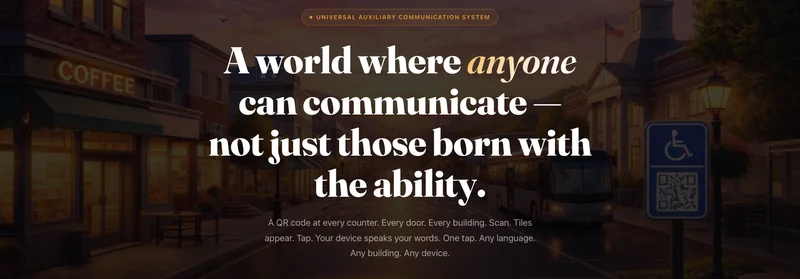
Tinky Town is a QR-code-based auxiliary communication infrastructure designed to bridge the gap between non-verbal or non-English speaking visitors and front-desk staff in public and private facilities. Rather than serving as a personal, dedicated AAC (Augmentative and Alternative Communication) device, Tinky Town acts as public accessibility infrastructure—similar to a wheelchair ramp or Braille signage. Now’s a good time for Tinky Town to exist because recent advancements in lightweight, on-device AI make it possible to instantly provide secure, privacy-focused communication tools without requiring users to download an app or purchase dedicated hardware.
Who does Tinky Town serve? What’s exciting about your users and customers?
Primary Users (Visitors): Non-verbal individuals, AAC users, neurodivergent visitors, people with speech impediments, and non-English speakers who need to communicate quickly at front desks without specialized personal hardware.
Secondary Users (Venues & Staff): Front-desk personnel, receptionists, and customer service staff at public and private facilities (e.g., libraries, community centers, municipal offices, museums, healthcare clinics, and retail establishments).
Value Provided: Visitors get immediate, barrier-free communication without app downloads or specialized setup. Venues gain a low-friction accessibility solution that enhances inclusivity, customer service efficiency, and compliance with accessibility standards.
What technologies were used in the making of Tinky Town? And why did you choose ones most essential to your techstack?
Tinky Town relies on a custom, lightweight AI stack built entirely from scratch, utilizing proprietary models like the 31-million parameter TinkyBrain-31M and the on-device PEEL-conditioned TinkyBrain-v6 hosted on the Hugging Face Hub. We prioritized building our infrastructure to run locally on constrained hardware because it ensures data privacy, ultra-fast response times, and supreme reliability for vulnerable users without depending on massive cloud architectures.
What is traction to date for Tinky Town? Around the web, who’s been noticing?
While Tinky Town is currently in a stealth, pre-launch phase to build out its infrastructure, our standalone AAC communication device, TinkySpeak, has already gained strong early validation. TinkySpeak has been featured multiple times by autism advocacy communities and therapeutic centers, proving that there is a genuine organic interest and trust in our underlying tech stack before the broader public rollout of Tinky Town.
Tinky Town scored a 97.61 proof of usefulness score (https://proofofusefulness.com/report/tinky-town)
What excites you about this Tinky Town's potential usefulness?
Democratizing Accessibility: Brings zero-cost, immediate communication tools to non-verbal individuals, non-English speakers, and stroke survivors who are often overlooked in public spaces.
• Restoring Independence: Gives visitors a simple way to speak up for themselves in real-world scenarios—like municipal offices, clinics, and local stores—without relying on an interpreter or personal AAC device.
• Low-Barrier Deployment: By framing accessibility as venue infrastructure (via simple QR codes), facilities can achieve meaningful inclusion instantly using light, on-device AI.
Walk us through your most concrete evidence of usefulness. Not vanity metrics or projections - what's the one data point that proves people genuinely need what you've built?
The most compelling evidence of need comes from our sister project, TinkySpeak: organic adoption and recurring daily usage by speech language pathologists (SLPs) and non-verbal users within autism communities and therapeutic centers without paid acquisition. Users actively rely on our custom TinkyBrain architecture for immediate, daily communication—proving that light, low-latency AAC tools fill a vital real-world gap where traditional software is too complex or costly.
How do you measure genuine user adoption versus "tourists" who sign up but never return?
Because Tinky Town operates as frictionless public infrastructure without requiring sign-ups or app downloads, we measure adoption through repeat interaction depth per venue QR code rather than account registrations:
- Metrics:Completed communication exchanges, session length, and return interaction rates at specific physical locations.
- Retention Story:A "tourist" scans once out of curiosity and drops off in under 5 seconds. Genuine adoption looks like recurring daily/weekly scans by local community members, paired with front-desk staff actively initiating or completing two-way QR sessions to resolve visitor inquiries.
If we re-score your project in 12 months, which criterion will show the biggest improvement, and what are you doing right now to make that happen?
Audience Reach & Impact will show the single biggest jump.
- Current Status:Pre-launch/stealth mode (score heavily constrained by current reach).
- Execution Plan:We are actively transitioning from local model development on Hugging Face (TinkyBrain-31M and TinkyBrain-v6) into physical venue deployments. Rolling out initial pilot sites across municipal offices and healthcare clinics will move our audience reach from 0 to thousands of verified monthly interactions.
How Did You Hear About HackerNoon?
We discovered HackerNoon through its developer community discussions surrounding open-source AI and small language models. Participating in the Proof of Usefulness hackathon has been fantastic—the platform's emphasis on real utility and technical substance over vanity metrics directly aligns with our mission to build lightweight, privacy-focused accessibility infrastructure.
Given the early validation TinkySpeak has received from autism advocacy communities and therapeutic centers, how do you plan to leverage those relationships to secure your first wave of public venue pilot partnerships for Tinky Town?
Therapeutic centers, advocacy groups, and families using TinkySpeak already experience the benefits of our underlying TinkyBrain models. We are leveraging these established relationships in two ways:
- Warm Venue Introductions:Using partner therapists and advocates to champion Tinky Town directly to the community facilities they visit regularly (e.g., local libraries, clinics, civic centers).
- Co-Design & Advisory:Involving clinicians from our therapeutic network to help refine venue-specific communication templates before we launch pilot installations.
You expect each venue to reach 200-500 monthly interactions once deployed. What is your strategy for onboarding venues and ensuring their front-desk staff actually encourage visitors to use the Tinky Town QR codes?
Our onboarding strategy focuses on minimizing friction for front-desk staff:
- Plug-and-Play Setup:Physical QR placards feature ultra-clear signage ("Scan to communicate with front desk") requiring zero hardware or IT integration.
- Staff Micro-Training:We provide 2-minute quick-start guides and physical desktop prompts that frame Tinky Town as a customer service tool that speeds up interactions rather than adding workload.
- Incentive & Visibility:Facilities receive accessibility compliance badges and periodic usage summaries showing how many community communication barriers they successfully resolved.
By framing Tinky Town as public accessibility infrastructure rather than a personal device, how do you ensure the on-device AI models like TinkyBrain-v6 accurately predict phrases across vastly different types of venues, from municipal offices to healthcare clinics?
To ensure high accuracy across vastly different environments (e.g., municipal offices vs. healthcare clinics):
- PEEL Conditioning & Location Profiles:TinkyBrain-v6 uses PEEL-conditioned prediction that dynamically adjusts phrase probability based on venue context metadata embedded in the venue's QR code.
- Domain-Specific Lexicons:Scanned QR codes load optimized, lightweight vocabulary sets (e.g., medical intake terms for clinics vs. permit/form terminology for municipal offices).
- Privacy-Preserving On-Device Adaptation:The model runs lightweight local fine-tuning to learn high-frequency local requests over time without sending sensitive visitor text to cloud servers.
Meet our sponsors
Bright Data: Bright Data is the leading web data infrastructure company, empowering over 20,000 organizations with ethical, scalable access to real-time public web information. From startups to industry leaders, we deliver the datasets that fuel AI innovation and real-world impact. Ready to unlock the web? Learn more at brightdata.com.
Neo4j: GraphRAG combines retrieval-augmented generation with graph-native context, allowing LLMs to reason over structured relationships instead of just documents. With Neo4j, you can build GraphRAG pipelines that connect your data and surface clearer insights. Learn more.
Storyblok: Storyblok is a headless CMS built for developers who want clean architecture and full control. Structure your content once, connect it anywhere, and keep your front end truly independent. API-first. AI-ready. Framework-agnostic. Future-proof. Start for free.
Algolia: Algolia provides a managed retrieval layer that lets developers quickly build web search and intelligent AI agents. Learn more.