Blown accounts don't die at random. Watch enough of them and you start seeing the same movie, frame for frame. The trader is different. The market is different. The sequence is identical.
Somewhere between 74% and 89% of retail traders lose money, depending on which regulator's data you read. That number gets quoted like it's a mystery. It isn't. Most of those accounts walk through the same four phases, in the same order, and almost none of them notice while it's happening.
Phase one: cautious success
You start small because you're nervous, and nervous is exactly right. You size conservatively. You take profits when the plan says to. You cut losers because you don't yet trust yourself to be right.
And it works. Not spectacularly, but it works. This is the most dangerous phase in the whole spiral, and it looks like the safest. The discipline that's making you money right now is discipline born of fear — and fear fades the moment the account turns green.
Phase two: overconfidence
Here's what the winning does to you. When you close a green trade, your brain releases dopamine, the same chemical that drives every addiction we know of. Profit, then reward, then a craving for a bigger hit. Yesterday's position size stops feeling exciting, so you nudge it up.
You start attributing the wins to skill instead of a favorable stretch of market. The rules that felt essential in phase one now feel like training wheels. Why respect a stop when you've read the last six moves correctly? You widen it. You add on. You tell yourself you've graduated.
What actually happened is that a small edge met a good tape, and you mistook the tape for yourself.
Phase three: the one catastrophic loss
The blowup isn't a slow bleed. It's usually a single trade — the one where the enlarged size, the moved stop, and the certainty all arrive at the same time. The market does something it was always allowed to do, and this time you're carrying three times your normal risk into it.
One trade erases weeks of gains. Sometimes it erases the account. The math is quietly brutal here: a 50% loss needs a 100% gain just to get back to even. You didn't lose twice as much as a 25% loss — you lost far more than that in the effort required to recover.
Phase four: terminal decline
This is where the account actually dies, and it dies from the psychology, not the number. After the big loss you don't return to phase-one caution. You return angry. You want it back, and you want it back fast.
So you trade bigger to recover quicker, which is the exact behavior that just cost you. Revenge trades stack on revenge trades. What's left of the balance drains out over a couple of frantic weeks. A Brazilian study of day traders found that 97% of those who kept at it past 300 days still lost money. Persistence in this phase isn't grit. It's the spiral finishing its work.
Where the chain actually breaks
Notice that three of the four phases are emotional, not analytical. The cautious success feels good. The overconfidence feels earned. The revenge feels justified. Willpower is supposed to hold the line through all of it, and willpower is precisely what disappears the moment fear or greed shows up.
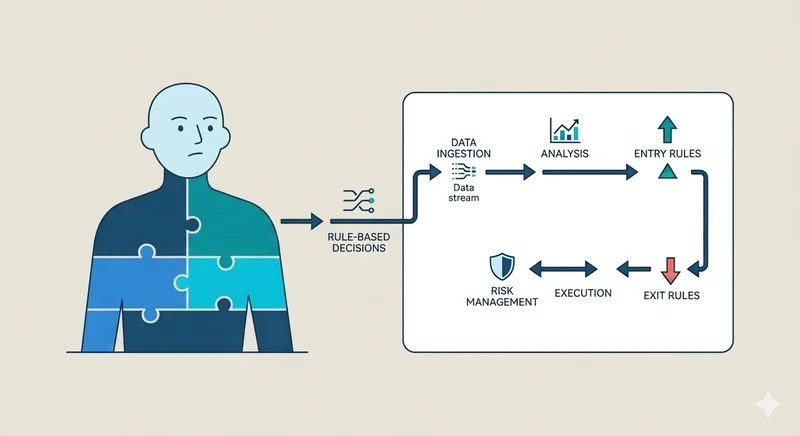
That's why just being more disciplined has never fixed a single one of these spirals. You can't out-discipline your own brain chemistry at the exact moment it's flooded. The only reliable fix is to remove the decision from the moment entirely. Fixed size that a winning streak can't inflate. A stop that lives in the exchange, not in your head. Rules set while you're calm and executed when you're not.
The spiral needs your discretion to run. Close that door and it has nothing to work with.
If you recognize yourself somewhere in those four phases, the answer probably isn't more willpower — it's taking the emotional decisions out of the loop. That's the whole point of trading systematically.