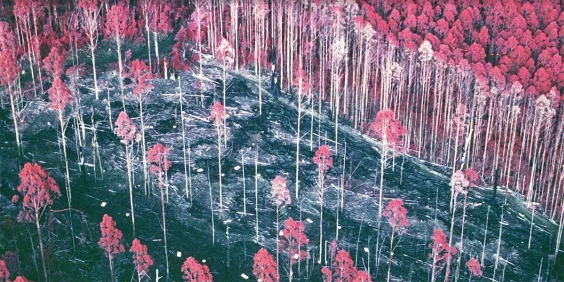
Scientific studies are often focused on specific periods of time—a month on a new drug, five years of weather changes—but a team from the University of Melbourne in Australia returned to a dormant research project three decades after it began.
The project was located in the mountain ash forest of Tanjil Bren, Victoria, in the southeast of the country. Originally undertaken in 1987, its aim was to investigate alternatives to clearfelling, or the practice of harvesting timber by completely clearing a forest patch, burning what’s left, and sowing new seeds in the fertile ashes.
Read more: “The 315-Year-Old Science Experiment”
Studies published in the years following concluded that clearfelling was indeed the best way of sustainably managing forests, better than leaving a specific proportion of the trees standing. At the time, they found clearfelling resulted in more trees returning, at a quicker rate, compared with the alternatives.
Then, in the early 2000s, active monitoring stopped. No more papers were published, and the project was largely forgotten.
In 2014, however, new researchers returned to Tanjil Bren. Five years later, the process of obtaining field measurements began again, and in 2026, the team published new findings in the journal Forest Science.
Their conclusion? Retention harvesting—that is, leaving 30 to 50 percent of mature trees standing—seems to now work better than clearfelling, at least in terms of the size of the remaining trees that had continued to grow. In addition, retention harvesting was better for carbon storage, as the surviving trees had recaptured the carbon lost by harvesting—and then some. What’s more, the bigger trees that grew over the last 30 years are more likely to form hollows, which are an important habitat for threatened species in the area, including the Leadbeater’s possum and the majestically swooping greater glider. They’re more resistant to fires as well.
The researchers describe the results as “astounding” in a post detailing the latest findings from the experiment site, positioning the use of retention harvesting as a “win-win-win” that can supply timber while also protecting ecosystems.
All of which begs the question: How many other forgotten experiments are out there just waiting to be rediscovered?
Lead image: Centre for Forest Tree Technology