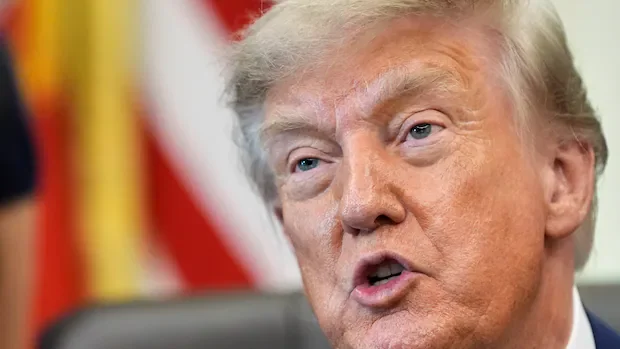
Rights groups sue Trump administration over ICC sanctions
Plaintiffs say campaign against International Criminal Court violates right to free speech
Four human rights groups in the United States are suing President Donald Trump’s administration over its sanctions against the International Criminal Court (ICC), which they say are unlawful.
The American Friends Service Committee, the Center for Constitutional Rights, Human Rights Watch, and the Open Society Institute filed the lawsuit on Tuesday in the Southern District of New York.
It accuses Trump of exceeding his authority when he signed an executive order in February 2025 authorizing sanctions against ICC personnel and any foreign nationals or groups supporting the court's work. The sanctions came after the ICC issued arrest warrants in late 2024 for Israeli Prime Minister Benjamin Netanyahu and former defence minister Yoav Gallant for alleged crimes against humanity and war crimes in Gaza. Israel has rejected those allegations.
Washington denounced both the "baseless" warrants and the ICC's efforts to investigate U.S. personnel in Afghanistan upon announcing the sanctions.
The plaintiffs in Tuesday's lawsuit also argue those sanctions have forced them to curb a range of human rights and legal work, in violation of rights protected under the U.S. Constitution, including the right to free speech.
"By targeting the ICC's work through these sanctions, the Trump administration is undermining the very rule of law we depend on to stay safe and promote and protect human rights everywhere," Liz Evenson, international justice director at Human Rights Watch, said in an online news conference on Tuesday, unveiling the lawsuit.
"The Trump administration seeks a get-out-of-jail-free card for whomever it chooses, and with this case, we say no — no to impunity, no to injustice, and no to the erosion of global norms on which human rights protection depends."
WATCH | Trump clashes with ICC:The White House and the U.S. State Department did not immediately respond to requests for comment.
The ICC, based in The Hague, investigates and tries individuals accused of war crimes, genocide, crimes against humanity and the crime of aggression.
The court has had a tumultuous relationship with the U.S. for decades.
It is not a party to the Rome Statute, the treaty that established the ICC in 1998, and does not recognize the court's authority. ** **
Tensions escalated dramatically under the Trump administration, which last year sanctioned the ICC's former top prosecutor as well as several judges — including Canada's Kimberly Prost.
- ListenThe Trump administration sanctioned ICC judges. A Canadian judge is fighting back
- ICC regroups after ousting chief prosecutor over sexual misconduct allegations
Last month, the U.S. government launched an intensified campaign to "dismantle" the ICC, which it accused of posing a "threat to American sovereignty."
"As we speak, the ICC and its friends are waging a war against our country," U.S. Secretary of State Marco Rubio said in a video in mid-July. "Not with bullets or missiles; [with] statutes, compacts and the force of so-called international law."
Last month, two U.S.-based advocacy groups also sued the Trump administration over its ICC sanctions, alleging they violate freedom of speech and "muzzle" Palestinian human rights advocacy.
"The Trump administration is using the blunt instrument of economic sanctions not only to punish human rights defenders but to police the political expression of millions of Americans," said Omar Shakir, executive director of DAWN, one of the groups involved in that case.
Separately, three sanctioned ICC judges, including Prost, filed a lawsuit in June, also in the Southern District of New York, arguing the sanctions are an unlawful attempt to "influence their judicial decision-making."
LISTEN | ICC under fire:## Fight over birthright citizenship
Separately on Tuesday, U.S. legal groups asked a judge to "make it unquestionably clear" that the Trump administration cannot impose restrictions on birthright citizenship.
In late June, the U.S. Supreme Court turned down the administration's attempt to deny citizenship to children born in the United States to parents who are in the country without authorization or temporarily.
Despite that ruling, last week, Trump issued two executive orders seeking to curtail birthright citizenship.
Tuesday's filing, in U.S. District Court in New Hampshire, by the American Civil Liberties Union and other groups argues those orders attempt to get around the Supreme Court's "clear direction."
The groups urged the court to "underscore that the government may not strip away class members' citizenship through any executive orders or other similarly flawed assertions of Executive power over birthright citizenship."