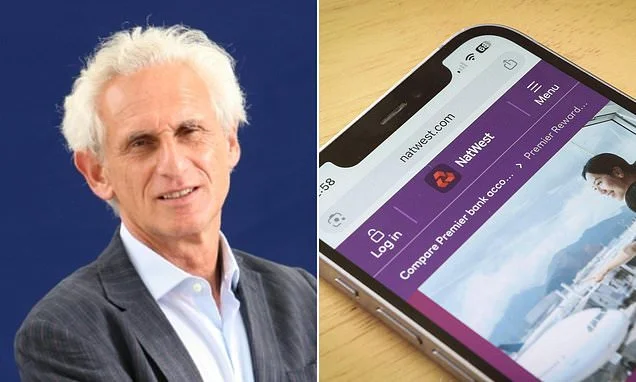
For nearly two decades I’ve been making a mistake with my bank account – and I’m lucky it has not cost me dearly.
I’ve been using a NatWest charge card for my everyday spending, blissfully unaware that it is any different from a credit card.
You may think I ought to have realised. But if I log on to my NatWest online banking, the card is even described as a credit card.
If a purchase had gone wrong and I had cause to ask for a refund from my bank, I would have learned the hard way I had no such protection.
Charge cards are a payment method that allow you to borrow up to a certain limit every month – so far, much like a credit card.
However, unlike credit cards the balance must be cleared every month via a direct debit set up from your current account.
That means there is no option to borrow credit, pay interest and spread out the cost of a purchase over more than one month.
I might have noticed this distinction if I had needed to borrow. But like millions of charge card and credit card holders, I always choose to pay off the balance in full every month.
In my case the spending limit on my charge card is £6,000, enough one supposes to pay for a handsome vacation. The more you use the card, the more often the limit is raised.
Alex Brummer says his loyalty to NatWest has remained intact since his father introduced him to his manager at the then District Bank (it was absorbed by NatWest) over a cup of tea
To charge card holders (who like this writer may believe they hold a credit card) there is something important to know. Charge cards do not qualify under Section 75 of the Consumer Credit Act of 1974.
Credit card users (as opposed to other forms of plastic such as debit cards) are entitled to a full refund from the card lender, the retailer or provider of service if items are faulty, or the seller goes bust. This can be particularly valuable if something goes wrong with an expensive car repair or, as often happens, a flight or holiday paid for with a credit card which goes horribly wrong. Purchases between £100 and £30,000 are covered.
Debit and charge cards offer some protections, but not nearly as strong as with credit cards and it is not legally binding. If a purchase goes wrong – you don’t get what you paid for, for example – you can ask your debit or charge card provider to issue a chargeback. This is where they pull money back from the retailer’s account.
My preference for using my NatWest Charge Card, as opposed to the debit card, now looks daft. For the last couple of decades, I have lived under the illusion that the law is there, on my side, if something goes wrong.
I realised I had a charge card only when I received a confusing letter from NatWest, where I have banked for six decades, informing me my charge card was being cancelled from the autumn.
On enquiry I was politely told by the bank that there were so few users with charge cards, it was not economic to operate them any longer. People now preferred to use a ‘digital wallet’. If I wanted a credit card instead, that would be no problem but I would have to contact the bank’s customer service team. I would then be required to fill in an application and be subject to a check since credit cards require a loan agreement.
Ascertaining how many NatWest customers are affected by the change is like seeking a state secret. An initial response was that there were very few charge card clients left and in any case such disclosure was not possible because it was commercially sensitive. Since the charge card is being cancelled, the sensitivity appears hard to understand.
NatWest, with more than 19 million customers, is not the only UK operator of charge cards, with American Express being the largest
After further questioning I was told there were just 0.5pc of holders among NatWest customers. Since the bank has more than 19million customers, I estimate that the small number of charge card customers could be 95,000 – not an inconsiderable number even for a mass-market bank. A later email reiterated ‘it’s a very small number’ adding that of those in possession of the card one-third are dormant and the majority are spending £100 a month. In my case, it is often many times more than that.
NatWest is not the only UK operator of charge cards. The leading provider is American Express, which is estimated to have some two million charge card customers including this writer who has held a British Airways Amex card for the past ten years. It, like NatWest, requires the holder to clear the balance by direct debit each month. The incentive for using Amex is the Avios points (recently devalued) which can be used to upgrade on BA flights, pay for holidays and – if used enough – to churn out a companion air ticket.
NatWest’s peremptory way of dealing with long-standing customers is less than satisfactory. The obligation on the customer to apply for an alternative card, rather than easy access to a transfer offer, is clumsy in the extreme. I appreciate that I might be regarded as part of a nuisance minority, perhaps expensive to service. But the fact that Amex has some two million customers on charge cards, suggests it is not the dinosaur facility it is suggested as.
I know that NatWest says applying for a credit card is an easy process, but I fear that when dealing with banks even simple tasks can be drawn out. I recently had a quarrel with two ATM cash machines, using a debit card, which failed to deliver the money but charged my account. Customer service were slow to sort it out and I was left hanging on the phone for an eternity. The allegedly withdrawn ATM cash was eventually returned to my current account, but it took weeks.
I’m a well-paid professional working full time, so the delays to the reimbursement did not make much impression on my livelihood. But for someone on a more limited stipend or a meagre pension, jumping through the hoops and the delays would have been hugely troublesome.
Over the years I have been persuaded that the privilege of a Premier Black account, a cost of £36 a month or £432 a year, is worth paying for. There are multiple benefits, such as access to travel insurance (not free because of my age) and car breakdown services – never used. The package of charge and debit cards suited my needs and those of my wife (we have had a joint account since our marriage 50 years ago). Now I am not sure.
My loyalty to NatWest has remained intact since my father introduced me to his manager at the then District Bank (it was absorbed by NatWest) over a cup of tea, biscuits and a civilised chat before going up to university.
It has been a long journey. I was among the unfortunates to be a shareholder in its previous incarnation as the Royal Bank of Scotland before the financial crisis and even subscribed to Fred Goodwin’s desperate, last-ditch £12billion rights issue. Even now the losses still rankle as countless executives have ridden off into the sunset clutching large cheques and with eyewatering pensions.
As an investor and premium customer, I deserve better.
What is your experience of charge cards? moneymail@dailymail.co.uk