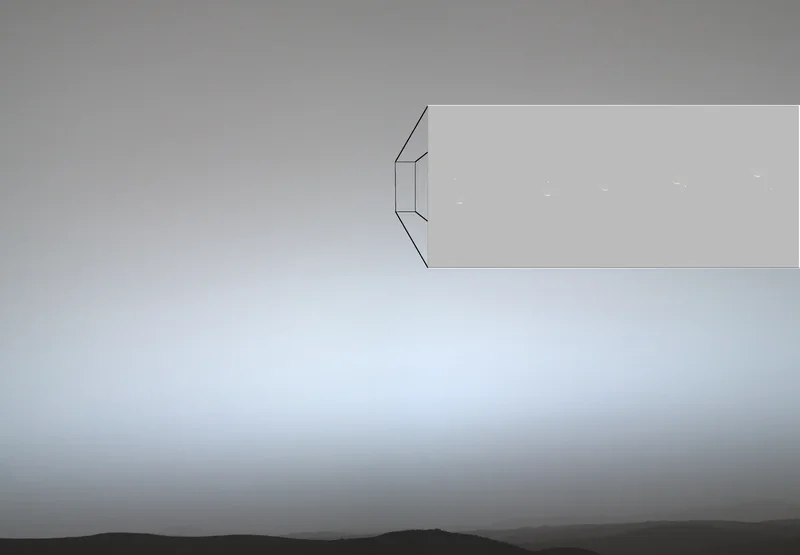
*The Perseverance rover catches the Martian moon Phobos covering up the Earth. *
Sure. It may not look like much. But sometimes, the 'wow' factor in an image lies in knowing just what you're seeing. While most of us are eagerly awaiting Wednesdayâs total solar eclipse across the North Atlantic and Spain, robotic emissaries on the Martian surface have recently given us a look at an astronomical occlusion of a different sort, as Phobos crossed in front of Earth.
An annotated, timestamped version of the Earth occultation as seen from Mars. Credit: NASA/JPL.
The event occurred on July 2nd (Mars sol 1907 for the mission) at 7pm local solar time. The rover observed the occultation of Earth by Phobos at Martian dusk via its Mastcam-Z imager. The sequence of nine images shows the pair above the Martian landscape and the rover's Jezero crater home, with Earth pulling a vanishing act behind Phobos for about 10 seconds.
âThe composite image makes for a unique Earth self-portrait, taken from the surface of another planet, with a Phobos photobomb,â said Justin Maki (NASA/JPL) in a recent press release.
An enhanced strip map of the Earth occultation event, showing Phobos approaching Deimos. Credit: NASA/JPL.
Martian Astronomy
Phobos appears as a sunlit oblong crescent in the images, while Earth is a single-pixel, -2 magnitude star. Our +2nd magnitude Moon was actually too close to Earth to see at the time, though it would occasionally be within naked eye visibility to a Martian astronomer.
About a 1/3 the apparent size of a Full Moon, Phobos orbits Mars once every 7.5 hours at a distance of just 7,800 kilometers from the planet's surface, the closest for any moon in the solar system versus its host planet. This means that Phobos actually rises in the west and sets in the east, as it orbits Mars faster than the planet rotates. Just 27 kilometers in diameter, Phobos is doomed to crash in to the Red Planet some 20-50 million years from now.
The tiny +12th magnitude Martian moons Phobos and Deimos are a tough catch from Earth, though it's just possible to nab them during opposition season. Currently low in the dawn sky, Mars reaches opposition again on February 19th, 2027.
Moving at a degree per minute the equivalent of two Full Moons, Phobos would cover lots of sky real estate daily. You would actually see the moon moving, in real time. This would also mean that occultations of planets including the Earth arenât all that rare, though the rover team had to plan carefully to catch the event.
A closeup of Percy's Mastcam-Z imager. Credit: NASA/JPL
The twin moons of Mars also only have about a one degree orbital tilt versus the planetâs equator, meaning theyâre only visible from latitude 70-80 degrees north to 70-80 degrees south. Plus, Earth would behave like Venus as seen from Mars, never straying farther than 36-37 degrees from the Sun as a morning or evening âstarâ.
This occultation of Earth as seen from the surface of Mars is a first, though Percy and other Mars rovers have proven themselves as valuable Mars observation platforms in the past, observing sunspots on the farside of the Sun during solar conjunction and even catching misshapen annular eclipses as the moons transit the Sun.
Percy sees Phobos cross the Sun on March 7th, 2024. Credit: NASA/JPL.
Thereâs even a known scientific benefit to watching eclipses on Mars. These allow researchers to refine the known orbits of the Martian moons in order to better understand how they evolve over time.
Head to Mars on November 10th, 2084 and you can see Phobos transit the Sun and actually occult the Earth (with the Moon thrown in for good measure!) as seen from the slopes of Elysium Mons:
Looking to the future, we may soon see another fantastical view, as two missions plan to head to Phobos. First up is the Japan Aerospace eXploration Agencyâs Mars Moon Explorer MMX, which may launch as early as the end of 2026. Next, Roscosmos plans to dispatch its Mars-Grunt âBoomerangâ mission by 2030, as a follow up to the ill-fated Fobos-Grunt mission, which crashed back to Earth in early 2012, two months after launch in late 2011.
As with most astronomical events, the key was to know just where and when to look. Perhaps one day, human astronomers will stand on Mars to witness the strange sky scene.
There are eclipses, occultations and transits as seen from Mars and throughout the solar system, awaiting human eyes. For now, our robotic representatives can witness what we cannot, as a teaser of whatâs out there awaiting us.