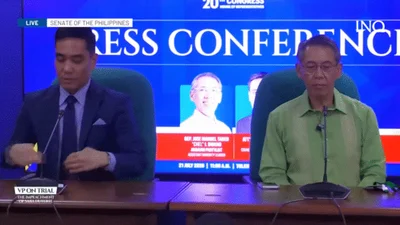
Lawyer Benjamin Tolosa Jr. and Rep. Chel Diokno gives a press conference on the impeachment trial of Vice President Sara Duterte on Tuesday, July 21, 2026. —Screenshot
MANILA, Philippines — The House prosecution, through Rep. Jose Manuel “Chel” Diokno and lawyer Benjamin “Jay” Tolosa Jr., denied the claim that Vice President Sara Duterte was impeached before any evidence was collected.
In a press conference, Diokno and Tolosa stressed that the House had already gathered sufficient evidence to approve the articles of impeachment, pointing out that the Senate impeachment trial would be the proper constitutional forum for the full presentation, examination, and testing of that evidence.
They were responding to a Facebook post made by Davao City Rep. Paolo “Pulong” Duterte questioning why the prosecution sought Senate subpoenas for the bank and Anti-Money Laundering Council (AMLC) records of Vice President Sara Z. Duterte and her husband, lawyer Manases “Mans” Carpio, after the articles of impeachment had already been transmitted.
Article continues after this advertisement
READ: Senate subpoena on Duterte finance docs a ‘victory’ for people
Proper context
In his post written in Bisaya, Paolo Duterte reportedly portrayed the sequence as impeachment followed only afterward by a search for supporting documents.
According to Diokno, that remark confused the House committee on justice’s probable-cause inquiry with the full trial conducted by the impeachment court.
“We know, and we talked about that issue yesterday, that they were calling it a fishing expedition. But let’s put what we’re talking about in the proper context,” Diokno said in Filipino
Citing the Constitution, the prosecutors explained that the House initiates impeachment cases and determines whether the allegations should proceed to trial. Then it will be the Senate that will try and decide on the articles of impeachment, with the prosecution and defense presenting their evidence before the senator-judges.
Article continues after this advertisement
“When the impeachment complaint reaches the committee on justice of the House of Representatives, the duty of the committee then was to determine if there was probable cause,” Diokno said.
“It’s not our job to dig up all the evidence and have a trial right away because it’s the Senate’s part to conduct a trial,” he went on.
Article continues after this advertisement
“As you will notice, only a portion of the evidence was what the committee on justice saw,” he added.
Still, he pointed out, the House proceedings included documentary submissions and testimony used to determine probable cause, and the subpoena for evidence was made when the case reached the Senate impeachment court.
READ: Senate needs VP financial docs to rule on unexplained wealth
Subpoena request granted
On Monday, the impeachment court granted the prosecution’s requests for subpoenas covering specified peso-denominated bank records, Anti-Money Laundering Council documents, and the Bureau of Internal Revenue records of the vice president and her husband, lawyer Manases Carpio.
The court did not, however, authorize an unrestricted examination. It excluded foreign-currency deposits and two corporations for which it found insufficient links.
The AMLC records will first undergo an in-camera review, while the BIR commissioner must make the appropriate return before the court determines what tax records may lawfully be produced.
Diokno said the sequence followed by the prosecution conformed to the Constitution rather than bypassing it.
“The process we followed was no different from that laid down in our Constitution. That’s why we believe, and we have repeatedly said, that there was no fishing expedition, no shortcut,” he said.
Like a criminal case
For his part, Tolosa compared the two-stage impeachment process to that followed in a criminal case, where prosecutors first determine probable cause before a full court trial.
He stressed that the comparison concerned the sequence of proceedings, not the evidentiary standard ultimately applicable to impeachment.
“As Cong. Chel said, before the House of Representatives, it’s determination of probable cause first. It’s the same in a criminal case before the prosecutor’s office — determination of probable cause first,” Tolosa said.
“It’s still not required and not expected for all the evidence to be presented. All the evidence will comte out during the trial itself,” he added.
According to the prosecutors, the subpoena ruling does not establish the truth of the allegations or make the requested records automatically admissible. The documents will still have to be produced, authenticated, and formally offered, and the defense may still object to their admission and explain the transactions recorded in them.
Your subscription could not be saved. Please try again.
Your subscription has been successful.
“Since the determination of probable cause was done in the House of Representatives, when it reaches the impeachment court, this is already a full-blown trial. This is the right venue to request, present, and examine all the evidence,” Tolosa said. /atm