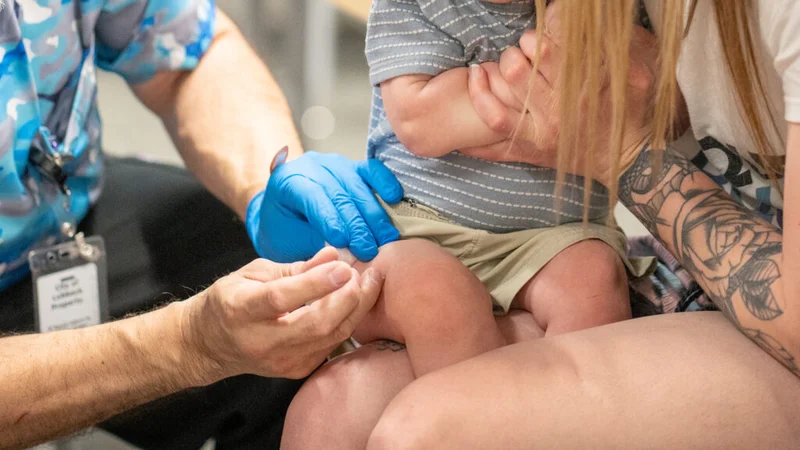
The White House fact sheet accompanying President Trump’s executive order, which he signed Monday, makes a claim worth examining: that most peer nations sustain high childhood vaccination rates through “public trust and education” rather than mandates.
Let’s use trust as the test.
The order reaffirms a childhood vaccination schedule already cut from 18 diseases to 11 and targets state mandates. Most problematically, the order asks uncertain parents to trust a government that is simultaneously revising established vaccine recommendations and presenting those changes as a new “gold standard.”
Consider who is actually listening. In a June poll, KFF asked whether respondents believed in four vaccine falsehoods. Eight percent of adults endorsed all four pieces of misinformation, while 55% rejected all four. But 31 percent fell into KFF’s “malleable middle” — people whose answers are inconsistent and more often “probably” than “definitely.” Among parents who reported skipping or delaying their children’s vaccines, 45% came from that malleable middle.
The malleable middle group demonstrates that many parents reporting delayed/skipped vaccination are not staunch vaccine opponents. They are uncertain and disproportionately receptive to false claims. KFF found that parents who skipped or delayed vaccines were more likely than parents who kept their children up to date to endorse each false claim tested — 57% versus 30% on the “MMR causes autism” claim.
Official signals matter most to this population. Someone still weighing the question is the person an official recommendation can move.
The executive order shows how.
The first example is the measles, mumps, and rubella vaccine. The order says MMR should eventually be replaced by separate measles, mumps and rubella shots once those products are domestically available, and directs the Department of Health and Human Services to develop single-vaccine options. Two doses of the combined MMR are about 97% effective against measles. So the government is directing the health system toward an alternative that is not licensed here — and asking parents to reconsider a familiar, highly effective combination vaccine in the process.
The second is the counting. The administration’s 18 comes from its own assessment, which counts 17 vaccine-preventable diseases plus RSV (RSV has a monoclonal antibody that is not a vaccine). But the assessment does not consider the timing or order of vaccines, nor the number of doses, except for HPV. Those are the questions the order addresses when it recommends splitting MMR and separating visits.
The administration is not wrong that some wealthy countries use narrower schedules. The harder question is whether injection counts tell the whole story. Denmark is the administration’s most prominent comparator. Its 11-injection figure, however, is achieved through combination vaccines, including one product covering five diseases and two doses of MMR given as a single shot. (There are other reasons why Denmark should not be a role model for the U.S., too.)
The vaccines no longer on the schedule are not banned; they move to high-risk and shared clinical decision-making categories. But risk-based recommendations work only as well as the system’s ability to identify risk, and that requires screening, follow-up and access to care. The United States is the only country in the administration’s comparison without universal health coverage. Vaccines for Children covers the shots, but not the visits that identify risk.
Hepatitis B (HBV) offers a cautionary example. In two population-based studies cited by the CDC, 61% to 66% of chronic HBV infections among U.S.-born Asian/Pacific Islander children occurred in children born to mothers who tested negative for HBV surface antigen. The CDC concluded that a substantial proportion of those infections would not have been prevented by a strategy targeting only infants born to mothers who tested positive. Risk is not always visible when a vaccination decision has to be made.
Then there is friction. The order also recommends that, to the maximum extent feasible, all childhood vaccines should be administered at separate medical visits. In practice, this means added appointments with busy pediatricians, plus transportation costs, unpaid time off, and childcare. Families with the least scheduling control absorb the most burden.
Every additional appointment is another opportunity for a dose to be delayed or missed. What looks like flexibility on paper will likely become attrition in practice.
This would matter less if there were room to spare. There is not. Kindergarten MMR coverage was 92.5% in the 2024–25 school year, below the 95% generally needed for community protection against measles, leaving roughly 286,000 kindergartners without documented completion of the series.
As of Aug. 6, the CDC had recorded 2,465 confirmed measles cases in 2026 — already more than in all of 2025, itself the country’s largest annual total since 1991. Ninety-three percent of this year’s patients were unvaccinated or of unknown vaccination status. In November, we will learn whether the United States still officially holds the measles elimination status it has maintained since 2000.
The order did not start this outbreak, but it enters a system with little margin left. A peer-reviewed analysis has modeled a 1% annual decline in MMR coverage sustained over five years as producing, by 2030, a central estimate of 17,000 cases, 4,100 hospitalizations, and 36 deaths in the U.S. in a single year.
Though trust is falling, the public has not abandoned vaccines. Eighty-three percent of American adults called the MMR vaccine safe in late 2025, down from 88% in 2022. Last fall eight in 10 parents surveyed supported current state laws requiring children to be vaccinated against measles and polio to attend public schools, with exceptions.
These are the laws the order asks states to reconsider. Trust remains an asset.
The administration is right that trust matters more than compulsion alone. But trust is not created by making established recommendations look provisional, adding barriers to care, or asking parents to navigate conflicting signals. If trust is the standard, the policy should be judged by whether it strengthens confidence in sound recommendations — not simply whether it removes mandates.
The administration has made trust the load-bearing wall of its vaccine policy. It is dismantling the thing it is standing on.
Katrine Wallace is an epidemiologist, researcher, and a professor at University of Illinois Chicago School of Public Health. She also debunks misinformation and educates about disease outbreaks on her popular social accounts as “Dr Kat, Epidemiologist.”