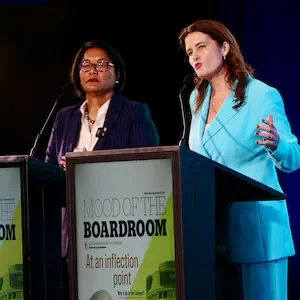
Finance Minister Nicola Willis and Labour finance spokeswoman Barbara Edmonds at last year's Mood of the Boardroom, where superannuation was a hot topic. Photo / Dean Purcell
Every election cycle brings fresh debate about KiwiSaver, New Zealand Superannuation, healthcare funding, financial advice and the cost of living.
The problem is that we tend to discuss each issue separately. Retirement savings are debated as retirement policy. Healthcare is debated as health policy. Financial advice is treated as afinancial services issue. Insurance sits somewhere else again.
Yet for most New Zealanders these are not separate challenges. They are parts of the same financial journey.
The real question is not how we improve one component in isolation. It is how we build a system that works together.
That is why one of the most interesting aspects of the Prosperity Agenda recently released by the Financial Services Council (FSC) is not any individual recommendation, but the broader philosophy behind it: the idea that retirement savings, financial advice, insurance, healthcare and investment should be viewed as a connected ecosystem rather than a series of unrelated policies.
From products to people
Historically, financial services have been organised around products. There is a KiwiSaver provider, an insurance provider, a mortgage provider, an investment manager and perhaps a financial adviser helping clients navigate between them.
But people do not live their lives in product categories.
A 25-year-old joining KiwiSaver, a 40-year-old paying off a mortgage and a 70-year-old drawing retirement income are all facing different decisions, yet they are part of the same financial journey. The challenge for policymakers and financial institutions alike is creating systems that evolve with people through those different life stages, rather than forcing them to repeatedly navigate disconnected products, providers and processes.
Viewed through that lens, retirement savings become just one component of a much larger financial wellbeing framework.
New Zealand has made significant progress through KiwiSaver. More than 3.4 million New Zealanders are now members, with funds under management exceeding $147 billion. This is while the wider financial services sector manages more than $340b of savings and investments, and contributes more than $16b to GDP.
Yet many people are still not saving enough to achieve the retirement lifestyle they hope for.
The FSC’s manifesto proposes measures such as greater participation, higher contribution rates over time and targeted support for lower-income workers. Among the recommendations are automatic enrolment for workers who are not currently in KiwiSaver, a gradual increase in combined employer and employee contribution rates to 12% by 2032, and support mechanisms designed to help lower-income workers participate in long-term saving.
The manifesto also proposes retaining access to KiwiSaver at age 65 regardless of any future changes to eligibility for New Zealand Superannuation. Each proposal can be debated on its merits, but collectively they reflect a desire to increase participation, strengthen retirement savings and provide greater certainty for savers.
It also outlines an ambition of reaching $1 trillion invested in retirement savings by 2040. To put that into perspective, that would represent a retirement savings pool roughly seven times larger than KiwiSaver assets today.
Whether every proposal eventually proceeds or not, the direction of travel is clear. KiwiSaver has evolved from a retirement savings initiative into one of New Zealand’s most important pools of long-term capital. The question is no longer simply how many people are in the system but what role that growing capital base can play in retirement outcomes, investment and economic growth.
Longer life expectancy means retirement may last 25 to 30 years for many New Zealanders, placing greater importance on building adequate savings balances during working life.
The debate therefore should not simply focus on how much people have saved today. It should focus on whether the retirement system is capable of producing financially resilient retirees 20 years from now.
Some of the more ambitious proposals also look further ahead. One recommendation is automatic enrolment into KiwiSaver at birth, coupled with an initial government contribution. While such ideas would require careful consideration, they reflect a broader willingness to think about retirement saving as a lifelong journey rather than something that begins when people enter the workforce.
For nearly two decades the retirement conversation has focused primarily on accumulation. How much should we contribute? What fund should we choose? How aggressively should we invest?
These are important questions, but they largely deal with the first half of retirement planning.
The second half begins when people stop receiving employment income and start relying on accumulated savings to fund their lifestyle. New Zealand has invested significant effort helping people build retirement balances. We have spent far less time helping them convert those balances into sustainable retirement income.
The FSC identifies retirement income and decumulation as a major policy gap and calls for a formal framework to help New Zealanders convert accumulated retirement savings into sustainable income streams. This may ultimately prove one of the most important recommendations in the manifesto. New Zealand has spent nearly two decades building a retirement savings system. The next challenge is ensuring people can convert those accumulated balances into sustainable and confident retirement income.
That issue is likely to become increasingly important as KiwiSaver balances grow and larger numbers of members approach retirement. The future challenge is no longer simply helping people accumulate wealth; it is helping them use it effectively. Retirement planning, expenditure forecasting, income sustainability and financial resilience in later life may at some point become just as important as contribution rates and fund selection.
One of the strongest themes running through the manifesto is improving access to financial advice and making financial capability a lifelong priority.
That matters because financial decisions are becoming increasingly complex. People are no longer making a single retirement decision at age 65. They are navigating investment choices, mortgages, insurance requirements, healthcare costs, changing employment patterns and evolving retirement expectations throughout their lives.
If retirement savings, insurance and investment are increasingly interconnected, then access to quality advice becomes more important, not less. Improving retirement outcomes is not simply about getting people into KiwiSaver. It is also about helping them make better decisions at every stage of their financial journey.
Good advice helps connect those decisions.
We often think about infrastructure as roads, airports, electricity networks and broadband connections. Yet financial advice increasingly performs a similar role in the economy. It helps households make better decisions about saving, investing, borrowing, insuring and planning for retirement. As choices become more complex, accessible and scalable advice may become one of the most important pieces of social and economic infrastructure New Zealand has.
The more complicated the financial landscape becomes, the more important it becomes that advice is affordable, accessible and available throughout a person’s life, not just when major financial events occur.
Savings and prosperity
There is also a broader economic dimension.
One of New Zealand’s long-standing economic challenges has been relatively low levels of national saving and comparatively shallow capital markets. When domestic savings pools are small, businesses, infrastructure projects and growth initiatives often need to rely more heavily on offshore capital to fund investment and expansion.
The FSC argues that larger pools of long-term retirement savings could help address that challenge by supporting deeper capital markets and greater investment in businesses, infrastructure and economic growth.
This matters because retirement savings do more than support individual retirees. They also help create the domestic investment capital needed to fund future productivity growth (where New Zealand also lags). Countries with deeper savings pools typically have greater capacity to invest in innovation, infrastructure and business expansion.
In that sense, retirement policy is not simply a household issue. It is economic policy. The strength of New Zealand’s future retirement system will influence not only retirement outcomes, but also the country’s ability to finance growth and invest in its future.
The bigger opportunity
The most interesting aspect of the current debate is that the boundaries between traditional financial products are becoming less relevant. Retirement planning increasingly overlaps with healthcare planning. Investment decisions increasingly overlap with financial advice. Insurance forms part of broader household resilience, and technology is making it easier to bring these elements together into integrated planning tools, advice platforms and customer experiences.
That matters because the next phase of New Zealand’s financial evolution is unlikely to be about individual products.
The KiwiSaver member of the future will not simply need a retirement savings account. They will need advice, retirement projections, investment solutions, healthcare planning, insurance protection and eventually retirement income support. The organisations that succeed will be those that stop thinking in product silos and start thinking about lifetime financial outcomes.
Too often New Zealand debates retirement, healthcare and financial resilience as though they are separate challenges. They are not. They are different expressions of the same long-term question: how do we help people remain financially secure throughout their lives?
The sooner we start thinking about them as one connected system, the better the outcomes are likely to be for households, retirees and the wider economy.
The first 20 years of KiwiSaver were about helping New Zealanders save. The next 20 years may be about helping them navigate everything that sits around those savings.
Generate is a New Zealand-owned KiwiSaver and Managed Fund provider managing over $10 billion on behalf of more than 195,000 New Zealanders.
This article is intended for general information only and should not be considered financial advice. The views expressed are those of the author. All investments carry risk, and past performance is not indicative of future results.
To see Generate’s Financial Advice Provider Disclosure Statement or Product Disclosure Statement, go to www.generatewealth.co.nz/advertising-disclosures/. The issuer is Generate Investment Management Limited.