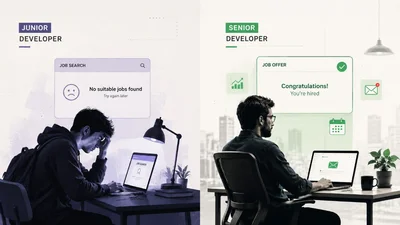
Learning to code was once considered one of the safest bets for a stable, high-paying career in tech. While that remains true for many experienced engineers, the equation is beginning to change for fresh graduates and junior developers. According to a new report from the Stanford Digital Economy Lab, the ongoing AI boom is creating a growing divide between junior and senior software professionals. While experienced software engineers are adapting well to the AI transition, it is becoming increasingly difficult for younger developers to land their first job and build a career.
The study, titled AI Economic Indicators, finds that early-career workers in AI-exposed occupations are experiencing noticeably weaker employment trends than more experienced professionals. Based on ADP payroll data covering millions of workers across a five-year sample of US firms, the researchers say employment in AI-exposed occupations has weakened significantly for workers aged 22 to 25 since ChatGPT arrived in late 2022. Meanwhile, older and more experienced developers have remained far more resilient during this AI-driven shift.
According to the report, employment for young workers in AI-exposed jobs is falling by around 3.8 per cent each year, while jobs less affected by AI are continuing to grow. Among experienced professionals, however, the difference is much smaller and almost disappears in senior roles.
The report identifies software developers as one of the professions where young workers are feeling the biggest impact. It says early-career software developers, along with customer service workers, have seen some of the sharpest declines in employment. Meanwhile, occupations with lower AI exposure continue to create more opportunities for younger workers.
The findings mirror what many developers are already seeing on the ground. In a recent Bloomberg Businessweek report, engineers described how their work has fundamentally changed over the past year. Instead of spending hours writing code line by line, many said they now spend much of their time directing AI assistants such as Anthropic's Claude Code and OpenAI's Codex, asking them to generate code, fix bugs, translate between programming languages and even test software. Some engineers also told Bloomberg they have stopped writing code manually altogether because AI now handles much of the routine work.
That shift is also changing what companies expect from software engineers. Rather than hiring large teams of junior developers to write repetitive code, employers are increasingly looking for experienced engineers who can design software systems, review AI-generated code and manage multiple AI agents at once. Universities are also beginning to adapt. Carnegie Mellon University, for example, is redesigning parts of its computer science curriculum to place greater emphasis on software fundamentals and AI coding tools.
The Stanford researchers also say how companies use AI matters. Their analysis finds that AI is less likely to affect jobs when it is used to help people with their work. But when companies use AI to automate tasks that people used to do, younger workers are more likely to lose out.
- Ends
Published By:
Divya Bhati
Published On:
Jul 21, 2026 15:12 IST