- READ MORE: Hot days could have four extra hours of heat by 2100, study warns
- See more Daily Mail on Google - save us as a Preferred Source
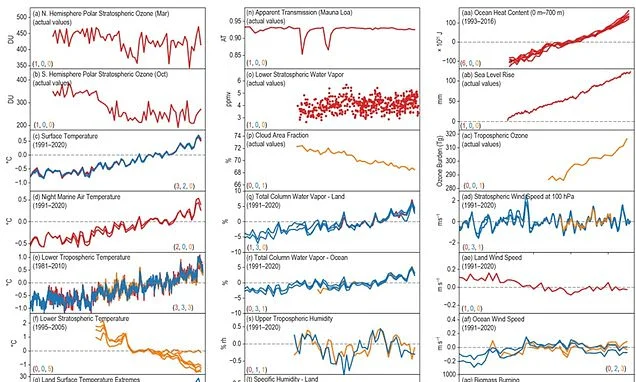
A damning report has confirmed greenhouse gas concentrations, global sea level and ocean heat all reached record highs last year.
The international annual review, published by the American Meteorological Society (AMS), provides the most comprehensive updates on Earth's climate.
Data is collected from monitoring stations and instruments located on land, water, ice and space, with contributions from 625 scientists in 60 countries.
And it paints a stark image of the dismal state of the world's climate.
The data shows the amount of harmful greenhouse gases including methane and carbon dioxide reached record levels, while fossil fuel emissions reached a new high.
Our oceans are steadily warming, with the majority experiencing at least one marine heatwave, while sea levels also reached unprecedented levels thanks to climate change.
Despite the absence of an El Niño event, which can drive global temperatures higher, the planet remained exceptionally hot.
And with a 'Super El Niño' event imminent, it could mean that this year and next get even worse.
The report provides the most comprehensive update on Earth's climate indicators, notable weather events and other data collected by environmental monitoring stations and instruments located on land, water and ice, as well as in space
Our oceans are steadily warming, with the majority experiencing at least one marine heatwave, while sea levels also reached unprecedented levels thanks to climate change
The paper reveals that 2025 was among the three warmest years in the instrumental record, which goes back 175 years.
'The extreme warmth extended to the polar regions, with Antarctica experiencing its warmest year in the record that began in 1979, and the Arctic experiencing its second–warmest year since the start of its record in 1900,' it adds.
All five major global temperature datasets agree that the past 11 years, from 2015 to 2025, were the 11 warmest ever recorded.
Europe experienced its hottest year ever, while Russia, China, South Korea and Argentina each recorded their second–warmest year.
The amount of carbon dioxide in the atmosphere also reached a new high, with the global average hitting 425.6 parts per million in 2025 – around 53 per cent higher than before the Industrial Revolution.
Methane and nitrous oxide, two other major greenhouse gases, also reached record concentrations.
Meanwhile, fossil fuel emissions hit an estimated record of 10.3 petagrams of carbon, more than three times the level recorded in the 1960s.
Greenhouse gases are harmful because they trap too much heat in the air – adding fuel to an already warming planet.
Despite the absence of an El Niño event, which can drive global temperatures higher, our planet and its oceans remained exceptionally hot
These graphs show how sea ice levels in both the Arctic and Antarctic have plummeted thanks to global warming
Much of the resulting excess heat is being absorbed by the oceans, which have taken up almost 90 per cent of the additional energy trapped in the Earth's system.
Global ocean heat, measured from the surface down to 2,000 metres (6,500ft), consequently reached another record high in 2025.
Around 87 per cent of the world's ocean surface experienced at least one marine heatwave during the year, compared with just 26 per cent experiencing a marine cold spell.
Sea surface temperatures were the third–highest in the 172–year record, despite cool or weak La Niña–like conditions in the Pacific.
Global sea levels also reached a record high for the 14th consecutive year, standing around 111 millimetres above the 1993 average when satellite measurements began.
Warming oceans have contributed around 1.6 millimetres per year to sea–level rise since 2005, while melting glaciers and ice sheets have added a further two millimetres per year on average.
The Arctic is also losing its oldest sea ice, with ice more than four years old almost disappearing compared with the vast areas covered by such ice in the 1980s.
Glaciers around the world have now lost ice for 38 consecutive years, with the equivalent of more than a metre of water lost on average for the fourth year running.
The data shows the amount of harmful greenhouse gases including carbon dioxide, methane and nitrous dioxide reached record levels
The report also recorded 97 named tropical cyclones during the 2025 storm seasons, above the 1991–2020 average of 87, underlining the scale of the extreme weather occurring against this backdrop of a rapidly changing climate.
Robert Dunn, from the UK's Met Office, was one of the report authors.
Commenting on its findings, he said: 'At the time of writing, halfway through 2026, there are indications of an extremely strong El Niño forming.
'The climate in 2025, being only slightly 'below' 2023 and 2024, has potentially set some concerning precursor conditions for 2026.'