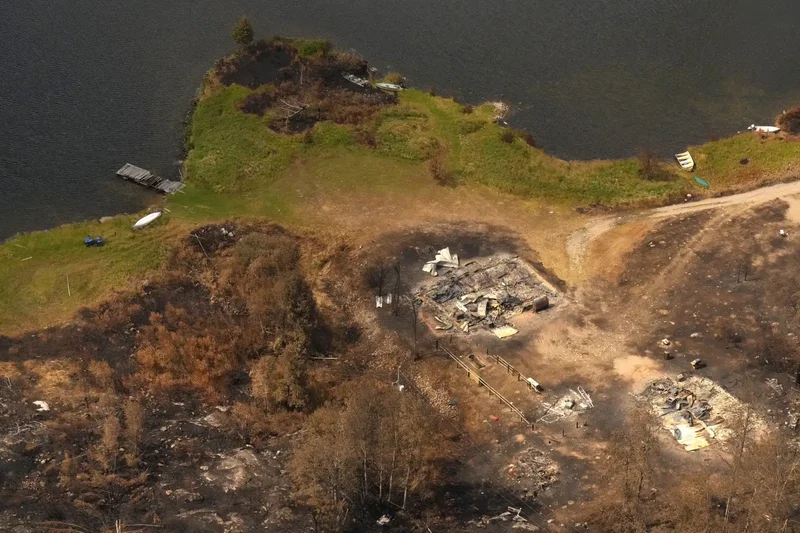
Ontario officials say the wildfire season and response is trending in the right direction, but the province is not yet in the clear.
“While we are seeing fewer fire starts, our work does not end here,” Mike Harris, minister of natural resources, said in an update Tuesday.
There are currently 152 active fires across Ontario, with 12 considered “out of control,” according to provincial data. Eighty-four additional fires have been put out in the past week, Harris said.
In terms of hectares burned, this is Ontario’s worst wildfire season on record, data shows, with more than 700,000 hectares scorched.
The Thunder Bay 36 fire is the largest on record in Ontario, burning at 350,000 hectares.
But Harris said the number of fire starts this year isn’t out of the ordinary, but the fact that many fires started in a short period of time was a huge challenge.
“What really kind of got us behind, if you will, is that storm that came through now about four weeks ago, almost to the day, and torched off somewhere in the neighbourhood about 30 fires that grew very, very quickly,” he said.
Crews from Manitoba, New Brunswick, P.E.I., Alberta, Quebec, Nova Scotia and Newfoundland, as well as aircraft from Yukon and the federal government, have aided in fire suppression efforts. Recently, crews from Mexico have also arrived in northern Ontario.
Get breaking National news
But Harris said some of these provincial crews will begin to return home, or will now head to B.C. to aid in wildfire efforts there.
“While we’re not in the clear here in Ontario yet, we are confident that we have the crews and the aircraft that we need to get the job done,” he said.
Part of the government’s response is now shifting to repatriating people who have had to flee their homes.
As of Tuesday, 14 communities have been evacuated, Jill Dunlop, minister of emergency preparedness, said. Six of those communities have returned home and one community is in the process of returning home.
More than 1,100 evacuees remain in host communities across the province.
- Animal sanctuary among evacuees of Summerland wildfire
- Summerland wildfire: Planning for re-entry already underway, but now is not the time
- Videos capture aftermath of Summerland fire in Faulder, residents say it was ‘eerie’
- Cause of Summerland wildfire under investigation as RCMP examine reports of suspicious activity
Greg Rickford, minister of northern development and Indigenous affairs, said the process of repatriation can be very “unsettling” for some as they return to communities that have been torched by wildfires.
“It’s incredibly stressful and we remain engaged on the ground through texts, through phone calls and the likes to make sure that details are there as communities come back,” he said.
But there are also a number of self-evacuees, many from communities that saw fires approaching and say alerts did not come fast enough.
Now First Nations across Ontario have called for a public inquiry into Ontario’s wildfire response.
“Let me be clear: the Ontario Government has completely and utterly failed our communities. Every step of this response has been inadequate. The warnings, the coordination, the evacuations, all of it,” Nishnawbe Aski Nation Grand Chief Alvin Fiddler said in a media statement.
The calls have been backed by the Fire Chiefs of Ontario and the Ontario Public Service Employees Union.
Harris said the province acted as quickly as it could to tend to impacted communities.
“Obviously we try to give as much warning as we possibly can. And I think that’s one of the things that we really want to press upon communities. If you see a fire starting and you’re able to evacuate, you should do it. You don’t necessarily have to wait for the NNR or the government to come,” he said.
Harris reiterated that an internal review occurs at the end of every wildfire season but made no commitment to a public inquiry.