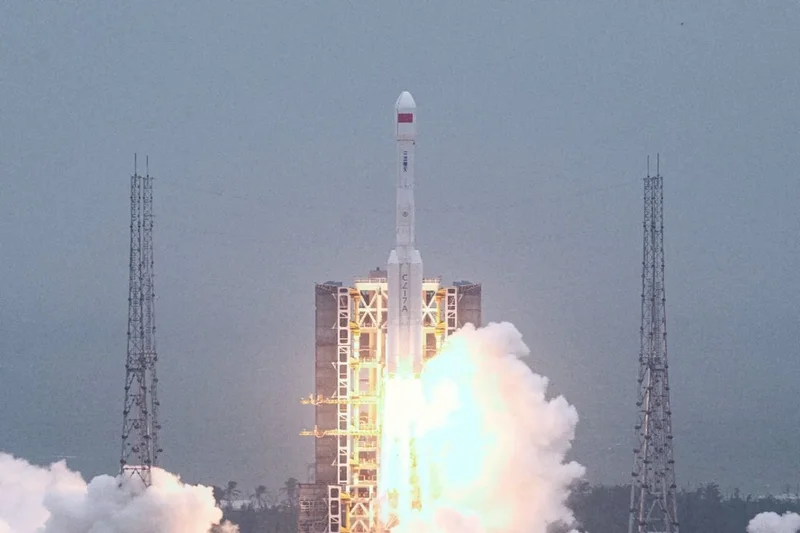
A Chinese rocket went up in flames less than two minutes after launch, triggering a huge explosion in the skies above the island of Hainan.
China’s Long March 7A rocket launched on Monday from the Wenchang Space Launch Site. Around 85 seconds after liftoff, the rocket erupted in a massive fireball that left a thick trail of smoke and debris across the sky.
Waking up to see the loss of a Long March 7A. Really unexpected. pic.twitter.com/XnU8WveWYS
— CNSPACE (@CNSpaceflight) August 10, 2026
The incident was captured on video and shared online. Chinese state media later confirmed that the rocket experienced an unidentified anomaly during flight and that an investigation into the failure was underway, the Associated Press reported.
Unusual failure
Monday’s explosion marked the Long March 7A’s first reported failure since the rocket’s debut more than six years ago. On March 16, 2020, China’s medium-lift vehicle experienced an engine malfunction shortly after stage separation and its inaugural flight ended in failure.
A year later, Long March 7A sent a classified, experimental payload into geosynchronous transfer orbit for its first successful mission. Since then, the rocket has completed more than a dozen missions without a hitch. The recent failure ended that long-running lucky streak.
The Long March 7A is capable of delivering up to 7 metric tons of payload to geosynchronous transfer orbit, a temporary, highly elliptical path satellites take to reach a geostationary orbit high above the Earth. This makes the Long March 7A crucial for China’s specialized, high-orbit satellite missions. The rocket can also be used for deep space missions and to send spacecraft to the Moon, according to the China Academy of Launch Vehicle Technology.
Rocket, interrupted
During its most recent launch, the rocket was carrying the ChinaSat 4B satellite, a geostationary communications satellite designed to provide internet and broadcasting services to users.
The explosion not only led to the loss of the payload but also reportedly delayed the long-anticipated launch of another rocket. Zhuque-3, developed by Chinese startup LandSpace, was scheduled for liftoff on Tuesday from the Jiuquan satellite launching station but its mission was pushed back, according to CNN.
The partially reusable rocket is crucial to China’s efforts to compete with industry giants like SpaceX. Earlier in July, a Long March 10B launched on its maiden flight and its first stage was caught by a net-like grid system at sea, marking China’s first recovery of a rocket booster.
China has been making significant progress with its rocket industry, but as SpaceX CEO Elon Musk points out, “Rockets are insanely hard,” he wrote on X in response to the Long March 7A failure.