What to know about the Iran war today:
- The U.S. and Iran are close to "some sort of an arrangement," Pakistan's Defense Minister Khawaja Asif told Bloomberg in Islamabad on Tuesday. "Things are shaping up again in favor of a peace arrangement or a deal," he said.
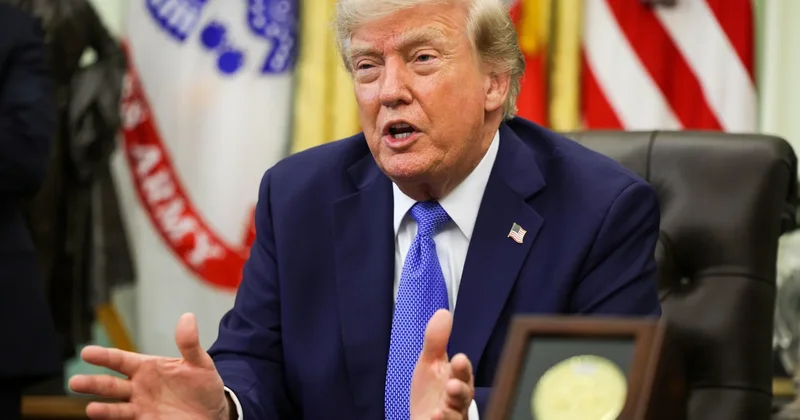
- President Trump told reporters Monday the U.S. controls the Strait of Hormuz and insisted Iran's economy is suffering due to the war. Mr. Trump also for the damage caused by the conflict.
- The president secretly switched planes for his trip from Turkey at the end of last month's NATO summit after U.S. intelligence detected a , CBS News has learned.
Iran rejects Trump's comments demanding compensation for war damage
Iran is rejecting comments by President Trump, saying that since Iran is seeking compensation as part of any peace talks, he'll demand the same.
The Trump administration is hoping that months of bombing have pushed Iran's economy to a breaking point that will force its leadership to cave to demands to end its nuclear program and fully reopen the Strait of Hormuz to oil and natural gas tankers.
The president on Monday said that since Iran is seeking compensation as part of any peace talks, he now intends to demand the same for the U.S. side. It's part of a larger pivot this weekend by Trump to argue that Iran is now on the cusp of financially collapsing, even though it has already endured decades of financial sanctions, which are often a longer-term strategy rather than an immediate tool of warfare that can halt a conflict.
The shift comes as U.S. stockpiles of key weapons have dwindled and as stop-start talks seem again to have stalled. But Trump insists the pressure can lead to a breakthrough.
6 killed in alleged Houthi strike on ship in Red Sea, Yemen coast guard says
At least six people were killed in alleged strikes by Iran-backed Houthi rebels on a cargo vessel Tuesday near the Bab al-Mandeb Strait, off Yemen's southern coast, the country's coast guard said Tuesday. The latest death toll was slightly higher than one given earlier in the day by Yemen's Saudi-backed transport ministry, which said at least four had been killed.
The strikes are the latest in a number of deadly attacks against shipping in the entrance to the Red Sea since the Houthis announced a naval blockade of Saudi Arabia last month.
The coast guard from Yemen's internationally recognized government said four sailors aboard the cargo vessel — identified as the Tihamah — were among the dead along with two members of the forces deployed during a rescue mission to evacuate the ship.
The initial salvo targeting the ship "caused a fire to break out aboard the vessel and inflicted extensive damage, in addition to causing deaths and injuries among its crew, including three Pakistani nationals and one Indonesian national killed," the coast guard said in a statement.
A second strike targeted the vessel as rescue workers carried out a mission to evacuate the ship.
"The attack struck the site of the rescue operation and resulted in deaths and injuries among the forces participating in the response operation," the coast guard added, saying 10 people were injured over the course of the strikes.
The statement came hours after the Yemen government's transport ministry accused the Houthis of launching the strikes that hit the vessel, which arrived in Mokhata, Yemen, on Aug. 8 and didn't broadcast a signal until the night of Aug. 10, according to maritime tracking records reviewed by CBS News.
CBS/AFP
Iran's supreme leader merges two main pillars of country's military command
Iran's Supreme Leader Ayatollah Mojtaba Khamenei ordered on Monday the merger of the Central Khatam al-Anbiya Headquarters and the General Staff of the Armed Forces, bringing together two main pillars of the country's defense command structure.
In his decree appointing Maj. Gen. Abdollahi as chief of staff of the armed forces, Khamenei set the merger as a key objective "expected to be fully realized."
Khatam al-Anbiya Headquarters was established in February 1984 to create a joint command between the Army and the Islamic Revolutionary Guard Corps (IRGC).
The General Command of the Armed Forces was established in 1989 to provide overall coordination of the armed forces.
The IRGC's Telegram channel reported Tuesday that the need to merge the two structures became more prominent following the deaths of Maj. Gen. Mohammad Bagheri, the chief of general staff, and Maj. Gens. Rashid and Shadmani, commanders of Khatam al-Anbiya Headquarters, during the 12-day war.
The report added that the objective is to reduce the distance between the "staff" and the "battlefield."
"In new wars, which involve the air, missile, drone, cyber and intelligence domains, speed of decision-making and coordination among the sectors is vital," it said.
The merger has been described within Iran as one of the most significant changes to the command structure of the country's armed forces since the end of the eight-year Iran-Iraq War.
Iran has "astonished the whole world" in the war against the U.S., says foreign minister
Iranian Foreign Minister Abbas Araghchi told reporters on Tuesday that his country had "astonished the whole world" in the war against the United States and Israel, proving "that it is a tough and invincible power."
"Our armed forces made tremendous sacrifices and managed to incapacitate and defeat what was ostensibly the largest army in the world. This is not a slogan; it is a reality that the entire world is acknowledging," Araghchi said.
"In the recent war, it was the Islamic Republic of Iran that proved itself to the world and demonstrated that it is a resilient and invincible power," he said. "I have heard this repeatedly from foreign ministers and officials from other countries: 'You Iranians have achieved something extraordinary.' Those are their exact words. You astonished the entire world."
Iran has refused to back down on demands that the U.S. end its blockade of Iranian ports, lift sanctions on the Islamic Republic and fulfill other conditions before Tehran will consider reopening the Strait of Hormuz.
Iran effectively closed the strait after Israel and the U.S. attacked the country on Feb. 28. Attacks on the key waterway — through which roughly one-fifth of the world's traded oil supplies passed before the war — and uncertainty around its future have kept energy prices a major focus of U.S. politics ahead of November's midterm elections.
CBS/AP
U.S. stocks mixed as oil prices ease
Wall Street stocks were mixed early Tuesday as Treasury yields and oil prices eased ahead of key U.S. inflation data.
About 20 minutes into trading, the Dow Jones Industrial Average was up 0.4% at 54,193.86.
The broad-based S&P 500 was unchanged at 7,752.26, while the tech-rich Nasdaq Composite Index declined 0.3% to 26,523.91.
Major U.S. indices dipped Monday as oil prices shot higher on escalating tensions between the U.S. and Iran over efforts to reopen the Strait of Hormuz.
But oil prices edged lower on Tuesday.
This week's inflation reports will serve as inputs to the Federal Reserve on possible interest rate changes at meetings in September and later in the year.
Pakistani interior minister meets Iranian foreign minister in Tehran
Pakistan's Interior Minister Syed Mohsin Raza Naqvi met with Iranian Foreign Minister Abbas Araghchi in Tehran on Tuesday afternoon for talks.
He also spoke to Iran's Interior Minister Eskandar Momeni, state broadcaster IRIB reported.
Pakistan's defense minister told Bloomberg in Islamabad on Tuesday that the U.S. and Iran are close to "some sort of an arrangement."
"Things are shaping up again in favor of a peace arrangement or a deal," he said. "The signals in the last two three days are that we are close to some sort of an arrangement."
4 killed in Houthi attack on ship in Bab el-Mandeb, says Yemen's transport ministry
A Houthi missile attack on a commercial vessel in the Bab el-Mandeb strait Tuesday killed four crew members and wounded four others, according to Yemen's Saudi-backed transport ministry.
The ship, the Tihamah, which was carrying food supplies, was struck by three ballistic missiles, causing a fire and damage to the vessel, the ministry said. Three Pakistanis and one Indonesian were killed. One member of the rescue team was also wounded, according to the ministry.
The ministry said another missile was fired at the vessel as rescue teams attempted to reach the crew and evacuate the wounded.
Maritime tracking records reviewed by CBS News show the vessel arrived in Mokhata, Yemen, on Aug. 8 and didn't broadcast a signal until the night of Aug. 10.
Saudi drone targets Yemen's Saada governorate, Houthis say
A Saudi drone has targeted Yemen's Saada governorate, the Iranian-backed Houthis said Tuesday.
The Houthi media center said in a post on X that a Saudi drone dropped two shells on the Ghor al-Mashwat area in Yemen's northeastern Saada governorate, which is under Houthi control.
No further details were given.
Pakistan says U.S. and Iran are close to "some sort of an arrangement"
Pakistan's Defense Minister Khawaja Asif told Bloomberg news in Islamabad on Tuesday that the U.S. and Iran are close to "some sort of an arrangement."
"Things are shaping up again in favor of a peace arrangement or a deal," he said. "The signals in the last two three days are that we are close to some sort of an arrangement."
Pakistan's interior minister arrives in Tehran for talks, says Iranian media
Pakistan's Interior Minister Mohsin Raza Naqvi has arrived in Tehran for talks with Iranian officials, Iran's semi-official MEHR news agency reported Tuesday.
Pakistan has been mediating between the U.S. and Iran throughout the conflict, alongside Oman and Qatar, to try to bring the two sides to some sort of lasting peace agreement.
Casualties reported after ship struck by "unknown projectile" in Red Sea, U.K. maritime agency says
A cargo vessel was hit by a projectile near the Bab el-Mandeb Strait off the coast of southern Yemen, causing an unspecified number of casualties, the United Kingdom Maritime Trade Operations (UKMTO) reported on Tuesday.
"It has been reported that a cargo vessel in the southern Red Sea has been hit by an unknown projectile resulting in casualties," the British military agency said in a statement.
Separately, Greek maritime firm Marisks issued a security alert Tuesday saying a Saudi-owned commercial vessel had "reportedly been struck by a missile" while transiting the Bab el-Mandeb.
"Initial reports indicate three crew fatalities – two Pakistani and one Indonesian national," wrote Marisks, without specifying where the reports were coming from.
It is not clear whether the incidents that UKMTO and Marisks issued alerts about were the same.
CBS/AFP
Lebanon says Israeli strike on south wounds two, damages ambulance
An Israeli attack on southern Lebanon wounded two people on Tuesday and damaged an ambulance, the Lebanese health ministry said, condemning the "continued targeting" of rescuers.
Lebanon's state-run National News Agency said the strike targeted a vehicle in the southern city of Nabatieh, with the health ministry reporting two wounded.
The ministry said the Israeli military struck again when rescuers from the Risala Scouts Association, linked to the Hezbollah-allied Amal movement, came to the scene, damaging the ambulance.
"The ministry reiterates its condemnation of the enemy's continued targeting of rescue teams, which constitutes an unacceptable violation of international humanitarian law and all international norms," the health ministry said.
Lebanon's civil defence meanwhile said that its personnel were targeted by an Israeli drone strike while they were trying to extinguish a bushfire, also in the Nabatieh area.
No one was wounded, but the incident forced them to leave.
Hezbollah drew Lebanon into the Middle East war in March with rocket fire at Israel in support of its backer Iran.
Israel responded with heavy air strikes and a ground invasion that Lebanon says have killed more than 4,300 people.
While violence has significantly decreased since the signing of a U.S.-Iran memorandum of understanding in June and a framework agreement between Lebanon and Israel days later, Beirut still reports intermittent Israeli strikes and demolitions.
The Israel-Lebanon deal involves the disarmament of Hezbollah, a gradual withdrawal of Israeli forces from south Lebanon and the deployment of the Lebanese army to the region.
Hezbollah rejects the deal and refuses to disarm. It has called negotiations with Israel "appeasement."
CBS/AFP
Iranian-backed Houthi rebels renew attacks on key port city
Iranian-backed Houthi rebels renewed their attacks Tuesday on government-controlled areas in Yemen as ongoing violence threatened to reignite the country's civil war and raised fears over new threats to shipping lanes.
Yemen's military said the rebels targeted both the port city of Mokha on the Red Sea coast and the central province of Marib with missiles and drones, but did not provide further details.
The Houthis struck Marib and the eastern province of Hadramout last week, killing dozens of government troops and civilians. They hit Mokha with missiles and drones over the weekend and killed at least seven people, including three troops, according to the Yemeni military.
Mokha is a main port under Yemen's internationally recognized government and has been renovated to handle shipping to avoid the Houthi-held port of Hodeida.
The strikes came as part of a recent escalation by the Houthis against government forces in Yemen and oil facilities in neighboring Saudi Arabia, which supports the internationally recognized Yemeni government, and the kingdom's shipping in the Red Sea.
With the Strait of Hormuz effectively shut down by Iran, there has been a renewed focus on the Red Sea and Bab el-Mandeb Strait at Yemen's southern tip, which is an alternate route for Saudi Arabia to ship its oil to open oceans.
The Houthi attacks could reignite Yemen's civil war after a four-year hiatus following a 2022 truce, and open a new front in the Middle East war.
CBS/AP
Oil prices jump further as hopes for Hormuz deal fade
Oil prices extended a strong rally Tuesday as hopes for a reopening of the Strait of Hormuz faded, fanning fresh inflation fears and ramping up bets on at least one U.S. interest rate hike this year.
Crude has surged more than 10% over the past week, with the United States and Iran appearing no closer to a deal on the crucial waterway despite upbeat comments from the White House earlier in the month.
In the latest blow to a possible ceasefire, President Trump said Monday he would for damage caused by the conflict as part of any peace negotiations, citing attacks and killings stretching back decades allegedly backed or perpetrated by Tehran.
On Monday, both main crude contracts jumped around 5%. They rose more than 2% on Tuesday, with Brent edging back toward $90 a barrel.
"In the absence of any positive headlines on negotiations to reopen the strait, pressure on oil prices has been upward," wrote Jason Wong at Bank of New Zealand.
And Stephen Innes, global strategist at Quintex Intel, said: "In effect, both sides are trying to weaponize the oil barrel without firing another shot. Washington is trying to choke Iran's ability to get its crude out while Tehran is squeezing the artery through which everybody else's crude gets through.
"It is quite the game of chicken."
The prospect of oil prices remaining elevated for the time being has revived concerns over inflation and boosted the chances of interest rate increases in the U.S.
CBS/AFP
Trump secretly switched to different plane in Turkey amid Iran missile threat
Shortly before Air Force One took off from Turkey at the end of last month's NATO summit, President Trump secretly slipped away from the presidential jet and was whisked to another plane with the help of an airport catering truck, according to a U.S. official with direct knowledge of the matter.
The ruse was employed because the U.S. had learned of a threat from Iran and its allied proxies. U.S. intelligence had detected a credible plot to fire a missile at the plane Mr. Trump was on as he left the Turkish capital of Ankara, CBS News reported exclusively.
The president had expressed awareness of the risks posed by the U.S.-Iran war, calling himself Iran's "number one target" during the NATO summit.
Oil price remains unchanged after surging
Brent crude, the international benchmark for the price of oil, was unchanged at $87.72 a barrel, while U.S. benchmark crude also was flat at $82.13 a barrel, after surging 5% on Monday.
The price swung between $72 and $102 last month as hopes rose and fell that the United States and Iran could reach an agreement that would allow oil tankers to freely exit the Middle East again to deliver crude worldwide.
Trump responds to Iran's demand for compensation with his own
After Iran made compensation for war damage one of its conditions for reopening the Strait of Hormuz, President Trump responded with his own demand for compensation Monday.
"I am likewise demanding compensation from Iran, for all of the people that they have killed and gravely wounded with their roadside bombs and many conflicts," Mr. Trump said on his Truth Social platform.
The president said the families of the 17 U.S. sailors killed in the 2000 bombing of the USS Cole in Yemen as well as "thousands of others killed in combat" should be included.
He also said Iran should pay "the families of the hundreds of thousands of innocent protesters that Iran has killed over the last 50 years, not to mention the 52,000 that have been killed in the last five months."
Mr. Trump said he's instructed his representatives "to put this firmly into any, and all, future negotiations."
Trump claims U.S. controls the Strait of Hormuz
President Trump told reporters Monday the U.S. controls the Strait of Hormuz, calling the U.S. naval blockade on Iran a "steel wall."
"The only one that has control of the Strait of Hormuz right now is the United States Navy. We have a blockade that's been infallible," Mr. Trump told reporters in the Oval Office.
The president said some ships are transiting through the narrow waterway through which around 20% of the world's oil supply passed before the war began on Feb. 28.
Iran has previously mirrored those claims, insisting it controls the waterway and occasionally attacking ships that attempt the crossing. Mr. Trump added that Iran "can make trouble, but they're broke."