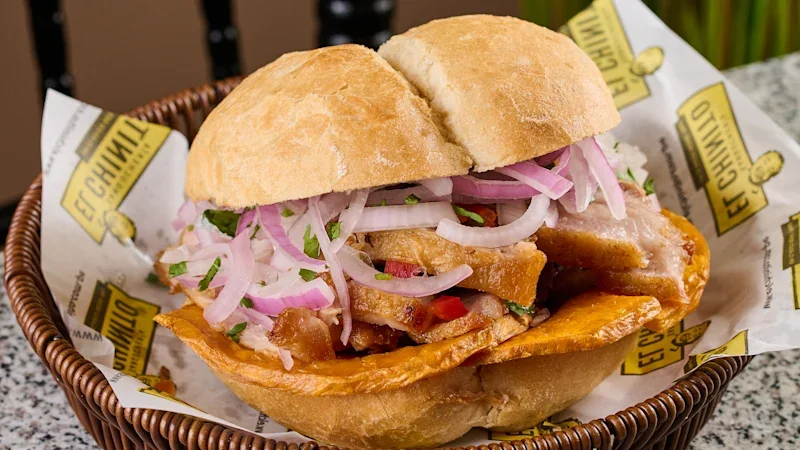
At the open grill, one of the cooks at El Enano is toasting soft bread rolls, tossing and chopping roasted meats to create a sizzling, smoky char before adding onions, sauces and other toppings. He’s working so fast I can barely follow his knife, but the aroma is intoxicating. It’s lunchtime in Miraflores and my mouth is watering.
Sangucherias, the casual diners dedicated to the art of the sandwich, are everywhere in Lima, but this is my first experience eating at one. I survey the extensive menu written on a board above the open kitchen, order through a window, then take a stool at the open counter in front of the cook.
While I wait, I sneak a look at what other people are eating – rolls stuffed with juicy pork, turkey, roast chicken, ham, fried eggs or burgers, fat enchiladas and plates of meat and chips accompanied by large jugs of freshly squeezed juices. This is not snacking territory, nor your regular fast food. The recipes behind the preparation of every sangucheria’s chicharron (pork ribs) or butifarra (pork ham) are closely guarded, their virtues fiercely contested and defended.
With food this good, I’m surprised it’s not busier, but that’s because I’ve missed peak sandwich eating time.
Get exclusive travel deals delivered straight to your inbox. Sign up now.
“Sandwiches are typically a breakfast food,” says Jimena Agois, an award-winning photographer and food writer based in Lima. “Everybody eats a sandwich on the way to work.”
The practice started with food stands on the street, then evolved into a more social experience, she says. Although breakfast at a sangucheria, particularly on weekends, is a beloved ritual, there really is no bad time to eat a sandwich. Most places are open from early in the morning until late at night, when the queues for sangucherias can stretch down the block. “You can eat those sandwiches at any time,” Agois reassures me.
I’m asking experts for advice because after just a few days in Lima, and despite my best efforts to eat my way through a full sangucheria menu, I’ve only touched the surface. And as a first-time visitor to the city, who am I to try to explain the history and appeal of this quintessentially Limeno experience?
Food writer Nicholas Gill, who worked with chef Virgilio Martinez and Agois on Central, the book about the world-famous Peruvian fine-dining restaurant, and has been writing about Peruvian food for two decades, says sangucherias have been around for a long time.
“[They] started to become more popular in Lima in the early 1900s at bodegas and taverns like Bar Cordano and Antigua Taberna Queirolo in and around the centre of Lima, though formal sangucherias came decades later, in the 1960s,” he says.
Now I understand why El Enano has the look of a diner from TV’s Happy Days.
“Peru’s culinary scene is incredibly diverse and can be rather overwhelming for some, so the sandwich culture can sometimes get lost to outsiders,” says Gill. “For Peruvians, however, sandwiches are a staple food and a beloved part of popular culture.”
Carlos Olaechea, a Peruvian-born, now Miami-based, food writer, whose 2019 story The Vast, Incredible World of Peruvian Sandwiches kick-started my obsession with sangucheria, agrees. “It’s an easy introduction [to Peruvian food],” he says. “Raw fish, like ceviche … might not be for everyone, guinea pig might not be for everyone, but a sandwich? [That’s something] almost everyone can get behind.”
Lima’s reputation as a world-famous gastronomic destination is usually associated with its fine-dining restaurants, but their prices and waiting lists mean they’re not accessible to everyone. Sangucherias offer something that is about more than food – it’s a social and cultural experience that’s open to all.
“It’s very democratic,” says Olaechea. “You could be standing in a queue for a sandwich, and you could be next to a millionaire or someone who’s just scraping together cash … it’s all priced the same, and everyone’s enjoying it.”
THE DETAILS
EATYou can find sangucherias throughout Lima, and some of the most popular brands have multiple outlets. Don’t miss El Chinito, Lima’s oldest and most beloved, the popular La Lucha Sangucheria Criolla (now expanded internationally and to Jorge Chavez International Airport), Panaderia Carmelitas, famous for its pan con chicharron, and El Enano, tucked away in a quiet street in Miraflores. See elchinito.com.pe, instagram.com/laluchasangucheria, instagram.com/pancarmelitas
FLYLATAM Airlines offers direct flights to Santiago, Chile, from Sydney and Melbourne with connections to Lima. See latamairlines.com
STAYFor a taste of old-style Lima, the 1923 Spanish-colonial Antigua Miraflores Hotel offers generous rooms and a large garden in a quiet part of Miraflores. Standard rooms from $113. See antiguamiraflores.com