Sign in. It’s quick, free and it’s up to you.
An account is an optional way to support the work we do. Find out more.
IT IS THAT time of year again as 32 contestants from Ireland and across the globe compete for the Rose of Tralee crown.
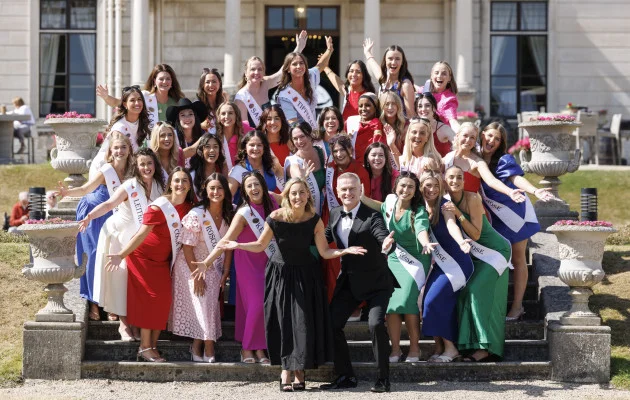
THE 67th Rose of Tralee festival will begin this week and today the roses gathered at a hotel in south Dublin for their first photocall with hosts Dáithí Ó Sé and Kathryn Thomas.
This Dublin launch happens each year ahead of the main televised event on 17 and 18 August to crown the winner.
As part of the festival, roses also embark on a tour, taking part in parades and cultural events across the county.
But ahead of this years competition, here’s everything you need to know about one of Ireland’s oldest festivals.
Who can apply, and how does it work?
Women between the ages of 18 and 30 are eligible to apply for the festival.
The key requirement is that applicants be born in Ireland, hold Irish citizenship or be of Irish ancestry through an ancestor born in Ireland.
Counties and cities worldwide have rose centres which organise local selections to choose a rose to participate in the main festival.
Internationally, key rose centre locations include Chicago, London, Melbourne, Texas, Toronto and the UAE.
This year’s Chicago Rose, Fiona Gaffney told The Journal that the centre has “connected people for decades” within the Irish American community and that it remains a prominent event.
Similarly, Texas Rose Ally Padgett had been involved with her rose centre for many years.
It is common for past roses to introduce potential candidates to the festival. Padgett credited 2010 Texas rose Adrienne Hussey, who has since passed away, for her getting involved.
If chosen as the Rose of Tralee, the winner must have lived in their representative region for at least one year and plan to stay there for the following twelve months.
Why do the roses want to get involved in the festival?
Beyond the fashion, free travel, and the good craic among the roses (Louth rose Chloe Moran admitted she made the decision to apply after “a few vinos” and is just there to enjoy herself) there are common reasons for applying.
Some have family members who were previous roses so it remained a tradition (the grandmother of the Waterford rose Cara Comerford took to the stage in 1967).
Others have a particular cause which spurred them on, with many of this year’s roses wanting to use it as a platform.
Westmeath rose Caoilfhinn Ní Choiligh, who has alopecia, said “I think it’d be really meaningful to be able to put myself out there and talk about the condition and talk about other autoimmune conditions that can sometimes be hidden”.
This year’s Dublin rose Suad Mooge agreed that the festival is a way of promoting inclusivity and celebrating each woman.
“There was a bit of a rocky start and a bit of negative feedback when I first got selected,” she explained.
“But I just want to be the rose that I would have needed when I was younger, and there are girls coming up to me, regardless of where they’re from, I want to instil that confidence”.
Simply making connections and “knowing someone in Galway or Cork or even New York and New Zealand”, was the biggest motivator for Derry rose Cará Hamilton.
What about the judging?
In 2025, over half a million people tuned in to watch Laois Rose, electrician Katelyn Cummins, secure the title.
After taking the crown, Cummins stayed in the public spotlight, even winning Dancing with the Stars.
Over the years some notable winners have included member of the European Parliament Maria Walsh and mathematician and broadcaster Dr Aoibhinn Ní Shúilleabháin.
But how is first place decided among the 32 roses?
Despite what viewers may think, the winner is not chosen based only on their stage appearance during the live broadcast.
Judges meet the roses during the course of the festival in different settings and also conduct panel interviews.
Most of the judging takes place away from the camera.
While the festival does not publish specific judging criteria, the primary focus is selecting a strong role model and global ambassador for the festival.
Former judge and now host Dáithí Ó Sé, told The Journal that the decision is always difficult and that the margins are tiny.
He described one year when “the band was coming on, and we still had not got the Rose picked, and it was down to two people, and there was five there, and I was the person who just said, we have to pull the trigger”.
The winner of the Rose of Tralee will receive a range of prizes from a car to a €25,000 travel bursary.
The bursary is used by the winning rose to represent the festival at Irish community events worldwide.
The Rose of Tralee airs on RTÉ One and RTÉ Player, Monday 17 August and Tuesday 18 August from 8pm
To embed this post, copy the code below on your site