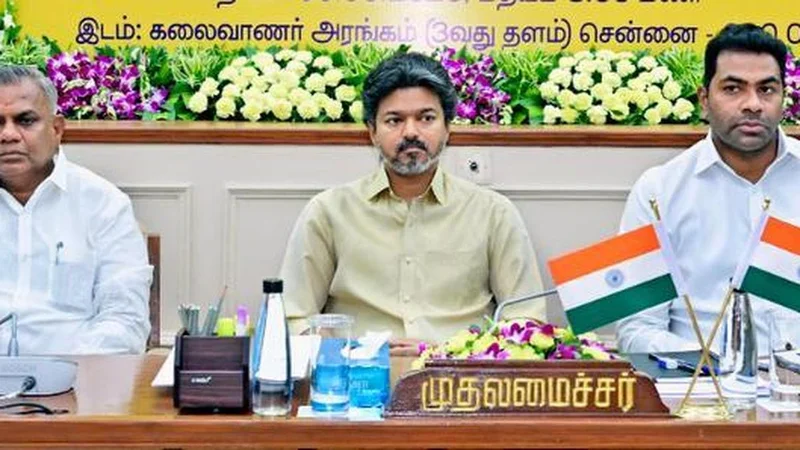
At a time when the State has been animatedly deliberating on the Cauvery issue, on August 6, 2026, Chief Minister and Tamilaga Vettri Kazhagam (TVK) president C. Joseph Vijay announced a meeting for parliamentarians in Chennai on August 8 to discuss the possible impacts of the proposed Delimitation Bill on the State.
Mr. Vijay’s initiative caught the Opposition, especially the Dravida Munnetra Kazhagam (DMK) and the All India Anna Dravida Munnetra Kazhagam (AIADMK), off guard. In fact, on August 6, news had spread that the DMK might consider providing support to the proposed Bill if the Bharatiya Janata Party (BJP)-led Union government agreed to three of its demands — the extension of a constitutional freeze on seats based on the 1971 Census for 25 more years, the introduction of a 50% increase in the Lok Sabha seats for all the States, and the insertion of a Schedule indicating the number of seats for each State.
Change of position
Four months ago, when the campaign for the Assembly elections was at its peak in Tamil Nadu, the Dravidian major, a long-standing vociferous critic of the proposed delimitation, had staged dramatic scenes as its president and then Chief Minister M.K. Stalin burnt a copy of the Constitution (131st Amendment) Bill.
**
Editorial | Case for consensus: On delimitation**
This was the time when Parliament met to discuss and pass the Bill which sought to increase the strength of the Lok Sabha from 543 to 850 and pave the way for a fresh delimitation before the 2029 Lok Sabha elections, apart from providing the constitutional basis for implementing women’s reservation in legislature. At the time, the Bill had failed to secure the two-thirds majority required for a constitutional amendment, and unity among all anti-BJP forces was perceptible.
But, now, divergent voices are heard even from within the Dravidian major. While the party general secretary Durai Murugan stated that his party’s MPs would attend the meeting on delimitation if the government held an all-party meeting on the Cauvery dispute, the Leader of Opposition, Udhayanidhi Stalin, told the House that his boss would decide about DMK’s MPs attending the meeting. Moreover, the organisation, having totally 30 MPs in both Houses of Parliament, was not comfortable with Chief Secretary M. Sai Kumar sending invitations to MPs individually to attend the meeting instead of the Chief Minister or any of his senior Ministers contacting Mr. Stalin directly and placing the request for participation.
At the end, the DMK leadership chose to stay away from the meeting. The AIADMK, which has four MPs in the Upper House, followed suit. The party expressed doubts about the TVK’s genuine interest as it had also found fault with the latter for not having consulted with other parties on the Cauvery issue. The sole representatives of the Pattali Makkal Katchi and the Desiya Murpokku Dravida Kazhagam also skipped the meeting.
Attended by 19 MPs belonging to the present allies of the TVK, which has no MP to its credit, the meeting saw the adoption of a resolution, demanding that the number of Lok Sabha seats be frozen at the existing 543 and the current representation of the States be retained.
Apart from emphasising that the erstwhile allies of the DMK such as the Congress, the Viduthalai Chirtuthaigal Katchi, the Marumalarchi Dravida Munnetra Kazhagam, the Indian Union Muslim League, the Communist Party of India (CPI) and the CPI(Marxist) have now become partners of the TVK, the purpose behind the meeting remains unclear.
Settling scores
However, senior leader of the Congress and former Union Minister P. Chidambaram, regretting the absence of the DMK and the AIADMK, stated that the State had lost an opportunity to reach a consensus among the parties in the State. Despite the DMK’s leaders questioning the need for such a meeting, the party has received flak, as its critics wonder what difference the party has seen in the last four months for not collaborating with other anti-BJP parties on the issue. Politically, much water has flown down the Cauvery with the Dravidian major losing power and most of its allies to the fledgling TVK.
What is quite evident is that, as in the case of many other issues, the delimitation controversy too is being used by the major players to settle political scores with each other.
Published - August 12, 2026 12:37 am IST