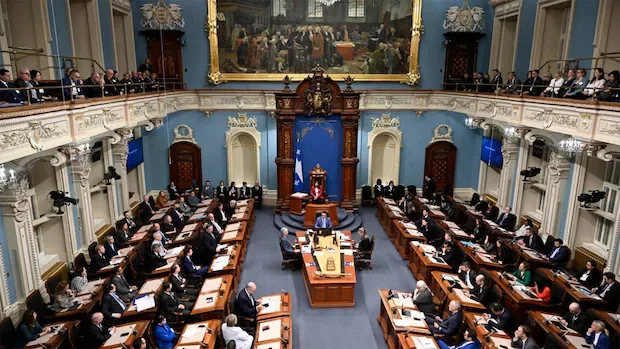
Quebec law ending mandatory oath to King faces constitutional challenge
Lawyer takes aim at 2022 law scrapping requirement for Quebec legislators
A constitutional lawyer is seeking to strike down a 2022 Quebec law that abolished the mandatory oath of allegiance to the King for members of the province’s National Assembly, arguing the provincial government overstepped its constitutional powers.
The application was filed in Quebec Superior Court in Montreal on Monday by the Public Interest Litigation Institute and its founder, Lawrence David, who teaches at University of Ottawa’s faculty of law.
The lawsuit names the Attorney General of Quebec as the respondent and the Attorney General of Canada as an interested party.
The challenge takes aim at Quebec's Bill 4, passed unanimously in December 2022. The law added a clause to the Constitution Act of 1867 stating that the oath to the monarch no longer applies to Quebec legislators.
The bill was tabled by the Coalition Avenir Québec (CAQ) government after facing pressure from the separatist Parti Québécois (PQ). Several members of the PQ had refused to swear allegiance to King Charles III and were barred from sitting.
- Quebec adopts law making oath to King optional for elected members
- Quebec MNAs who don't swear an oath to the King cannot sit in National Assembly, Speaker rules
The lawsuit argues that Quebec required the unanimous consent of the House of Commons, the Senate and all of the country’s provincial legislatures to abolish the mandatory oath.
It also alleges the law violates Section 3 of the Canadian Charter of Rights and Freedoms, which guarantees the right to effective representation, because politicians who do not take the oath are not qualified to serve as an MNA.
With the next provincial election scheduled for Oct. 5, the lawsuit argues that any laws passed by a legislative assembly made up of members who don’t pledge allegiance could be deemed invalid.
In an interview with CBC, David said he was motivated to file the lawsuit for both personal and professional reasons.
"I'm a Montrealer born and raised, and I have many family members in Montreal," he said Tuesday.
"It is necessary for political institutions, democratic institutions, to follow the rules of the Constitution."
Quebec's Justice Ministry and Canada's Justice Department did not immediately return a request for comment.