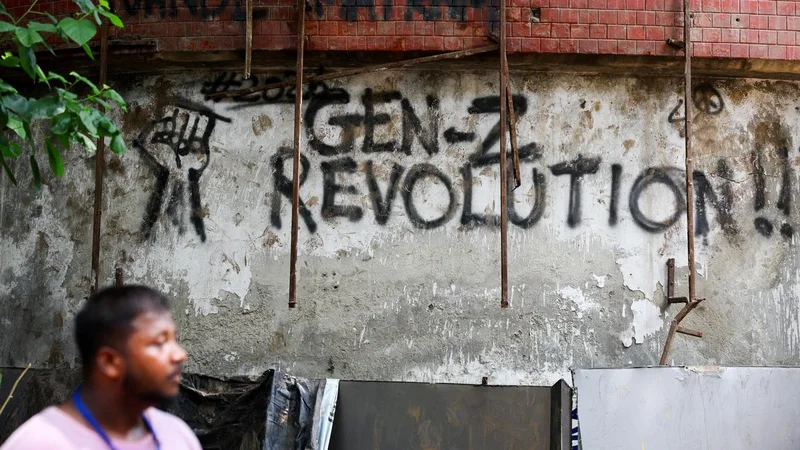
The Cockroach Janta Party (CJP)-led ‘GenZ’ protests are widely seen as a success story, and with reason. A decentralised, ideologically agnostic mobilisation converged on a singular demand: the resignation of the Union Education Minister. When that came through on July 25, the CJP leaders declared victory and called off the protest.
It is certainly important to claim victory, not least because the protesters had forced the Narendra Modi government to do what it abhors: appear weak by making a concession. This win also came at a significant conjuncture. After 12 years in power, it had begun to seem as if India’s ruling elite occupied a celestial realm insulated from the democratic claim-making of ordinary Indians struggling with petty indignities in a nether world rife with corruption and decay. Communication had become one-way — downward from the top. It was hence a major triumph to send a message back in the other direction.
A time for introspection
And yet, if we place the CJP phenomenon in a historical context of mass politics, hard questions arise. For instance, this protest sought to end endemic exam fraud. How do we view its effectiveness in altering the structure of impunity and corruption that make exam fraud a feature rather than a bug? The mammoth edifice of over-centralisation, embedded in an opaque, crony-infested network of hyper-privatisation that envisages higher education as a commodity to be monetised is not about to crumble from the resignation of one Minister. The state has merely made tactical concessions out of political expediency — concessions that will not alter the material reality that students continue to face. If changing that reality is the true project, it requires durable institutional capability, which this protest movement lacks.
A study in contrast is the farmers’ movement of 2020-21 against the three Farm Bills. It has come to embody the most unambiguous victory over the Modi government. But its success came after a campaign sustained on the ground for a year and four months. That was made possible by the institutional backbone of a multitude of farmers’ groups, and by the fact that the farmers had gathered there as individuals who had a relationship with political organisations. The CJP protests, on the other hand, began as a purely digital phenomenon, with no organisational capacity other than social media followership.
Political theorist Anton Jager, in his new book, Hyperpolitics: Extreme Politicization without Political Consequences, uses the term ‘hyperpolitics’ to describe mobilisations that often produce impressive spectacles of dissent, but in the absence of an institutional grounding, fail to produce lasting political change. He references the Black Lives Matter movement, the Yellow Vest unrest of 2018 in France, and the January 6 Capitol Hill riots of 2021 as manifestations of hyper-politics.
Born of a satirical meme, the CJP in its early days displayed classic hyperpolitical characteristics, especially in its refusal of representation by political parties. CJP leaders took pains to clarify that they had nothing to do with the Congress or the Aam Aadmi Party, that they were not against the Bharatiya Janata Party (BJP) per se, but were “only” interested in accountability for paper leaks. Jager provides an interesting question that can be used to test if a mobilisation is hyperpolitical: “What did you have in common before the protest, and what did you have in common afterward?” In mature mass politics, it is typically the relationship to an institution — be it a political party, a civil society group, or a union. It would be safe to say that 99% of those who showed up at the CJP protests had no such relationship with any political body.
What the legions mobilised by the CJP did have in common, though, was a set of influencers.
Digital performance of dissent
Much has been written about the demographic profile of the protesters. Indeed, a great many of them were frustrated NEET aspirants, gig workers, and unemployed youth. However, many of them were essentially consumers of ‘insurrectionary pleasure’, drawn to Jantar Mantar by the chance to participate in what cultural anthropologist Graham St John calls a ‘protestival’. The area around Jantar Mantar had become a fair, a Meme Expo, where thousands of ‘dissentrepreneurs’ performed dissent, consumed dissent, and turned the performance and consumption of dissent into monetisable digital content which, in turn, set in motion an infinite loop of production-consumption.
The internalised algorithmic rationality of Instagram and YouTube generated a burgeoning corpus of edgy yet entertaining political content that served to mobilise huge swarms of ‘GenZ’. This was not, and could not have been, foreseen, and its rapidly growing momentum made the state nervous, prompting it to bare its teeth. As was inevitable, the heavy-handed response from the state vested the movement with enough kinetic energy to transcend its hyper-political origins, and for a few days starting July 20, it did, before it was called off on July 25.
To its credit, the CJP leadership has said that it will continue to function as a pressure group. If this movement is to effect lasting political change, it needs to embed its agenda in existing institutional infrastructure, be they political parties, student bodies, women’s groups, or alternatively, build fresh organisational capacity that demands of its supporters much more than servicing the growing digital market for dissent.
Published - August 12, 2026 01:40 am IST