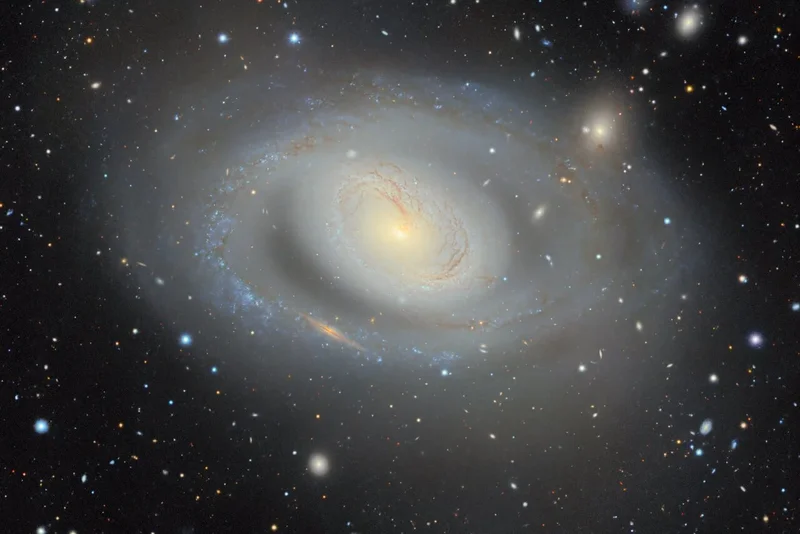
Astronomers just published the largest two-dimensional map of our universe - and it’s breathtaking.
The image took 13 years to make, covering 75 percent of the sky and including nearly four billion celestial objects. It contains stars, galaxies, supernovae and more, using data from the National Science Foundation’s Arizona Mayall telescope and Chilean Blanco telescope.
The 5.6-trillion-pixel map was created by the DESI Legacy Imaging Surveys team: an international collaboration of researchers led by the Department of Energy’s Lawrence Berkeley National Laboratory.
The map builds on past imaging and research from more than 160 scientists and 263,407 telescope sessions, showing the cosmos in both visible and near-infrared light that clears the dust of our Milky Way galaxy.
“Researchers expect it will remain the most comprehensive 2D map of our Universe for years to come,” the foundation said in a statement.
In addition to providing a wondrous view to skywatchers, the map includes data from surveys that the foundation says will be useful for professional and citizen scientists, alike.
“Researchers can search for rare phenomena like gravitational lenses, observe fleeting events like supernovae and investigate two of physics’ biggest mysteries: dark matter, the invisible substance that accounts for most of the mass in our universe, and dark energy, the force driving our universe’s accelerating expansion,” the foundation wrote.
The map can also be used as a reference for new observatories and telescopes and to help train artificial intelligence tools that will be used for new discoveries.
Notably, past surveys using the Dark Energy Spectroscopic Instrument on the Mayall telescope found that the impact of dark energy could be weakening over time.
Dark energy makes up the majority of the mass in galaxies and galaxy clusters, according to NASA. It’s the “invisible glue that holds the universe together,” so that finding was worrisome to some experts.
Research published in June by the Royal Astronomical Society has pushed back on that theory.