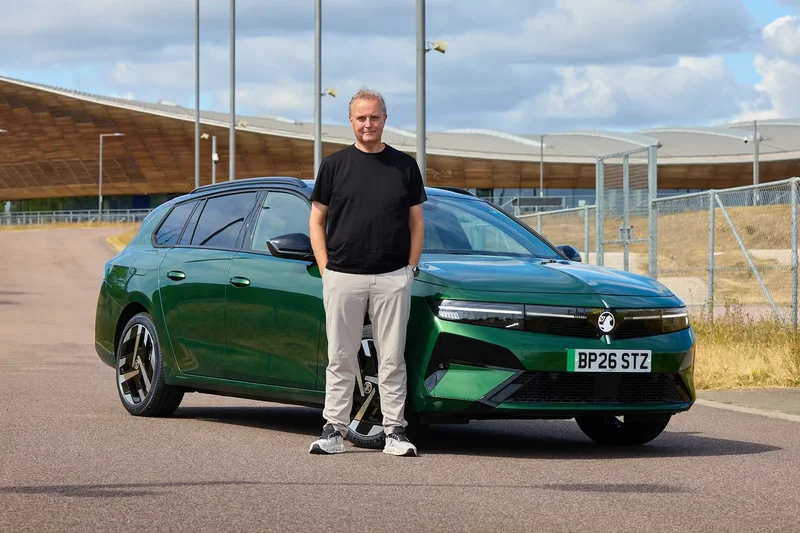
The Astra is one of Britain’s most familiar car models and now Vauxhall’s oldest nameplate in its current range. The first Astra appeared in 1980 and has now passed 45 years, eight generations and more than three million sales. The eighth-generation car arrived in 2022 and brought the first fully electric Astra, while the Sports Tourer Electric became one of the tiny number of all-electric estate cars on sale.
This revision keeps the same basic Astra bits, but changes the parts buyers see, use and pay for. There are hatchback and Sports Tourer bodies, Griffin, GS and Ultimate trims and a choice of fully electric, plug-in hybrid, 48-volt hybrid and pure petrol power. So there’s plenty of choice, but I chose the Ultimate-trim Sports Tourer – estate in any other language – which now costs the same as the hatch version. You’d just buy the better looking, more practical Sports Tourer then, wouldn’t you?
The most obvious new work has been done at the front. Vauxhall’s Vizor front look is narrower and more precisely drawn, with a permanently illuminated Griffin badge at its centre. From there, the illuminated Vauxhall Compass runs horizontally into the slim LED headlights and vertically along the bonnet crease. It’s the first production Vauxhall to use the full feature, taking inspiration from the 2023 Experimental and 2025 Corsa GSE Vision Gran Turismo concepts.
It certainly gives the revised Astra a recognisable face, although the amount of illumination feels a little overdone in my book. There’s a fair chance we’ll look back at the early days of illuminated grilles and wonder whether everyone got a bit carried away.
The rest of the redesign is easier on the eye, with wing-shaped daytime running lights, a sharp-edged rear spoiler, black mirrors and a Carbon Black roof on every version.
At the back, the Compass theme appears again through the centrally mounted Griffin, the upright high-level brake light and the wing-shaped tail-lamps. The Griffin badge also releases the boot, while the Astra lettering sits centrally below it. Vauxhall quotes a drag coefficient of 0.269 for the revised Astra, which is pretty impressive.
There are seven paint colours. Contour White is new, Electric Yellow is exclusive to the hatchback and Clover Green makes its debut on the Sports Tourer (although it does make the car look a bit like a Skoda Octavia from the back). Every colour now comes with the contrasting black roof, which suits the estate’s shape, and electric models have their own 18-inch diamond-cut alloy wheels. There’s no exterior chrome any more – just fancy lighting on the grille in its place.
The broader sales pitch is unusually simple: Vauxhall charges exactly the same for the hatch and estate in each trim – brilliant! The electric range starts at £28,495 after the government’s £1,500 Electric Car Grant, making this much less expensive than the car it replaces – to the tune of over £5,000. You’d be pretty miffed if you bought the old model at full price, not that many people did.
Then there’s the dog question. The Sports Tourer’s low loading level is genuinely useful for four-legged passengers jumping in and out, and the boot is far more convincing than the electric hatchback’s. Sky the Goldendoodle wasn’t keen on the amount of roof height, while Elvis the black Labrador settled in happily. So is it the best EV for dogs? The answer depends partly on the dog: Elvis has voted yes; Sky wasn’t so sure.
How we tested
I lived with the revised Vauxhall Astra Electric Sports Tourer Ultimate for a week, driving in and out of London, along motorways and through towns and villages across south-east England. Sky the Goldendoodle and Elvis the black Labrador joined me for plenty of dog-walk trips, helping me to give the boot, loading height, rear space and day-to-day practicality a proper examination.
Independent rating: 7/10
- Pros:Useful, dog-friendly boot, good rear space, comfortable seats, tidy road manners, hatchback price parity
- Cons:274 mile range not special, 100kW rapid charging is unexceptional, cabin feels dark and dated, touchscreen isn’t the easiest to use
Vauxhall Astra Electric specs
- Price from:£28.495
- Battery size:58kWh
- Maximum claimed range:275miles
- Miles per kWh:4.2
- Charging :up to 100kW DC – 20 to 80 per cent charge in 32 minutes
Battery, range, charging, performance and drive
The revised Astra Electric uses a 58kWh battery, 4kWh larger than its predecessor. It drives through a single-speed gearbox with 154bhp and 270Nm of torque available immediately. The Sports Tourer reaches 62mph in 9.5 seconds and has a 105mph maximum speed. Those are measured family-estate figures rather than hot-hatch numbers, and acceleration felt perfectly brisk enough in town, when joining motorways and when moving around slower traffic.
Range depends on body style and trim. The hatchback is rated at 280-281 miles, while the Sports Tourer manages 274-275 miles. The Ultimate model I tested was the 274-mile version, but Vauxhall says the revised electric car gains 22 miles, helped by the larger battery, battery preconditioning and a standard-fit heat pump which will be handy in colder months.
Efficiency was one of the more convincing parts of the week. But the range is only so-so when compared to the 300-mile figure that rivals boast, and which increasingly feels useful in an EV that’s likely to do a fair few miles on the motorway.
Charging hasn’t become any faster at its peak. A suitable 100kW DC charger takes the battery from 20 to 80 per cent in a claimed 32 minutes. The standard 11kW AC on-board charger completes the same 20 to 80 per cent window in three hours 20 minutes, while a normal 7kW home or public charger takes eight hours.
Vehicle-to-Load is now standard, allowing the battery to power an external device such as an e-bike, or to recharge your laptop. There are three levels of regenerative braking, selected with paddles behind the steering wheel. Moving between them is simple and gives the driver more choice over how strongly the car slows when the accelerator is released.
The battery is integrated into the latest, V3 version of the EMP2 platform that’s used in rival cars from Vauxhall’s parent, Stellantis. Despite the big battery, you don’t lose any luggage space compared with the plug-in hybrid and the battery pack actually makes the electric car 31 per cent stiffer than the petrol Astra.
The engineering changes haven’t altered too much about how the Astra feels on the road. The ride was okay rather than exceptional, and comfort was generally okay too, and the body stayed well controlled through bends. Handling was tidy, the steering felt natural and visibility made the estate easy to place in London traffic and car parks. On motorways it felt stable and settled, while acoustic glass, a soundproofed windscreen and extra seals around the doors and boot help to reduce road noise.
Interior, practicality and boot space
The Sports Tourer is 268mm longer than the hatch, with an extra 57mm between the axles, and the difference is most useful behind the front seats. Rear legroom is generous enough for adults, not just children, and this was one of the strongest practical parts of the car during the week – I had no complaints from human passengers, let alone dogs.
Electric Astra Sports Tourers have 516 litres of boot space with the rear seats up and 1,553 litres with them folded. That’s well ahead of the electric hatchback’s 352 and 1,268 litres, although the battery still reduces the estate’s capacity compared with the petrol and hybrid Sports Tourers, which offer 597 and 1,634 litres. Sadly, there’s no front boot for the charging cables, but the rear backrest does split 40:20:40, so long Ikea items can pass through the centre, while Ultimate trim adds a useful powered tailgate.
For dogs, the useful figure isn’t only the number of litres. The loading level is low, the opening is broad and the floor makes it easy for a Labrador or Goldendoodle to get aboard without a hoist, ramp or undignified shove from behind. Elvis the black Labrador was very happy with the arrangement but Sky the Goldendoodle found the roof a little low for her, showing the limit of the estate’s sleek shape for taller dogs that prefer to sit or stand upright. A smaller mutt will be just fine.
The cabin itself hasn’t moved on as far as the exterior, design-wise. The old fingerprint-hungry, high-gloss black trim has been replaced by a scratch-resistant satin grey finish across the hard surfaces, which is a good move. Even so, the dashboard still feels a little old-school, the materials don’t look especially upmarket for the price and the predominantly dark treatment can feel rather dismal. Seven-colour ambient lighting is fitted to GS and Ultimate, but coloured light can only do so much brightening of an unrelentingly dark cabin.
Vauxhall quotes some decent storage figures of 6.2 litres beneath the centre armrest, 2.6 litres for each front door pocket and 7.7 litres for the glovebox, which can apparently take a 1.5-litre bottle. There are two front cupholders and a sunglasses compartment, too, but I just felt there wasn’t quite enough storage space for odds and ends inside the cabin. Rear passengers do get two more cupholders, a phone bin in the centre armrest and door pockets sized for small half-litre bottles, though.
The seats are much more worthy of praise. Vauxhall’s standard Intelli-Seats have a recessed channel along the centre of the front squab, inspired by a road-bike saddle and designed to reduce pressure on your lower back. The AGR-approved front seats in the Ultimate spread support effectively and my ageing back felt very comfortable on longer journeys. Both front seats in my car were heated and had a massage function; the driver’s seat is electrically adjustable in eight directions and includes memory.
Ultimate seats and door inserts also use ReNewKnit, a really nice-feeling fabric with a texture similar to suede-like Alcantara that Vauxhall says is 100 per cent recycled.
The three-spoke, flat-bottomed steering wheel uses vegan leather and is heated as standard, while Ultimate also includes a heated windscreen, dual-zone climate control, keyless entry and power-folding heated mirrors.
Technology, stereo and infotainment
The dashboard hasn’t changed much and is built around Vauxhall’s Pure Panel Pro, combining a 10-inch digital driver display and 10-inch central touchscreen behind a single glass panel. despite the familiar hardware, revised software does bring new graphics, satellite navigation and over-the-air updates, while wireless Apple CarPlay and Android Auto are standard.
Ten inches no longer seems especially large when rivals seem to offer iPad-like 14-inch displays, and I’ve never found Vauxhall systems the easiest to use. At least there are still physical switches for volume, air-conditioning and drive modes, along with proper buttons on the steering wheel, that reduce the number of everyday jobs that require a prod at the screen. There’s also voice recognition that can operate navigation, media and climate settings after saying “Hey Vauxhall” to get its attention.
Ultimate trim adds a wireless phone charger and the Intelli-HUD head-up display, which projects key driving information onto the windscreen. There’s also keyless entry and start, a smart-looking, frameless rear-view mirror, rain-sensing wipers and an electronic parking brake. The six-speaker audio system isn’t very special to listen to, though.
Safety and driver assistance systems are extensive, while the Ultimate’s Intelli-Drive 1.0 package gives you lane-positioning and lane-change assistance, rear cross-traffic alert and blind-spot monitoring. The latter uses ultrasonic sensors to detect vehicles as far as 75 metres away and warns you through a light in the relevant door mirror. Rear bumper radars watch for movement approaching from either side when reversing, too.
The headlights are another impressive part of Ultimate trim. Intelli-Lux HD comes to the Astra for the first time and uses individually controlled elements to create a glare-free shape around vehicles ahead and oncoming traffic. Vauxhall describes the system as having more than 50,000 pixels. At night, the spread and depth were very impressive, the beam kept working around other road users and nobody flashed a complaint.
The system can alter its beam for city, country-road, cornering, bad-weather and foggy conditions, too. It apparently reduces reflections from wet roads, dims around reflective traffic signs and uses an extra module to illuminate the appropriate side when cornering.
Prices and running costs
The revised Astra range has three trim levels and the electric hatchback and Sports Tourer cost exactly the same – which I think is impressive. Before the Electric Car Grant, Griffin models cost £29,995, GS is £31,495 and Ultimate costs £33,995. The £1,500 grant reduces those figures to £28,495, £29,995 and £32,495. That means the Ultimate Sports Tourer I tested has a list price of £33,995, or £32,495 with the grant applied.
That price parity is unusual and makes the estate, which you would normally expect to cost more, particularly easy to choose if luggage (or dog) space is useful.
Entry to the electric range is more than £5,000 cheaper than before, so anyone who bought the old model at full price may wish to skip this paragraph. At £28,495 after the grant, it also gives keenly priced Chinese rivals something to think about. Vauxhall says the Electric costs less than the equivalent hybrid and plug-in hybrid once the grant is applied.
Griffin already includes heated front seats and steering wheel, the two 10-inch displays, navigation, wireless phone integration, adaptive cruise control, parking sensors, acoustic side glass on the Electric and the Sports Tourer’s 40:20:40 rear seat. GS adds sports bumpers and seats, a 180-degree camera, keyless entry, dual-zone climate control, power-folding mirrors and ambient lighting.
Ultimate throws in the Intelli-Lux HD headlights, Intelli-Drive 1.0, a head-up display, wireless phone charging, heated and massaging ReNewKnit front seats, an electrically adjustable memory driver’s seat, heated windscreen, powered tailgate and high-gloss black roof rails. Vauxhall reckons 60 per cent of buyers will be happy with a Griffen model, 25 per cent will opt for GS and 15 per cent will go for Ultimate cars.
The alternative plug-in hybrid Astras pair a 1.6-litre engine with a 17.2kWh battery, get a seven-speed dual-clutch gearbox and offer 192bhp and 360Nm. It’ll manage a claimed 52 miles on electric power alone, up from 35 miles previously, and starts at £29,995. The reduction is around £6,000 against the old model. A 143bhp 48-volt hybrid and a 128bhp 1.2-litre petrol are also available, so the Astra range still covers buyers who don't want to plug in all the time, or at all.
The verdict: Vauxhall Astra Electric
The revised Astra Electric Sports Tourer is a rare and useful electric estate – and you’d be better off choosing the estate than the same-price hatchback model. The Sports Tourer’s big, easily accessible boot, comfortable seats, good efficiency and hatchback-matching price work well for family and dog duties. The 275-mile range, 100kW charging and dark, familiar cabin hold it back, but with a starting price of £28,495 once the government’s £1,500 Electric Car grant has been taken into account, the Astra Electric is far easier to justify than its predecessor.
Vauxhall Astra Electric rivals
FAQs
How long does it take to charge?
The Vauxhall Astra Electric has a maximum DC rate of 100kW and takes 32 minutes to go from 20 to 80 per cent on a suitable rapid charger. Its standard 11kW AC on-board charger takes three hours 20 minutes for the same 20 to 80 per cent window, while a 7kW home or public charger takes eight hours.
How much does the Vauxhall Astra Electric cost - is it worth it?
The Astra Electric Sports Tourer starts at £29,995 before the grant and £28,495 after it. GS costs £31,495, or £29,995 after the grant, while the Ultimate tested here is £33,995, or £32,495 after the grant. Because the estate costs exactly the same as the hatch and brings a much larger boot and longer wheelbase, it offers the stronger practicality-per-pound case.
Does Vauxhall replace batteries for free?
The Astra Electric’s battery is covered for eight years or 100,000 miles, with at least 70 per cent of its original charging capacity guaranteed during that period. The standard car warranty lasts three years, with unlimited mileage in the first year and a 60,000-mile limit in years two and three.
Why trust us
Our team of motoring experts have decades of experience driving, reviewing and reporting on the latest EV cars, and our verdicts are reached with every kind of driver in mind. We thoroughly test drive every car we recommend, so you can be sure our verdicts are honest, unbiased and authentic.