More than spice: Why Singapore’s ginger collection matters
AI generated
SINGAPORE – Visitors to the Singapore Botanic Gardens are in for a fleeting botanical treat. Across the Ginger Garden, an array of gingers has bloomed.
For many species, the flowers last only a single day.
Beyond the familiar knobby, yellowish, edible ginger as we know it, the order includes culinary staples such as turmeric, galangal, and even the bananas we eat, among other plants.
Spanning a lush one-hectare plot, the Ginger Garden is jointly managed and co-curated by Dr Jana Leong-Skornickova, Keeper of the Herbarium and a principal researcher at the Botanic Gardens, and senior manager Sarah Lim Qing.
Together, they oversee more than 550 species, varieties and horticultural cultivars of the ginger order, Zingiberales, making the Botanic Gardens’ ginger living collection one of the largest of its kind in the world.
“It takes a lot of skill to grow these plants – each individual wants something slightly different, you have to take the time to understand what they want,” Dr Leong-Skornickova said, highlighting what it takes to manage the Ginger Garden.
Here are a few notable species currently stealing the show:
Heliconia estherae
A critically endangered tropical beauty, the Heliconia estherae cannot be found anywhere else in Singapore outside the Botanic Gardens.
Endemic to just two municipalities in Colombia and discovered only in 1982, this specimen was acquired by the Botanic Gardens at a 2010 auction. It took nine years to coax it from a flask into a flowering plant.
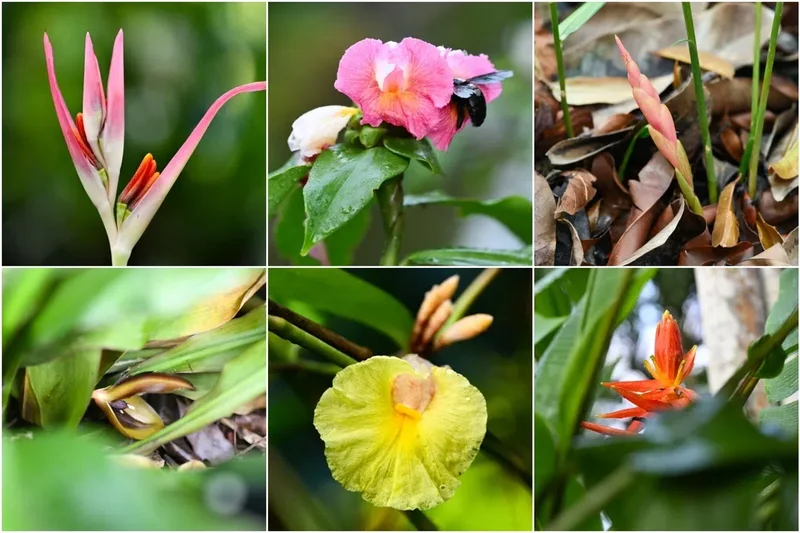
Growing up to 1.5m tall, the plant is striking with its upright inflorescences. Its bracts – modified leaves often mistaken for petals – transition from a near-white base to vivid pink tips.
When it blooms, its tubular flowers are speckled with contrasting shades of dark to bright red.
However, the Heliconia estherae demands specific tropical conditions to thrive. It may not flower if the lighting is too harsh, and it needs just the right amount of humidity.
Fortunately, horticulturists have found its “Goldilocks zone” in a shaded corner of the Ginger Garden, where it is currently in bloom.
Zingiber singapurense
Also known as the Singapore Ginger, this critically endangered plant is one of the few endemic to the island.
Given that it grows nowhere else in the world, it is one of over 80 plant species protected under the National Parks Board’s (NParks) Species Recovery Programme.
The Singapore Ginger holds a special place in Dr Leong-Skornickova’s heart as one of the many species she has described as new to science
In 2012, an NParks ranger spotted the plant deep inside the Central Catchment Nature Reserve. Without exact GPS coordinates, Dr Leong-Skornickova and her team searched the dense jungle high and low.
They eventually located several patches, but none were in bloom.
It was not until May 2014, on Dr Leong-Skornickova’s birthday, that the plant finally flowered, allowing her to formally describe and name the species after Singapore that November.
When in bloom, the plant is characterised by orange-red bracts and pale yellow flowers.
However, it tends to bloom just once a year between May and June, producing a flowering head that lasts a few weeks, though individual blossoms last only a single day.
While it is not currently flowering, visitors can still spot the plant in various parts of the Botanic Gardens, including Saraca Stream and the Ginger Garden.
Orchidantha foetida
You will likely smell this plant before you see it.
Belonging to the Lowiaceae family, the Orchidantha foetida is infamous for its strong, smelly odour.
While closely related varieties mimic the scent of sweaty socks, carnivorous animal droppings, blue cheese or rotten fruit, this particular species uses its foul stench to attract its primary pollinators: ground-crawling dung beetles.
Hailing from Thailand, this small, dark-coloured, orchid-like plant is a forest-floor dweller. To spot it, you might have to get on your knees and search through the leaf litter.
Similar to the Heliconia estherae, they are picky where they grow. Horticulturists in the Botanic Gardens found that, ironically, it thrives particularly well in a spot near the park’s toilets.
It is currently flowering near the main entrance of the National Orchid Garden Plaza.
Musa haekkinenii
Commonly known as the Hanoi Torch, the Musa haekkinenii is a striking ornamental plant native to Vietnam that belongs to the banana family known as Musaceae.
It is prized for its brilliant orange-red bracts that curve downwards as they open.
Well-adapted to Singapore’s tropical environment, the Musa haekkinenii is currently in bloom and can be admired in several locations throughout the Ginger Garden.
Costus lateriflorus
If you are wondering how to identify a spiral ginger, the clue is in its name: The leaves of such plants are arranged in a distinct spiral pattern.
Hailing from Africa, this species of spiral ginger harbours another trait – growing epiphytically. Unlike the vast majority of spiral gingers that grow in soil, this species lives on another plant or relies on an object for physical support without harming it or extracting its nutrients.
When it blooms, it showcases delicate yellow flowers with soft pink bases.
It flowers readily across the Ginger Garden.
Costus phyllocephalus
As another captivating African spiral ginger, the Costus phyllocephalus is renowned for its stunning floral display.
When in bloom, it produces large, pink and white flowers with a yellow patch.
This species also thrives in Singapore’s climate, and visitors can often spot it along the main pathway winding through the Ginger Garden.
Costus fenestralis
The Costus fenestralis flowered for the first time in over 25 years in the Botanic Gardens’ living collections in July – marking the first known instance of the species ever blooming in Singapore.
Cultivating this spiral ginger is tricky; while it can survive in the island’s climate, it “does not flower readily and thrive in very sunny conditions”, the Botanic Gardens said.
It took horticulturists experimenting with different locations, water, and fertiliser regimes to finally coax the lone plant to bloom in climate-controlled conditions.
It features large, tubular pink flowers and a bright yellow patch on the labellum. The yellow stamen ends in a delicate pink crest, shaped almost like a tiny crown.
Formally described only recently in 2016 from the Doudou Mountains of south-western Gabon, much of the plant’s live physical characteristics and colours were previously unknown as descriptions at the time relied largely on pressed and preserved specimens.
“From being 3D to 2D, the colours of flowers – which are flimsy – do not preserve well in dry materials,” Dr Leong-Skornickova explained.
“The moment you press them, they disappear,” she added, stressing the importance of studying gingers from living material.
Because the Costus fenestralis bloomed inside climate-controlled facilities, its flowers are not on public display here.
However, visitors can still admire non-flowering specimens in the shadier parts of the Ginger Garden.
‘Race against time’
Dr Leong-Skornickova, who has been studying the Ginger order for more than 20 years, has found and researched numerous new species, “but still, there are many left undescribed”, she said.
The ginger order currently encompasses around 3,000 known species.
“There’s too much to dissect and research, and yet there’s too little time,” she said. “Meanwhile, forests are disappearing across the world, so it really is a race against time.”
“Gingers are not only beautiful, they are used in many ways in different cultures – as spices, food, dyes, religious objects and ornamental plants,” Dr Leong-Skornickova said.
She added: “Teh Halia relies on true gingers known as Zingiber, Chinese rojak depends on torch ginger, Boesenbergia is commonly used in Thai cooking.”
“Life in South-east Asia would be sad without it... your food would be bland.”
For those hoping to catch the fleeting beauty of these ginger flowers, morning or early afternoon is the best time to visit.
The period between June and August is also when most gingers will flower.
The Ginger Garden, officially launched in 2003, offers free entry and is open daily from 5am to midnight.