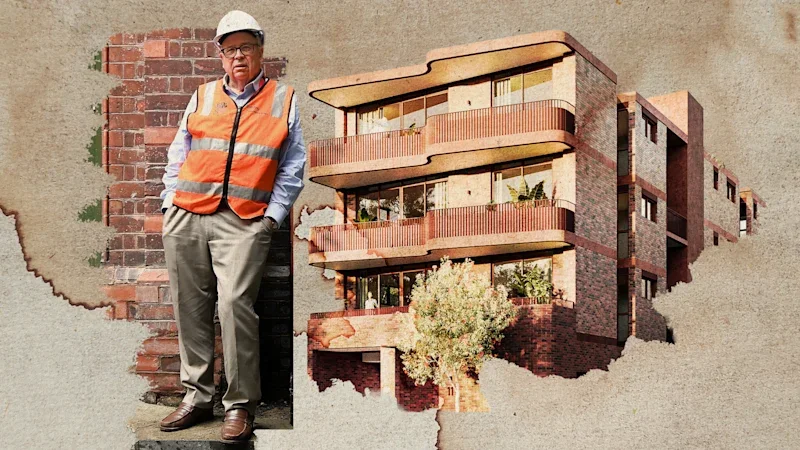
Former NSW building commissioner David Chandler says he would be willing to return to public life to address “absolute market failure” in the missing middle apartment sector, laying down his solution to address the state’s housing crisis by building thousands of cheaper dwellings for those who have been priced out.
Two years after resigning as the inaugural building commissioner, Chandler said he would apply to head the delivery of his “intentionally disruptive” project – named MM3 – if the Minns government adopted it, saying the housing initiative required someone with a reputation for “getting stuff done”.
Chandler’s intervention comes with the Minns government struggling to materially lift the delivery of housing supply despite introducing a raft of planning reforms.
“The crisis is so severe that you can’t park this under a bushel any longer. It’s time for some challenging ideas to surface,” Chandler said.
“The first thing is acknowledging that the system is not delivering for the people who most need it.”
The project’s intent is to deliver lower-cost apartments which have become unfeasible under current market conditions. The delivery of units at a more affordable price point would help people on the cusp of owning a home, using small and medium-sized builders who were looking to level up from greenfield sites to apartment projects, envisaged to range from six to 24 dwellings.
It outlines an avenue for delivering newly built apartments priced at less than $1 million. Chandler said his model could reduce building costs by at least 20 per cent, noting developers normally needed to attract a $1.2 million sale price and generate profit margins of around 20 per cent.
By using government-approved pattern book designs, Chandler said construction costs would be reduced as builders repeated the same project “50 or 60 times”, creating efficiencies and economies of scale as identical materials could be purchased for a year’s worth of projects.
With the government acquiring the land needed for these projects, apartments wouldn’t need to return the profit margin developers required.
The MM3 model would deliver a typical 85 square metre, two-bedroom apartment at a cost of around $350,000 to $400,000 for construction, with land costs “exceeding no more than $500,000” per dwelling.
It would also mitigate the risk of buyers bearing the risk of builders failing before the projects were finished, as government would provide a completion guarantee.
Chandler, who has 50 years’ experience in construction, said apartments remained unaffordable for those trying to enter the market, despite all the concessions government had given developers, such as greater floor-space ratios.
“We’ve certainly reached a point where, for a certain part of the market, there is absolute market failure,” he said.
Entry-level housing should be determined by what the purchaser can afford to pay, Chandler said, rather than what real estate agents dictate is easier to sell.** **
“We’ve lost our way where developers have always gone to a real estate agent or a marketing agency to say, ‘How will we get this project off the ground?’, ‘Well, it’s got to be bigger. It’s got to have marble bench tops’,” he said.
The strategy targets delivery of 4000 new units by the third year of operation. A program office, within an existing government department, would facilitate the delivery of the program. The proposal is designed to have a five to seven-year shelf life, providing a model for the private sector to replicate and ultimately take over from government.
“No one has sat down and thought through the fact that there’s a very seriously disenfranchised group of prospective people who want to become self-sufficient in housing to actually get on that ladder, and all the current mechanisms are synthetic at best,” Chandler said.
Chandler, who is due to give evidence at the ICAC’s Operation Rosny public hearing, declined to say what he would reveal. The ICAC has heard that Liberal operatives plotted to have Chandler dismissed as building commissioner. Chandler is not a target of the inquiry.
Asked about his willingness to return to public life, Chandler said if the government adopted his housing proposal, he would apply with others to run the MM3 program office, declaring the project needed an “unambiguous mandate” similar to when he was brought in to clean up the state’s building sector in 2019.
“There are very few bureaucrats who have got the ability or the guts to actually come up with something that will be disruptive,” he said.
“I have a reputation for getting stuff done, so there’s no value in giving a challenge like this to somebody who doesn’t have a reputation for getting stuff done. So I put my hand up, and I’d be quite happy to compete with somebody else who’s got a similar sort of capacity.”
A spokeswoman for Planning Minister Paul Scully said: “The NSW government welcomes any proposal that helps build more homes and innovative approaches by the private sector.”