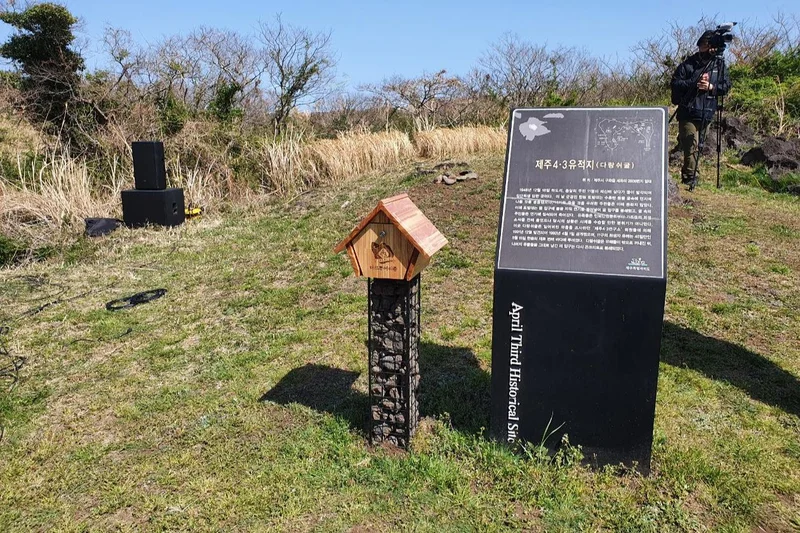
Deep within the volcanic terrain of Jeju Island lies a damp, narrow lava tube known as Darangshi Cave. For more than four decades, it remained a silent, sealed tomb — holding the remains of eleven villagers, including women and children, who choked to death on smoke in 1948 when government forces blockaded the entrance and built fires outside.
Long kept in the shadows of national memory, the site of that tragedy is now slated for official government preservation
The National Heritage Administration said Wednesday that it will officially register the cave hideout and massacre site as a National Registered Cultural Heritage. The move reflects a broader national effort to confront painful historical atrocities, cement state accountability, and preserve physical spaces that long sat on the margins of official memory.
The designation coincides with the prospective registration of Manseojeong, the historic residential quarters of Jang Seok-yeong, a prominent Korean independence activist who drafted the 1919 Paris Petition appealing for national sovereignty during Japan's 1910-45 colonial occupation of Korea.
Together, the two sites encapsulate the dual pillars of modern Korean memory: the tragic, civilian sacrifice during post-liberation ideological turmoil, and the fierce resistance that defined the country’s march toward sovereignty.
The Jeju 4·3 Incident — a dark chapter spanning from 1947 through 1954 — began as a series of local protests against divided nationhood and escalated into a brutal anti-communist scorched-earth campaign by state military and police forces. In late 1948, commanders issued a standing order that anyone found more than five kilometers inland from the coastline would be shot on sight without question.
Seeking refuge, local villagers from nearby Jongdal-ri and Hado-ri fled into the interior, taking shelter inside Darangshi Cave. Their discovery by government forces ended in tragedy.
When the cave was finally unearthed in 1992, the discovery sent shockwaves across the nation. The intact presence of cooking pots, iron cauldrons, and personal belongings alongside the victims' skeletons stripped away decades of state denial, serving as a powerful catalyst for the truth and reconciliation movement that followed.
"Darangshi Cave is a vivid, intact testament to the suffering endured by civilians during the Jeju 4·3 Incident," the National Heritage Administration said in a statement, emphasizing that the pristine preservation of the hiding place offers invaluable historical and academic value.
While the cave serves as a monument to civilian tragedy, the addition of Jang Seok-yeong’s home in Chilgok, North Gyeongsang Province, highlights the ongoing recovery of Korea’s independence movement sites. Uncovered through a systematic audit of historical assets ahead of the 150th anniversary of independence leader Kim Koo’s birth, the house preserves written records and structural elements from 1939.
The government will observe a 30-day public review period for both locations before submitting them to the National Heritage Committee for final review.
By placing a dark, subterranean massacre site alongside the home of a revered freedom fighter, Korea signals an evolving approach to its heritage — one that refuses to sanitize history, recognizing that a nation’s identity is shaped as much by its unhealed wounds as by its triumphs.
This article was published with the assistance of generative AI and edited by The Korea Times.