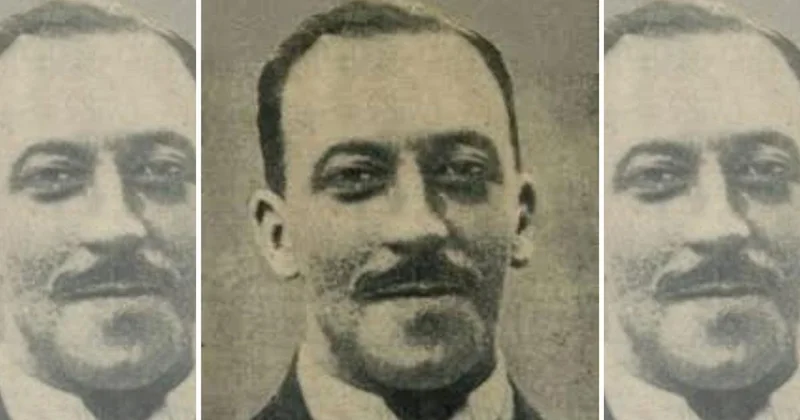
Robert Douglas, the District Magistrate of Midnapore, perhaps had some premonition of the lurking danger that awaited him. His predecessor, James Peddie, had been shot dead by youth revolutionaries while inspecting a school in April 1931. Robert, a civilian with 16 years of experience, was sent to the difficult Bengal district of Midnapore. Unlike his predecessor or most other British colleagues, India was not totally alien to Robert. His father, Rev. John, had come to Nagpur towards the end of the 19th century and engaged himself in missionary work, rendering service to the distressed people in the Central Provinces during famine and plague.
Robert was born in England but came to India with his parents as an infant and spent some years of childhood at Nagpur. He returned to England for his education, was selected for the Indian Civil Service in the year 1913, and came to Bengal in the following year. When the Great War broke out, he volunteered and was in military service during the years 1916 to 1919, fighting on the battlefield. Such outrages, therefore, could hardly frighten a man like Robert. Violence did not abate in Bengal, and in July 1931, another senior member of the ICS, Ralph Reynolds Garlick, the District and Sessions Judge of Alipore, was shot dead in the courtroom. In the following month, Robert wrote to his brother, who was the principal of a college at Rajamundry in the Madras Presidency. “The relevant fact is that my life is in real and serious danger. My house is guarded day and night by two armed sentries with loaded rifle and bayonets. I cannot stir a foot over the threshold without a plain clothes constable armed with a revolver. I am under the strictest orders to have a loaded revolver by me day and night. I have been practically forbidden to attend any public meeting or gathering.”
The whole town of Midnapore was plastered with posters, urging youngsters to take revenge against British officials. Robert noted one such poster, written in English, captioned with “Blood for Blood.” He received regular warning messages from the Intelligence Department, which he initially ignored as a joke, as they were always anonymous. But the boycott of foreign goods in the town was so complete that it cut out even the supply of Robert’s essentials: cigarettes, foreign or Indian. Threatening letters continued, and gradually, the stark reality descended on Robert, which he confessed to his brother: “I’m tired of hearing almost daily that the revolutionaries intend to commit further outrages … It is impossible to ignore the repeated warnings any longer… Madras, I believe, is fairly safe and in any case no European should shirk the danger.”
War veteran Robert amused himself in thinking that such threats lend spice to life, but the revolutionaries had other ideas and never wavered. Robert’s ten-month tenure came to a tragic end on 30th April 1932, when he was shot at in the District Board office. Shaken and pale but perfectly calm, Robert was immediately taken to the hospital, where his wounds were dressed. The agonising moments were short-lived, and Robert passed away on the same day. The gruesome murder rattled the colonial administration, and the provincial government quickly huddled to select a successor. The choice fell on Bernard Edward John Burge, the Commander of Hijli detention camp of political prisoners. Educated at Oxford, Bernard had joined the army and served in the Royal Fusiliers during the Great War. After service in Gallipoli and France, he came out to India and was in the North West Frontier Campaign of 1918–19. In 1921, he was appointed to the ICS and eventually became a Settlement Officer in Bengal. An enthusiastic cricketer, Bernard captained a Calcutta cricket club. His wife Barbara and their four-year-old daughter accompanied him to Midnapore and the family knew exactly what perils they were embarking on. Bobbie, as the ICS man was popularly known, seemed unaffected by the strain of such an existence. He was always cheerful and chatted with people in fluent Bengali. Barbara knew the harsh realities and correctly sensed the danger, allowing no one to interview him unless she personally met them first.
It was the bodyguard’s business to accompany Bobbie wherever he went during the day and to sleep within a few feet of him at night. Sentries patrolled the house day and night. Such guarded protection could hardly deter the spirited youth revolutionaries who detected Bobbie’s unchecked love for sports and seized on it. The opportunity came very soon. On September 2, 1933, Bobbie arrived at the Police Club ground to play football for his team. Just two days ago, Bobbie played in a local tournament and scored two goals. On the 2nd, he was accompanied by the Additional Superintendent of Police and the Civil Surgeon of the District, both British. Alighting from his car, he had taken only a few steps towards the ground when the youths closed in. A fusillade of shots struck Bobbie in several parts of his body. Death was instantaneous. Bobbie became the third District Magistrate of Midnapore to fall victim to the revolutionaries, the shootout being one of the most daring outrages as it had taken place in broad daylight and in the presence of a big crowd.
Condolence came from no less than Viceroy Willingdon, who had been a guest of the Burges for a few days in their Midnapore bungalow not long ago. He shared his personal impression of the conditions under which anarchy compelled them to live. He was impressed by the magnificent courage that the family had displayed in the face of hideous, subtle, and calloused danger. Expressing his deep distress at the “brutal and senseless outrage,” he conveyed his deepest sympathies to Mrs Burge. The third murder of a Midnapore Magistrate in two and a half years, the killing of a man of such indomitable goodwill and abundant cheer as “Bobbie” Burge made Simla bitterly angry. Mahatma Gandhi shared his “utter disbelief in violence as a method for gaining political rights or political freedom” and deeply deplored the assassination.
British India in the 1930s had nine provinces, which further increased to 11 in 1937 with the separation of Orissa from Bihar and Sind from Bombay. The province of Bengal was one of the three old presidencies along with Bombay and Madras. It consisted of 27 districts and was of a little over 6200 sq km, nearly the size of Great Britain. Calcutta, the capital of Bengal, had also been the capital of India till 1911, when it was shifted to Delhi. It was this presidency where the East India Company first gained territorial jurisdiction, which gradually expanded to form the vast Indian empire. Western education was introduced quite early in this place, which created a group of people with admiration for the Western democratic system. The early introduction of Western education benefited the people of this province, who, in the course of time, abounded in government services and, other learned professions. Concurrently, a section of these Western-educated people started spreading the idea of nationalism and became actively involved in the foundation of the Indian National Congress in 1885, with a Bengali as the first president.
Womesh Chunder, the first president, was a successful barrister and a moderate nationalist in nearly equal measure. A Brahmin by caste, he showed unwavering zeal to reach England in his surreptitious journey to England, overcoming the religious prohibition of crossing the sea. Though the sentiment against foreign rule was spreading fast in the province, there was no overt friction with British rule till 1905, when the decision of dividing the province created strong resentment. The creation of a new province of Eastern Bengal with a majority of Mahomedan population agitated the sentiment, and Bengal reacted very strongly. A new mode of agitation against foreign rule started in the shape of the boycott of foreign goods and the promotion of indigenous products in their place. Another militant form of protest, though localised in the beginning, alluded to Hindu symbols and myths. The country was described as the incarnation of goddess Kali, and the nationalists as the devotees. This militant form operated mainly as secret societies and worked underground, avoiding public glare and escaping security surveillance. The sublime religious appeal drew the youths, who resorted to violence and targeted British officials known for their oppressive activities. Though active in nearly all the districts in varying degrees, these societies were most popular in Midnapore, Dacca, and Chittagong districts. Two unsuccessful attempts were made in the year 1907 to derail the train in which the Bengal Lieutenant Governor Andrew Fraser, despised for his role in the partition of Bengal, was travelling. In the following year, an attempt to murder Judge Kingsford was misdirected. The colonial authority responded with brutality and decided to crush the revolutionary activities. Khudiram Bose, the teenager who threw the bomb, was captured and hanged. Eventually, the decision of the partition of Bengal was modified in 1911, but the province was never restored in its original form, far less in a harmonious relationship with the foreign rule.
Excerpted with permission from Imperial Bureaucracy: An Untold Story of a Stormy Voyage (1914-1947), Satyaki Nath, Antonym Collections.
We welcome your comments at letters@scroll.in.