Hollywood’s next major horror franchise may already be hiding somewhere in your YouTube recommendations. Or at least studios seem to think so.
It's official: three more internet horror creations are heading to the big screen as creator-led movies continue to spark competitive bidding wars across Hollywood.
On July 2, United Artists, Steven Spielberg's Amblin Entertainment, and Amazon MGM Studios acquired the film rights to The Mandela Catalogue following an 11-studio auction. The announcement came one day after Warner Bros. won a five-studio bidding war for Siren Head, the viral monster created by artist Trevor Henderson. Less than two weeks later, Spooky Pictures and Image Nation Studios announced V/H/S: SCP, a 2027 movie that will bring the massive, fan-built SCP Foundation horror universe into the V/H/S found-footage franchise.
These back-to-back deals are the latest evidence of a broader hunt underway across Hollywood. After the enormous box-office success of Backrooms and Obsession, studios are searching YouTube, Reddit, and other online communities for horror concepts that already have recognizable worlds, committed audiences, and creators who have proved they can make compelling work without traditional studio backing.
From viral horror to studio bidding wars
Kister was 17 when he began making The Mandela Catalogue in 2021 using basic editing tools and footage filmed around his home. The YouTube series follows a Wisconsin county terrorized by entities called Alternates, creatures that psychologically torment people before assuming their identities. The analog horror series has since become one of YouTube’s most popular, drawing over 100 million views.
But audiences do more than watch these stories. They decode clues, organize timelines, debate theories, and help expand the mythology. That same participation transformed Trevor Henderson's Siren Head from a single 2018 illustration into an internet phenomenon.
Fans carried the towering, siren-headed creature into animations, games, short films, stories, Roblox, and Minecraft. Shutter Authority's Siren Head videos have accrued hundreds of millions of views (his first video has more than 241 million views). By the time Warner Bros. acquired the film rights, it had already become an internet urban legend far larger than Henderson’s original post.
Hollywood is also looking toward online worlds for inspiration — The SCP Foundation began in 2008 as a collaborative fiction wiki where writers document paranormal creatures, objects, and events. The planned theatrical anthology V/H/S: SCP, produced by Roy Lee and Steven Schneider, will turn that community-built archive into a feature film scheduled for 2027.
Each property arrives at the studio system with similar advantages: recognizable imagery, extensive mythology, active fandoms, and creators who already understand their audiences better than anyone else.
The box-office hits behind the rush
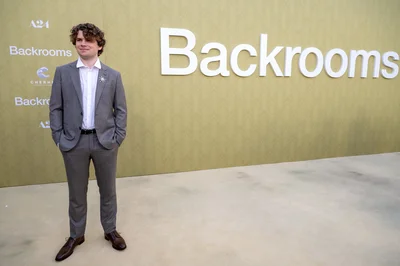
Interest isn't happening in isolation. In May, Backrooms, directed by 20-year-old YouTube filmmaker Kane Parsons, opened to more than $81 million domestically. As of July 20, it has earned approximately $384 million worldwide at the box office against a reported $10 million production budget.
The film provided the clearest proof yet that a horror world developed largely through internet culture could attract a mainstream theatrical audience. The Backrooms started with an anonymous image of an empty yellow room posted to 4chan in 2019. The concept spread across Reddit, online wikis, games, and collaborative fiction until Parsons, then 16, released his 9-minute YouTube video The Backrooms (Found Footage).
Within weeks, the video racked up tens of millions of views. Parsons then expanded it into a larger series exploring disappearances, scientific experiments, and an organization's attempts to study and map the mysterious space — all before it became a feature film.
Obsession demonstrated a similar version of the same opportunity. While the movie was not adapted from a preexisting internet mythology, its 26-year-old writer-director, Curry Barker, developed his audience and filmmaking style through online projects, including the horror short The Chair and Milk \& Serial, a found-footage feature made for about $800 and released on YouTube.
Made for approximately $750,000, Obsession has since grossed more than $428 million worldwide. Barker has completed another movie for Blumhouse and is now attached to direct A24’s reimagining of The Texas Chainsaw Massacre.
Together, the films expanded Hollywood’s understanding of what an online creator could bring into a studio — all in 1 summer.
Hollywood wants the filmmaker, not only the followers
These creators arrive with built-in audiences, but that is only one part of their appeal.
When I interviewed Backrooms producer Kori Adelson for Vanity Fair in May, she emphasized the filmmaking ability in Parsons' YouTube work that transferred well into blockbuster directing.
"His work is so singular and evocative," Adelson said. "And in terms of his technical skill set? It was more advanced than most experienced filmmakers."
Parsons built the original series in Blender, and those digital models became blueprints for the movie’s 30,000-square-foot set. Because he could adjust the designs himself, Parsons could show the production team exactly how each space should look.
Plus, because these creators have spent years watching audiences respond to their work, they understand what a movie adaptation needs to preserve.
"I sort of have made a contract with the audience, and I like to do everything I possibly can to hold myself accountable to that…regardless if we’re medium hopping," he told me back in May.
Warner Bros. Motion Picture Group co-chair Mike De Luca has compared that fan connection to an unusually long development process. "By the time you get to the movie, they've had a billion test screenings," he said during the Producers Guild of America's conference.
It also helps explain why creators like Parsons and Kister are being trusted to direct their adaptations rather than simply selling the rights and stepping aside.
The internet has become a proving ground for horror
This path hasn't been completely untrodden.
Back in 2023, Australian twins Danny and Michael Philippou made the leap from YouTube to theaters with Talk to Me. Before directing the horror hit, the pair had spent years creating chaotic horror-comedy videos, elaborate fight scenes, and practical-effects-heavy stunts for their RackaRacka channel. Their filmmaking experience translated: Made for about $4.5 million, Talk to Me earned nearly $100 million worldwide.
Mark Fischbach, better known online as Markiplier, followed a similar path with Iron Lung. He financed, directed, and distributed the video game adaptation himself, turning a budget of only a few million dollars into more than $51 million at the global box office.
Now, more filmmakers are lining up behind them. Dylan Clark is developing his viral YouTube short Portrait of God into a Universal feature produced by Jordan Peele and Sam Raimi, while Sam Evenson is directing a feature-length adaptation of his short Morafor Neon.
YouTube is not the only place where Hollywood is finding horror stories with built-in online audiences. Reddit’s r/NoSleep has long served as a testing ground for writers who present fictional stories as firsthand accounts, including Elias Witherow's Tommy Taffy series about a seemingly human figure who forces his way into families and takes control of their homes.
That story is now becoming The Third Parent, a feature adaptation scheduled to hit theaters on Jan. 22, 2027, with David Michaels writing and directing and Crispin Glover starring as Tommy.
Hollywood is always searching for the next big thing, and its next major horror franchise may still begin with a single creepy image or a teenager editing footage in a bedroom. The difference is that studios are now paying attention much earlier — and increasingly trusting the original creator to bring that idea to the big screen.