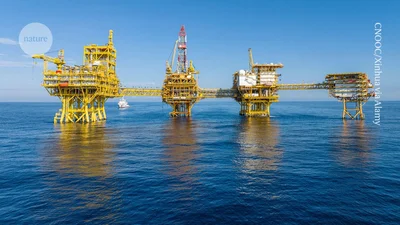
As fossil-fuel supplies from the Middle East remain disrupted after the US–Israel strikes on Iran, a dilemma has become clear. The world’s economies are heavily reliant on oil and natural gas. Yet, in the long run, they must shift to low-carbon forms of energy, such as solar and wind, to avert the worst effects of global warming. The question is, what happens during the transition? For the next decade, at least, natural gas will be crucial for meeting rising energy demands, filling gaps when renewable sources are intermittent and powering artificial intelligence.
Where will this gas come from? As older onshore and offshore fossil-fuel resources mature and become less productive, a new frontier is opening — the deep sea. Once hard to access, technological advances now make oil and gas exploration feasible hundreds of metres below the sea bed in waters that are thousands of metres deep. Searches extend even to the abyssal zone: the pitch-black, near-freezing layer of the ocean, 4,000–6,000 metres below the surface.
Four deep-sea technologies that could help detect deadly earthquakes and tsunamis
Investments in deep offshore oil and gas developments are growing fast — exceeding US$200 billion in 2026, double the average for the past decade. Around $2.5 trillion is expected to be spent on deep-sea drilling between 2026 and 2035.
But the deep sea is also fragile: remote and under-observed scientifically, ecologically slow to recover, risky to operate in and legally difficult to govern. The farther the oil and gas industry ventures from shore and beneath the waves, the harder it is to enforce inspection, liability and restoration requirements.
The central question is not whether the deep sea should be open to extraction — these resources are crucial for energy security (see ‘Energy trends’). But that alone cannot justify biodiversity loss being an acceptable operating cost.
Sources: Top: Energy Institute - Statistical Review of World Energy (June 2025); Bottom: Global Energy Monitor’s Global Oil and Gas Extraction Tracker (February 2025).
Here, I outline how a balance can be achieved. Projects should be justified on a case-by-case basis, and only when operators can show that ecological harm can be avoided, emissions can be independently verified, failures can be contained and responsibility will outlast production.
Ocean drilling boom
Advances in ocean drilling are redrawing the global energy map. Over the past decade, waters that are classed as deep (around 400 metres) have yielded more than 70% of ‘proven and probable’ reserves discovered by the seven largest publicly traded, investor-owned international oil companies. Discoveries in deep-water reservoirs are, on average, 16 times larger than those onshore.
The deep sea is challenging to work in, however. As well as being hard to reach, water near the sea floor can be extremely cold (a few degrees above freezing) and highly pressured (hundreds of times atmospheric pressure). Only around 15–20 oil companies have the technical expertise and financial capacity to operate under such conditions.
Trust in the sea-bed mining authority is fragile — here’s how to change that
Upfront licence payments and drilling campaigns can amount to hundreds of millions, or even billions, of dollars. Yet, by using the latest ‘subsea’ systems , floating production facilities and digital operations, deep-water projects can be cost-effective. The oil from these sites currently averages about $43 per barrel, which is comparable with or cheaper than many US shale-fracking projects.
Deep-water extraction is concentrated in the golden triangle of the US Gulf of Mexico and in basins off the coasts of Brazil and West Africa. In Brazil, prolific discoveries have lowered oil prices to $30–40 per barrel. The US Gulf of Mexico had a standout year in 2025, when floating production units, such as Whale, operated by the oil and gas company Shell, and Beacon Offshore’s Shenandoah, added nearly 350,000 barrels of oil equivalent per day — the largest addition in a decade. Emerging zones, such as the Stabroek Block in Guyana and the Orange Basin in Namibia, are also attracting record-breaking billion-dollar investments.
Deep-sea assets are increasingly central to national energy security, especially for the countries that host the reserves and the economies that depend on fossil-fuel imports. This includes China, which imports 70% of its oil and 41% of its gas.
Since 2022, the China National Offshore Oil Corporation has rolled out drilling projects across the South China Sea and Bohai Sea. One flagship project (Deep Sea No. 1) supplied enough natural gas (4.5 billion cubic metres) in 2025 to cover one-quarter of demand in the Guangdong–Hong Kong–Macao Greater Bay Area. China’s 15th Five-Year Plan, announced in March, positions the marine economy as a crucial pole of economic growth. The sector has already surpassed 11 trillion yuan (US$1.6 trillion) and accounts for 8% of gross domestic product.
Technological feats
Unlocking deep-sea resources requires engineering leaps. For example, reservoirs of methane lying 300–500 metres below the sea bed — known as ultra-shallow gas — have conventionally been a hazard for deep-ocean drilling and account for more than 20% of offshore blowouts that result in the uncontrolled release of oil or gas1. But this ultra-shallow gas can be recovered. In cold, high-pressure conditions, methane bubbling up through sediments can crystallize and form a mineral cap. Using seismic imaging, remote sensing and digital modelling, engineers can identify and preserve this cap while drilling carefully through it.
Demonstration of this technique in the Lingshui 36-1 field in the Qiongdongnan Basin of the South China Sea — the world’s first large-scale ultra-deep-water (below 1,500 metres), ultra-shallow gas field — offers a blueprint for re-evaluating once-dismissed energy resources.
The industry is also embracing a ‘whole sea’ development model: an integrated offshore architecture linking exploration, subsea wells, pipelines, floating production facilities and digital operations.
For exploration, advanced seismic, imaging and AI-assisted interpretation techniques help geoscientists to map reservoirs, faults and drilling hazards quickly2. For production, sensors in boreholes track pressure, temperature, flow, vibration, strain and fluid composition, allowing operators to adjust drilling and production controls in real time3.
Digital twins — live computer models of the whole system — combine physics-based simulations with sensor and inspection data to detect corrosion, fatigue, leaks and abnormal loads before they cause failure. Remotely operated vehicles (ROVs) and autonomous underwater vehicles (AUVs) can inspect subsea structures, flowlines and moorings that crewed vessels cannot easily reach.
A diver checks the underwater structure of Deep Sea No. 1, which supplies natural gas to one region of China.Credit: CNOOC/Xinhua via Alamy
At the surface, offshore operations must contend with typhoons, long supply lines, crew changes, tanker offloading and emergencies. AI-guided monitoring systems and drone-assisted inspections can help to maintain production under harsh conditions.
Floating production storage and offloading vessels are widely used in deep-water fields. Moored above wells, they receive fluids through riser pipes; separate oil, gas and water on board; store the crude oil in tanks in the hull; and offload it to tankers. Gas is exported, reinjected into wells or used to power operations. For example, in the South China Sea, the Haikui No. 1 vessel can process about 5,600 tonnes of oil per day, store 60,000 tonnes of oil and operate offshore for up to 15 years without docking.
Use of standardized components and structural designs cuts costs. And modular construction shifts more of the fabrication and testing onshore, so that pre-built modules arrive offshore ready to be lifted, connected and commissioned in shorter weather windows. They also mean that the foundations for wellheads can now be installed in five rather than ten days.
The next step is to make such tools industry standards. Validated digital twins, resident robotic inspections, durable subsea sensors and real-time methane and integrity reporting should be routine for all oil and gas companies.
Beyond energy supply, trillion-dollar investments in deep-water oil and gas are creating the industrial platforms of the future.
Materials designed to cope with pressure, corrosion, fatigue and low temperatures — including designer foams, corrosion-resistant alloys, flexible materials and insulation systems — are being adapted for aerospace and geothermal energy.
Sensing technologies — including laser-based methane spectrometers, pressure-tolerant acoustic systems and precise thermal detectors — can support autonomous inspections of hydrogen leaks and hazards in coal mines, for instance.
Pipelines, power and communication connectors, modular facilities and offshore bases can be repurposed for carbon dioxide transport and storage, nuclear decommissioning, polar logistics and urban infrastructure.
Environmental accountability
But it’s not all smooth sailing. The deep sea is also the site of an ongoing environmental and legal battle over how to reconcile energy security, climate accountability, biodiversity protection and control of sea-bed resources.
The impact of fossil fuels on climate change is one dimension. Methane, the main component of natural gas, is a potent greenhouse gas. Observations from satellites (such as MethaneSAT and Sentinel-5 Precursor) suggest that offshore venting and flaring of gas from wells are under-reported, with actual emissions being, on average, 50% higher than official inventories.
For accountability, it is crucial to link satellite-based monitoring with independent verification. When satellites flag anomalies, aerial drones, ROVs and AUVs can provide local follow-up, inspecting platforms and pipelines to locate leaks early. Methane plumes, flaring and leakage should be checked against company disclosures and national inventories. Projects that cannot prove low, verifiable emissions should face penalties, such as tighter import standards, stricter methane rules, higher insurance costs and delayed financing.
Why more drilling doesn’t need to mean more harm to the environment
The risk of catastrophic oil spills is another serious problem. The 2010 Deepwater Horizon disaster offers a warning: one failed deep-water well released more than 3 million barrels of oil over 87 days, fouling more than 1,600 kilometres of coastline before it was capped. As well as response plans, safer drilling requires barriers to blowouts that can be deployed remotely and quickly under high pressure, strong currents and poor visibility.
Worryingly, growing interest in deep-sea extraction is coming at a time when international control over the ocean floor is fragmenting. Most offshore oil and gas projects are regulated by coastal states in their exclusive economic zones or continental shelves. But, farther away, there’s little oversight.