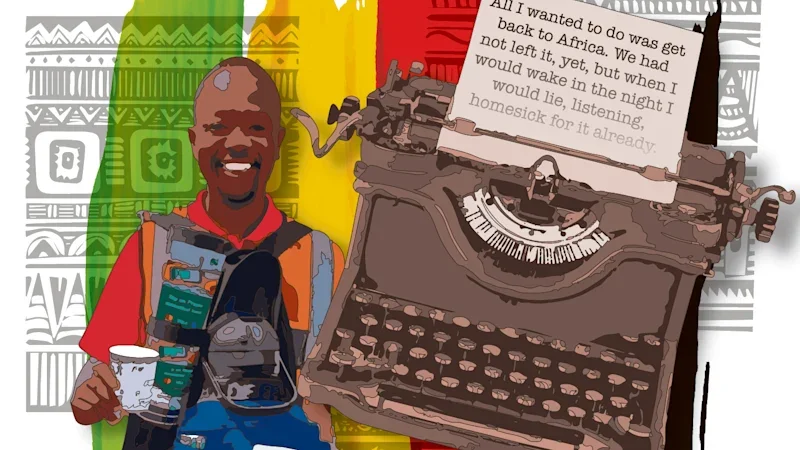
“All I wanted to do was get back to Africa. We had not left it, yet, but when I would wake in the night I would lie, listening, homesick for it already.”
I could have written these words, but Ernest Hemingway beat me to it. Nevertheless, they prove a theory I’ve long advanced: since Africa is the cradle of humankind, most visitors feel at home as soon as they put sole to soil. For those of us with roots stretching down through more recent generations, the sense of belonging is still more profound.
Africa smells like petrichor without the rain, a melancholic scent of sun blasting the ancestral bedrock. It’s a sign I’m home: the plane door opens, and I breathe in the motherland I left nearly 25 years ago, when my youngest child was a toddler.
Though mostly raised in Australia, she and my two older children possess a distinctly African sensibility – hard to avoid when growing up with parents tethered by an umbilical cord to a far-distant country.
When Hemingway spoke of his homesickness for Africa, he was really referring to the part sequestered from its human population – the bushveld where he liked to go on safari and hunt big game.
Get exclusive travel deals delivered straight to your inbox. Sign up now.
Certainly, these elemental tracts stir an affinity in the visitor, a recognition for one’s primordial birthplace. There are the immense skies puffing up with sun-gilded clouds and resident birdsong; the hyenas whose night calls amplify the emptiness; the wildlife whose bizarre stripes, elongated necks and pendulous heft must have bamboozled the first Europeans to clap eyes on them.
On the continent’s southern tip, there’s the unsullied dirt of Kruger National Park’s back roads which, after a lifetime exploring them, now sludges through my veins.
But though safaris are a big drawcard, landscape and wildlife alone can’t account for the continent’s charisma. It’s the people who intensify that sense of belonging. It’s impossible, of course, to distil 54 countries to a singular essence.
Consider Africa’s size: the US, China and India would fit comfortably into its landmass, with room to spare for assorted European nations. An unfathomable number of ethnic groups, languages, beliefs and traditions spill across Africa’s arbitrarily drawn borders.
But a modern continent birthed from centuries of struggle ends up acquiring common characteristics, notably resilience and ingenuity.
Stop at a “robot” (traffic light) in South Africa and you might see a homeless person directing traffic in the hope of scoring a tip, or a hawker selling takeaway coffee from his thermos. Drive from Kigali into Rwanda’s Virunga Mountains, and you’ll see men on bicycles hitching a lift from passing trucks by holding onto their trays. Visit the meat market in Arusha, Tanzania, and you’ll spy not a scrap of offal going to waste.
Some people imagine Africa as a rambunctious, disorderly place, but the so-called “developed” world can feel rather sterile by comparison. Disarray breeds flexibility, street smarts and a remarkable problem-solving capacity.
Returning home, I’m buoyed, too, by the population’s multilingual agility, and by the prevailing spirit of “ubuntu”, which roughly translates to, “I am, because we are”. Such interconnectedness is more easily forged when life is tough and neighbours tightly packed. But this human connection transcends community boundaries. Upon hearing my accent, young men often address me as “Mama”, and women call me “Sister”.
That’s not to say peace reigns. Conflict is rife and xenophobia grows. But harmless verbal skirmishes often bring a wry smile to my face. They affirm the rich humour and indomitable spirit inherent in my kinfolk.
And so, like Hemingway, I longingly await each return trip. But our Africas sound unalike; I’m homesick, it seems, for an altogether different place.