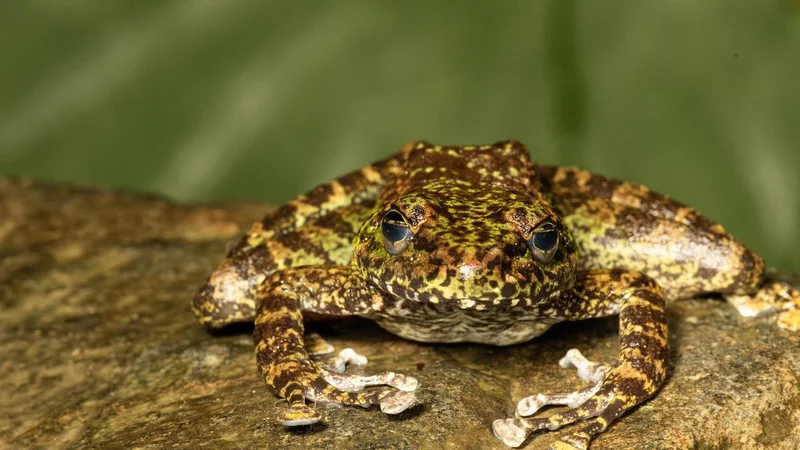
Scientists have discovered three new species of cascade frogs from the biodiverse-rich forests of Northeast India and documented five other species in the country for the first time.
The findings, published in the peer-reviewed Bulletin of the Museum of Comparative Zoology, are the culmination of over 15 years of extensive field research across the northeastern States.
The research, led by Prof. S. D. Biju of the Department of Environmental Studies, Delhi University, documented more than 300 geographic populations of cascade frogs inhabiting fast-flowing forest streams. Using DNA analyses along with detailed morphological comparisons of adult frogs and tadpoles, the scientists confirmed that populations from Tripura, Nagaland and West Bengal represent three species previously unknown to science.
The newly identified species are Ammachi’s Cascade Frog (Amolops ammachi), discovered in the Jampui Hills of Tripura; Sendenyu Cascade Frog (Amolops sendenyu), found in Nagaland and named after Sendenyu Village; and Beautiful Cascade Frog (Amolops bella), discovered in West Bengal and named for its striking green body marked with yellowish-green or reddish-brown mosaic patterns.
A. ammachi honours the late Kerala social worker and philanthropist Padmini Varkey, affectionately known as ‘Ammachi’ (or mother), in recognition of her compassion and lifelong service to people in need.
The study also reports five cascade frog species that have never before been recorded from India to expand the known diversity and distribution of the genus Amolops in the country.
These are Marbled Cascade Frog (Amolops afghanus), Nepal Cascade Frog (Amolops nepalicus), Wangyal’s Cascade Frog (Amolops wangyali), Medog Cascade Frog (A. medogensis), Pianma Cascade Frog (Amolops bellulus).
“This study is a work of over 15 years to comprehensively study India’s cascade frogs. It is a taxonomically challenging group but we have now clarified several confusing aspects of its biology, which will help in proper identification and conservation of species. Our study reaffirms that many Indian faunal groups remain poorly studied and contain undiscovered biodiversity, especially in the lesser explored northeastern States that are part of two internationally recognised biodiversity hotspots,” said Prof. Biju, the lead author.
DNA-based dating
To reconstruct the evolutionary history of cascade frogs, the researchers employed DNA-based dating analyses. Their results indicate that the frogs underwent extensive diversification around 32 million years ago during the Eocene-Oligocene transition, a period marked by widespread biological turnover.
The study suggests multiple waves of colonisation from east to west across Asia and identifies the early uplift of the Himalayas as a key factor shaping the present-day distribution and diversity of these amphibians.
Published - August 12, 2026 03:17 pm IST