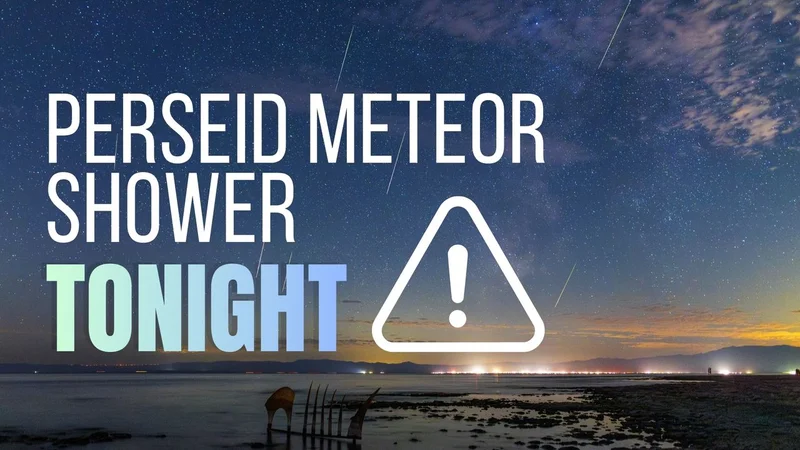
The Perseid meteor shower, one of the most prolific and impressive meteor showers of the year, peaks tonight!
Widely regarded as one of the best meteor showers of the year, the Perseids can produce up to 100 meteors per hour under ideal viewing conditions and weather permitting.
This year's display is particularly favorable because the shower peaks on the night of the new moon, leaving skies free from bright moonlight that can wash out fainter meteors.
What time should I look?
The Perseids can produce meteors throughout the night, but the best viewing begins around 11 p.m. local time, with activity increasing after midnight and continuing until the predawn hours. Under dark, clear skies, patient observers could see dozens of meteors every hour with the highest rates expected just before dawn.
Where do they come from?
The annual show occurs as Earth passes through a trail of comet dust and rocky debris left behind by Comet 109P/Swift-Tuttle. Every year, our planet plows through this stream of cometary material, causing tiny fragments — many no larger than a grain of sand — to slam into Earth's atmosphere at around 133,000 mph (214,000 km/h).
As these particles compress and heat the air in front of them, they burn up high above Earth's surface, creating the brilliant streaks of light we know as meteors or shooting stars.
How can I see the Perseids?
The Perseids appear to radiate from the constellation Perseus, but you don't need to look directly at the constellation to enjoy the show. In fact, the longest and brightest meteors appear about 45 degrees away from the radiant, when you're not viewing them head-on.
To give yourself the best chance of seeing as many meteors as possible, head somewhere with dark skies, away from city lights and give your eyes around 30 minutes to adjust to the darkness. Avoid checking bright phone screens (easier said than done!) and leave the telescope or binoculars at home — meteors are best enjoyed with the naked eye.
The highest number of meteors occurs in the predawn hours because it's when the side of Earth you're situated on has rotated into the stream of comet debris. You can think of it a bit like driving through rain — the windshield catches more raindrops than the rear window because it's facing the direction of travel. Likewise, before dawn, your location on Earth is facing into the stream of comet debris, meaning more meteoroids collide with Earth's atmosphere overhead.
A rare double sky show
Why have one remarkable sky event when you can have two? This year's Perseid peak arrives on the heels of today's total solar eclipse that crosses parts of Greenland, Iceland and Spain, making it possible to witness two of the year's most spectacular celestial events within just a few hours of each other.
If you're unable to catch the Perseids tonight, don't worry! While meteor numbers will gradually decline after the peak, the Perseids remain active through Aug. 24, meaning there are still opportunities to catch plenty of shooting stars under clear, dark skies.
If you're looking to snap photos of the meteor shower or the night sky in general, check out our guide on how to photograph meteor showers, as well as our best cameras for astrophotography and best lenses for astrophotography.
Daisy Dobrijevic joined Space.com in February 2022, having previously worked as a staff writer for All About Space magazine. She completed an editorial internship with BBC Sky at Night Magazine and worked at the National Space Centre, communicating space science to the public.
Daisy holds a PhD in plant physiology and a Master's in Environmental Science. Based in Nottingham, U.K., she covers all things space, with a special focus on solar activity and space weather. She also has a keen interest in astrotourism and is always on the lookout for the next northern lights adventure.
She will be a guest speaker aboard HX's Solar Eclipse Expedition in August 2026 and will join Hurtigruten as an onboard astronomer for a northern lights sailing in January 2027.