The war on Iran cracked the US-led regional order. The Mecca pact could deal the final blow
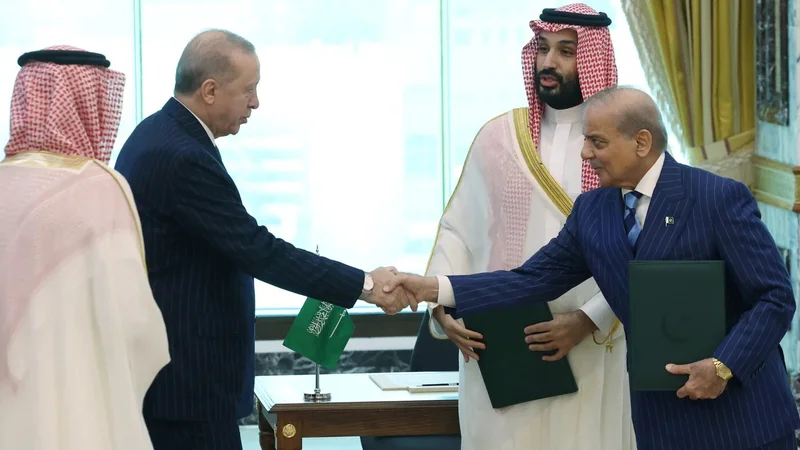
The signing of a joint defence agreement in Mecca on 7 August between Saudi Arabia, Turkey and Pakistan predictably set off a flurry of explanations.
Three of the most important Sunni Muslim states, alarmed by Iran's strategic ascendancy and the turmoil engulfing the region, were finally banding together, the argument went, to establish a military alliance that could eventually become a "Sunni" Islamic version of Nato.
This is the obvious reading. Saudi Arabia's contribution is clear: enormous financial reserves and a commanding geographic and religious position.
Turkey offers something different, as one of the region's most formidable conventional armies, backed by a defence industry that has grown more sophisticated in recent years.
Pakistan, meanwhile, brings perhaps the most consequential asset of all: a large, battle-tested military and the Muslim world's sole nuclear arsenal.
Geographically, Turkey lies to Iran's northwest, Pakistan to its east, and Saudi Arabia across the Gulf to its southwest. On a map, the three appear to form an arc around Iran.
After more than seven decades of overwhelming American military predominance in the Middle East, why does Saudi Arabia need Turkey and Pakistan to help guarantee its security?
The timing appears to reinforce this conclusion. The agreement comes after months of war involving Iran, the United States and the Zionist regime, and following Iranian attacks against American bases and interests across several Gulf states. It declares that an armed attack against one member will be regarded as an attack against all three.
Turkish Foreign Minister Hakan Fidan has described this provision as technically equivalent to Nato's Article 5, while insisting - somewhat tellingly - that the agreement is not directed against Iran or any other state. This is clearly intended to be more than another ceremonial declaration.
Yet the Nato analogy obscures a more fundamental question: after more than seven decades of overwhelming American military predominance in the Middle East, why does Saudi Arabia believe it needs Turkey and Pakistan to help guarantee its security?
The Mecca Agreement could prove to be less about constructing a new alliance against Iran than about the gradual unravelling of the American-centred security order that has dominated the region since the end of the Second World War.
No American victory
For decades, the region's US-centred security order rested on several assumptions.
The United States would remain the ultimate guarantor of its regional allies. The Zionist state would possess overwhelming military superiority over any conceivable combination of adversaries, while Arab and Muslim states would remain divided enough that no independent regional security system capable of challenging American predominance could emerge.
All three assumptions have now been shaken.
The American-Zionist aggression against Iran was supposed to demonstrate overwhelming military superiority, and in material terms there was never any question about the enormous disparity: Washington and Tel Aviv possessed formidable advantages in air power, intelligence, surveillance, precision weapons and technology.
Iran suffered enormous losses, yet by the metric that ultimately matters - political outcome - the war was a strategic failure for its architects.
Despite the Trump administration's repeated threats, the state did not collapse, its government was not overthrown and its military capacity was not destroyed. Above all, Tehran did not capitulate, nor was it compelled to submit to an American-designed regional order.
If anything, Iran showed the world it could retaliate and impose severe costs on its adversaries - and revealed what is perhaps its greatest strategic asset: the ability to disrupt the Strait of Hormuz and, with it, a significant portion of the world's energy supply.
Five months after the war began, Washington was negotiating arrangements concerning Hormuz while Tehran was demanding sanctions relief, compensation and other concessions.
Iran was able to secure highly favourable terms in the memorandum of understanding signed on 17 June 2026 and has continued to exercise considerable leverage by demonstrating its ability to withstand aggression and to fight back.
A war intended to restore American and Zionist deterrence instead exposed its limits.
The lesson drawn in Riyadh is unlikely to be simply that Iran is dangerous. Saudi leaders have now recognised the profound weakness of a security system they depended on for decades.
The kingdom does not want to become the battlefield on which Washington, Tel Aviv and Tehran settle their conflicts. It does not want its cities, energy facilities and economic infrastructure held hostage to wars whose timing and escalation it cannot control, or its survival to depend exclusively on decisions made in Washington.
Given these developments, the Mecca Agreement looks less like an alliance against Iran than a response to the unravelling of the American-led regional order.
No common enemy
The problem with describing the new pact as an anti-Iranian alliance is that neither Turkey nor Pakistan has any compelling interest in going to war against Iran.
Turkey and Iran have been competitors for centuries, their interests colliding in Syria, Iraq, the Caucasus and elsewhere, but competition is not the same as existential hostility.
Ankara has no interest in seeing the Iranian state destroyed or fragmented. Such an outcome could bring massive refugee flows towards Turkey, stimulate Kurdish separatism, create new armed groups along its eastern frontier, disrupt trade and energy routes, and invite another round of foreign intervention in a neighbouring country.
Fidan himself has referred to Iran as Turkey's neighbour and friend, emphasising the stability of a border that has remained essentially unchanged for centuries and warning against the consequences of destabilising the Iranian state.
Pakistan has even stronger reasons to reject such a course. Its long border with Iran runs through the sensitive Balochistan region, and the disintegration of Iran could easily spill across that border and aggravate Pakistan's own separatist challenges.
Islamabad's overriding conventional security concern remains India, while China is its most important strategic partner. Opening another major front to the west would make little sense.
Saudi Arabia may therefore see the agreement partly as insurance against Iran, but that does not mean Turkey and Pakistan have signed up for a Saudi war against Tehran. The country that appears to be the most obvious target of the agreement is precisely the one against which two of its three members are least likely to fight.
If this is supposed to become a conventional anti-Iranian military alliance, that contradiction could paralyse it
If this is supposed to become a conventional anti-Iranian military alliance, that contradiction could paralyse it. But if its purpose is broader, the contradiction becomes less puzzling.
Yemen and the Red Sea present a similar problem. Saudi Arabia has recently sought to organise a multinational maritime coalition after Houthi attacks threatened shipping through the Bab al-Mandab, the Red Sea and the Gulf of Aden, particularly after the disruption of Hormuz made the Red Sea route even more important.
Turkey and Pakistan both have a clear interest in keeping these waterways open, and have supported efforts to protect international shipping. But that does not mean either wants to be drawn into another Saudi-Houthi war.
Ankara may participate in maritime security operations, while Islamabad has been especially concerned that continued Houthi attacks on Saudi territory could force it into a confrontation it would prefer to avoid.
Protecting shipping lanes or Saudi territory is one thing, but joining an open-ended war against the Houthis inside Yemen is quite another.
Diverging ambitions
In 2018, I had a private exchange in Ankara with a senior Turkish official - still in office today - who, when asked about Turkey's grand strategic orientation, offered an answer that defied conventional expectations.
"We should seek a strategic triangle with Iran and Pakistan," he said. I remember being surprised by how casually he put it.
It was a private conversation, not an official policy declaration, but I have remembered it ever since, and the developments over the past several months have given it renewed significance.
Eight years later, Iran is absent from the agreement signed in Mecca, while Saudi Arabia is present. One explanation is that Turkish strategic thinking has changed. Yet recent statements from Ankara suggest that the story may be more complicated.
In 2018, I had a private exchange in Ankara with a senior Turkish official - still in office today - who, when asked about Turkey's grand strategic orientation, offered an answer that defied expectations
Earlier this year, Fidan discussed the possibility of a new regional security framework in terms that bear little resemblance to the creation of another sectarian bloc.
Such an arrangement, he argued, should be based on trust and prevent Turkish, Arab or Persian domination. It could begin with two or three countries but should eventually become broadly inclusive. It should not, he stressed, simply establish another camp confronting a rival camp.
His insistence after the signing in Mecca that the agreement is not aimed at Iran should be understood in that context. Iran's absence today does not necessarily mean its permanent exclusion tomorrow.
The three signatories have converged because each sees an advantage in the agreement, but they are not pursuing identical objectives.
For Saudi Arabia, the immediate objective is greater strategic freedom. Riyadh has effectively outsourced its ultimate security to Washington for decades.
That relationship will not disappear, and Saudi Arabia has no reason to exchange one form of dependence for another. What it wants is to reduce its vulnerability to any single external guarantor.
Pakistani military power and nuclear capability provide one source of strategic insurance; Turkey's military strength and rapidly expanding arms industry provide another.
Saudi Arabia's rapprochement with Iran since the Chinese-brokered agreement of 2023 is also relevant. Riyadh has no interest in Iranian domination of the Gulf, but neither does it have an interest in returning to the permanent confrontation that characterised an earlier period. The recent war demonstrated how dangerous such confrontation could become for the Gulf states themselves.
Turkey, which has spent much of the past two decades trying to expand its room for manoeuvre without abandoning Nato, sees a different opportunity. Its defence industry has become an increasingly important instrument of foreign policy, and its political reach now extends across the Balkans, the Caucasus, the Middle East, the Gulf, Africa and Central Asia.
The Mecca Agreement gives Turkey another avenue through which to transform military and industrial capability into political influence. But Ankara's ambitions may go beyond selling weapons or expanding influence. Turkey increasingly sees itself as one of the states capable of shaping a regional order rather than merely operating within one constructed by others.
For Pakistan, which has long relied on Saudi financial support and looks to Turkey for military technology and industrial cooperation, the agreement gives it greater diplomatic weight against India and a political role extending beyond South Asia.
Pakistan's nuclear arsenal inevitably heightens the significance of this role. But Islamabad will not subordinate its confrontation with India to Saudi priorities, just as Ankara is unlikely to subordinate its relationship with Tehran to Riyadh.
The three countries have therefore established a collective defence arrangement without developing a genuinely common threat perception - a divergence already evident over Yemen.
For all its contradictions, the agreement is more than symbolic, establishing a ministerial mechanism and permanent secretariat.
Cooperation could develop through joint exercises, intelligence sharing, missile defence, drones, cybersecurity, military production, training, maritime security and coordinated procurement.
Egypt or other regional states could yet participate.
Still, with no publicly identified integrated command, no standing multinational force, no automatic deployment mechanism and no agreed adversary, Mecca is not Nato - not yet, and perhaps not ever.
But that may be the wrong standard for judging an agreement through which three major Muslim powers have begun to institutionalise security cooperation outside the traditional American framework.
Where Iran fits
The bigger question, however, is not whether Mecca can contain Iran, but whether it can eventually be accommodated within the wider regional security architecture now taking shape.
That does not mean Iran must join the Mecca pact itself. Other mechanisms could develop around it, and a regional system encompassing Saudi Arabia, Turkey, Pakistan, Iran, Egypt, and other states is no longer inconceivable.
There are already foundations for such an arrangement.
Saudi Arabia and Iran restored diplomatic relations through the Chinese-mediated Beijing agreement in 2023. In doing so, they also revived their 2001 security cooperation agreement and committed themselves to working towards regional peace and security.
More recently, Turkey, Saudi Arabia, Pakistan and Egypt jointly emphasised the need for US-Iran de-escalation and warned of the danger the war posed to regional stability, maritime routes, energy markets and international trade, hardly the behaviour of states lining up neatly into two opposing camps.
An alternative scenario, in which the pact turns out to be an anti-Iranian Saudi-Turkish-Pakistani alliance, would reproduce a familiar regional pattern.
Iran would respond by strengthening its own alliances, driving Saudi Arabia and the Gulf back towards American protection, a guarantee the war just proved unreliable, and entrenching the region's division into hostile blocs.
A regional system that finds a way to accommodate Iran would produce a very different outcome.
If Riyadh and Tehran can manage their rivalry directly, while Turkey and Pakistan help establish a broader balance among the region's major centres of power, the justification for permanent American military guardianship becomes progressively weaker.
From Tehran's perspective, that would represent a strategic achievement far more important than dominating Saudi Arabia or imposing Iranian hegemony on the Gulf.
The American-Zionist war on Iran may one day be remembered not just for its failure to compel Iranian surrender, but also for having encouraged regional states to construct their own security arrangements.
The Palestine test
If the Mecca pact and the wider system taking shape around it are not ultimately aimed at Iran, it is the Zionist state that has the most cause for alarm.
Pakistan has never recognised Israel, while Turkey's relationship with the Zionist regime has become increasingly contentious. Saudi normalisation with Israel, meanwhile, which seemed imminent before 7 October 2023, has been profoundly altered by the genocide in Gaza and the wars that followed.
The three have not formed an anti-Israel military alliance, but their convergence disrupts the divisions that Israel has exploited for decades to confront its adversaries separately, normalise with some Arab states while attacking others, and rely on Washington to block any regional balance that might constrain it.
A wider arrangement drawing in Iran and Egypt would carry still greater implications for Israel. While the individual military and economic capabilities of these states have never been in doubt, what has long been missing is a political framework to bind them to any common strategic purpose.
Palestine could become the decisive test of whether the Mecca pact can provide one.
Such a framework of Islamic solidarity and collective security has been sought for well over a century, advocated by intellectuals such as Jamal al-Din al-Afghani in the 19th century and statesmen like Necmettin Erbakan in the 20th, yet for all the rhetoric the reality has lagged painfully behind.
While Gaza was being destroyed, Pakistan already possessed nuclear weapons, Turkey already possessed one of Nato's largest militaries, and Saudi Arabia already possessed enormous financial, diplomatic and energy leverage. None of these capabilities prevented the genocide - a fact that cannot be ignored.
If the Mecca Agreement ultimately means protecting regimes, borders, oil installations and shipping lanes while Palestinians are still being dispossessed and killed, it will have failed that test.
For Palestinians, it would change little to replace an American-led, anti-Iranian order with a "Sunni" alliance against Iran, or American hegemony with Iranian or Turkish domination.
What would change their condition is an indigenous regional balance capable of managing Arab, Turkish, Persian and South Asian interests without allowing their differences to be exploited by external powers and the Zionist regime.
Though the prospect of unity in the Muslim world and a defence alliance independent of Washington was unimaginable for most of the past century, the Mecca pact has brought both into view.
Post-American Middle East
Many assume that a declining hegemon must be replaced by a rising one, and that Beijing will therefore inherit Washington's role as the region's dominant military power. Yet China has never held that role or sought it.
Addressing the Arab League in 2016, Xi Jinping pledged that China would pursue no proxies in the Middle East, no spheres of influence and no attempt to fill any "vacuum".
Beijing needs energy supplies, secure maritime routes, expanding markets and political stability, and it profits from maintaining relationships with Pakistan, Saudi Arabia, Iran and Turkey all at once.
A country with those interests has little reason to reproduce the American model.
Palestine remains the ultimate test: the Mecca pact could either prove to be just another exercise in state protection while Gaza is destroyed, or mark the beginning of a regional challenge
The 2023 Saudi-Iran rapprochement showed how Beijing prefers to operate. China reconciled Riyadh and Tehran without establishing military bases or offering either side protection against the other, thereby facilitating an agreement that enabled the two adversaries to manage their relationship directly.
The Mecca Agreement is certainly not a Chinese project. Turkey remains in Nato, Saudi Arabia retains deep military ties with the US, and Pakistan has its own complicated history with Washington.
But Beijing does not need these states as allies and gains from their becoming less dependent on the US, whose regional order has always relied on exclusive alignments, while China operates comfortably amid multiple and overlapping relationships.
The decline of American hegemony may produce a more complicated system, in which several powers balance one another while dealing with Washington, Beijing and Moscow at once.
How much the Mecca Agreement will contribute to such a system is far from certain. Iran, too, must weigh whether integration into a broader regional order serves its long-term interests, and whether it can be reconciled with the networks and alliances through which it has exercised influence for decades.
Either way, the order the United States built on dependence and division is starting to crack.
Eight years ago, when I asked a senior Turkish official about Turkey's grand strategy, he spoke of a strategic alignment with Iran and Pakistan.
While the alignment that finally emerged swaps one partner for another, whether Iran eventually finds a place in it remains an open question. Turkey and Pakistan, however, have little interest in an anti-Iranian alliance, and Saudi Arabia has powerful reasons not to return to permanent confrontation with Tehran.
If this process draws the region's principal powers into a security arrangement of their own making, the consequences would reach far beyond Iran.
As ever, Palestine remains the ultimate test: the Mecca pact could either prove to be just another exercise in state protection while Gaza is destroyed, or mark the beginning of a regional challenge to the external domination and internal division that have served the Zionist project for generations.
Which outcome prevails depends less on the signatures in Mecca than on whether the signatories have the will to follow them where they logically lead.
The views expressed in this article belong to the author and do not necessarily reflect the editorial policy of Middle East Eye.