Sign in. It’s quick, free and it’s up to you.
An account is an optional way to support the work we do. Find out more.
IT IS NEARLY time for Ireland to experience one of the most significant astronomical events to hit the country for decades.
From just after 6pm this evening, we will witness the sky slowly get darker as the Moon moves directly between the Earth and the Sun, blocking its light.
But ahead of the big event, let’s look at what is happening and why the event holds such importance for scientists.
Also, how can I be sure I will be able to see it?
A solar eclipse occurs because sunlight shining on the Moon creates a shadow that falls on the Earth.
It is linked to the alignment of the Sun, Moon and the Earth in the solar system.
The position they align in determines the type of eclipse.
Solar eclipses happen only during a new moon and require the moon and sun to be aligned on the same side of Earth.
“At first, as the Moon begins its passage across the Sun, spectators will see a beautiful contrast between a dark moon and a bright sun,” Emma Whelan, physics professor at Maynooth University, told The Journal.
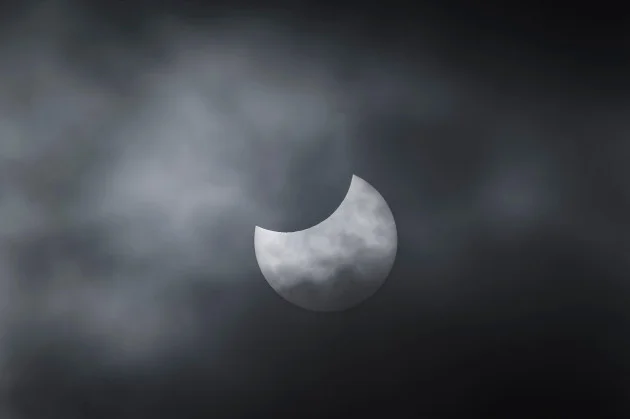
At the peak there will be a very thin solar crescent as more than 90% of the Sun will be obscured. It will get visibly darker during the peak of the eclipse.
Niall Smith of Blackrock Observatory told The Journal that “one of the things that is remarkable about eclipses is that the moon is in the sky almost exactly the same size as the sun, and this is just a complete chance event”.
“We just happen to have a moon that is just the right size,” Smith added.
For a total eclipse to happen, the moon and sun have to line up precisely. The next one visible from Ireland isn’t expected until 2090, though there will be one in August 2027 that can be seen from Spain.
What about totality?
Some countries will experience a higher level of coverage during the eclipse.
This is largely because of their location on the earth’s surface, often they are directly in the path of the moon’s dark central shadow, ‘the umbra’.
These countries are likely to experience a rare total eclipse.
Smith noted that “if you were in Spain or Iceland or Greenland for the upcoming eclipse, then you would see the moon just perfectly covering the sun”.
This is also the case in Ireland where the southwest is expected to have more coverage, with upwards of 97% obstruction of the sun predicted.
(Obviously, the level of cloud cover will also influence visibility.)
Linda Hughes, meteorologist with Met Éireann, said “it’ll really depend on the timing of when cloud is passing over the area the viewer’s in”, but generally there’s a “good chance” of catching it.
Dublin has a predicted obstruction of 96%, but Smith maintained that this will make a modest difference and an obstruction of 90% plus is significant enough to make an impact across the island.
The primary benefit of eclipses in the advancement of science is that they allow scientists to measure parts of the sun that we normally can’t see because of its glare.
The moon blocks out that glare, and it reveals parts of the sun.
Along with a team of scientists, Peter Gallagher, director of the Dunsink observatory, will fly off the Irish coast to observe the eclipse up close.
By flying three hours west of the island, the team can study and photograph a total eclipse, using a new airborne telescope called E-CorMag.
The sun’s magnetic activity and its effects throughout the solar system can be better understood from these observations.
“The sun is hot, and it has a shape, but nobody really understands why it has that shape, and nobody really understands why it’s so hot. But we think it’s the magnetic field of the sun that is holding the gas in place in the atmosphere and also treating it as well. Our cameras are going to tell us something about those magnetic fields”.
This is a problem that’s been around forever, but nobody solved it,” he told The Journal.
Whelan noted that because the eclipse is happening close to sunset the Sun will be low and therefore hills, trees or buildings could obscure it, so your viewing location will be all important.
While finding the Sun during the eclipse won’t be difficult, you might want to plan in advance where it is best to view it.
First step, what time? Timeanddate.com offers this guide for when the eclipse will begin, reach its peak, and end. Rule of thumb in Ireland is just after 6pm, just after 7pm, and just after 8pm respectively.
Then what direction, and will anything be blocking it? If you want to make it easy for yourself, Stellarium is a popular choice – download it here on iPhone or here on Android. It offers an augmented reality view of where the Sun will be at the key times (plus, it’s pretty useful for finding stars and other features of the night sky). Alternatives include Sun Tracker AR on iPhone and Sun Seeker on Android.
If you want to be old school: the Sun is setting west-north-west at this time of year, but will be roughly due west or a compass bearing of 275° when the eclipse reaches its peak. Your phone likely has a compass app; use that to find the direction. The eclipse will peak when the Sun is roughly 15° above the horizon. Hold your hand up – that equals one and a half fists above the horizon.
The other key part of the equation is cloud cover. Check the forecast here.
With additional reporting by Nicky Ryan
To embed this post, copy the code below on your site